
Sequence Branching Logic Based on Prospect Engagement Signals
Adapt email sequences in real time based on how prospects actually behave.
A sequence finishes its last step, nobody has replied, and the rep closing out the record has no way to tell what actually happened. Maybe the prospect was never a fit. Maybe they clicked the pricing page on day four and nobody followed up because the next scheduled email went out anyway, on time, as written. That gap between what the prospect did and what the sequence sent is the whole problem with static drip campaigns. A prospect who opened an email three times and clicked through to pricing gets the identical next message, on the identical day, as a prospect who never opened anything. The sequence was built on enrollment day around a plan for how the next two or three weeks would go, and it keeps running that plan regardless of what the prospect does in the meantime. Reps let warm prospects sit in a templated queue instead of getting a call, and reps keep emailing people who checked out two weeks ago, spending sender reputation on contacts who were never going to open the next message either.
The four decisions branching logic makes
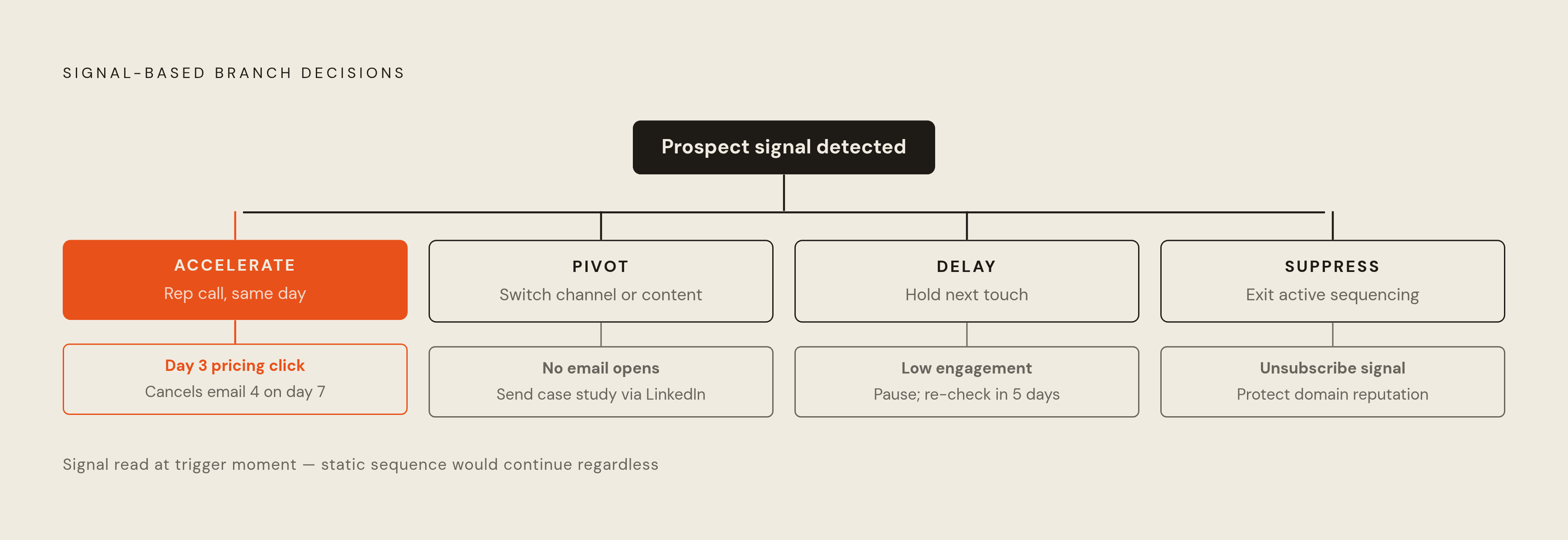
Branching logic replaces that fixed plan with a set of rules that read prospect behavior and pick a next step from four options: accelerate, pivot, delay, or suppress. Accelerate means moving the prospect to a higher-priority action, often a live rep task, because the signal just received indicates real buying interest. Pivot means changing the content or the channel, sending a case study instead of another intro email, or switching from email to LinkedIn, because the current approach doesn't seem to be landing. Delay means holding off on the next touch because the prospect looks disengaged for now but not gone. Suppress means pulling the prospect out of active sequencing because continuing to send would do more harm than good, whether to the relationship or to the sending domain's reputation.
Consider a prospect enrolled in a sequence who clicks a pricing link on day three. A static sequence would send email four on day seven regardless. A sequence with branching logic reads that click as an accelerate signal and interrupts the plan immediately: a task goes to a rep to call that day, and the templated email four never goes out, because it's no longer the right message for where the prospect is. That's the operating difference branching logic makes. It's a single workflow that knows which channel fired last, whether the prospect engaged, and what the next action should be as a result. Everything described in the sections that follow is a variation on these same four decisions, applied to different categories of signal.
How email engagement signals map to branch decisions
Email signals, opens, clicks, and the type of link clicked, are the easiest data to collect, since every sequencing platform already logs them. They're also the least reliable, and the reasons why matter for how a sequence should be built. A prospect who opens an email several times without replying has traditionally been read as interested but not ready, which argues for a pivot to a different kind of content, a case study or a testimonial, rather than another email making the same pitch again. A click carries more weight than an open, and not all clicks carry the same weight: a click on a pricing page says more about intent than a click on a blog post, and a sequence built to tell the two apart can route a pricing-page click straight to a rep task instead of letting it wait for the next scheduled send.
The complication is that open and click data has gotten less trustworthy over the past few years, not more. Apple's Mail Privacy Protection now accounts for the majority of tracked email opens, and those opens are generated by Apple's own proxy servers prefetching the message, not by a person actually reading it. A sequence branching on open counts is frequently reacting to a server rather than a prospect. Clicks have a parallel problem: corporate security gateways routinely pre-fetch links to scan them for malware before any human clicks anything, which inflates click totals the same way Mail Privacy Protection inflates opens. The signal that looks like the sturdier replacement for opens carries its own noise.
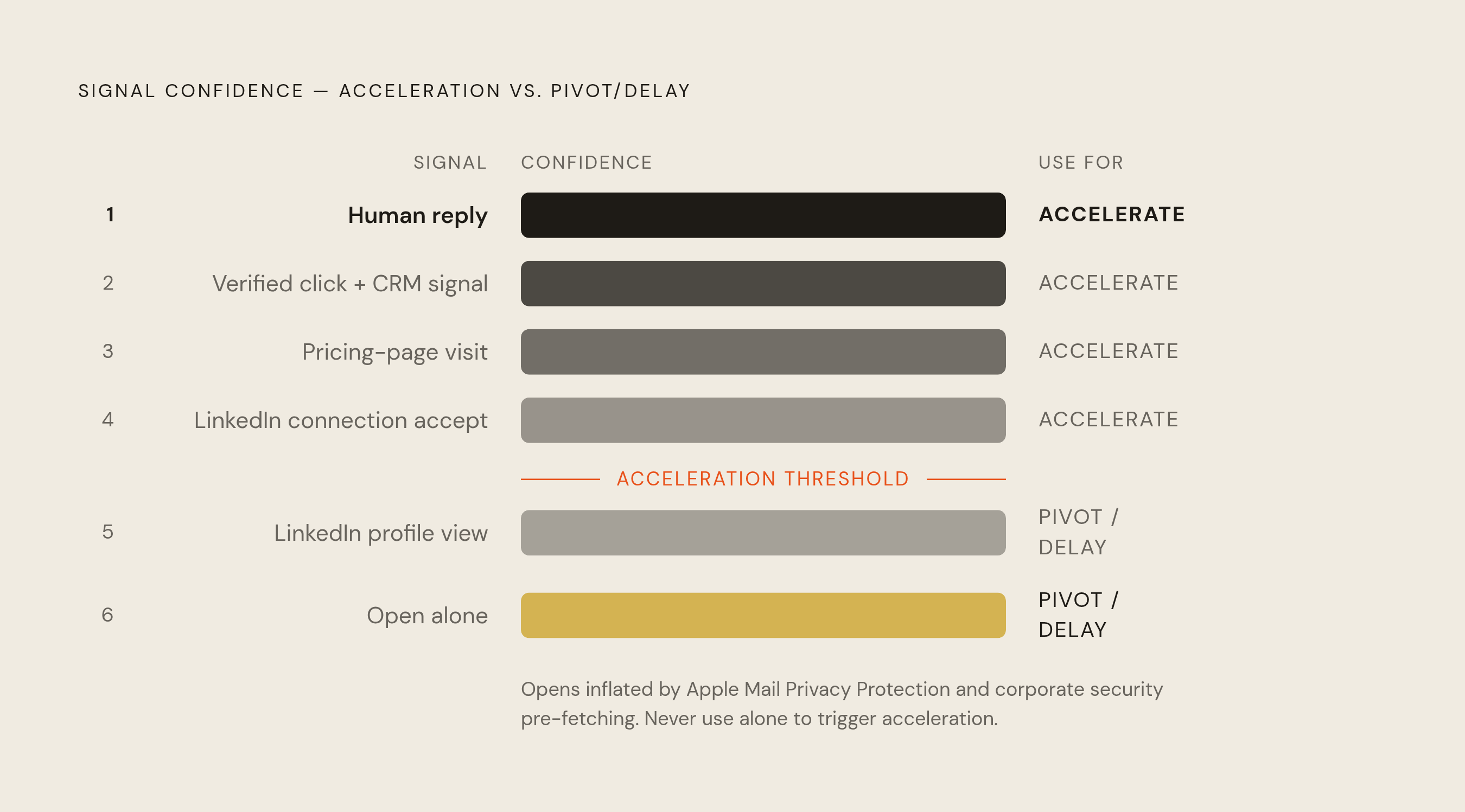
None of that argues for throwing email signals out. It argues for weighting them correctly. Opens alone are too easily generated by infrastructure rather than people, and shouldn't be enough on their own to trigger an acceleration. A reply is the clearest signal available, because a human had to write it. A verified click, especially one corroborated by CRM activity or other behavior, ranks next. Opens belong at the bottom of that hierarchy, useful for pivot and delay decisions where the cost of being wrong is small, but not the kind of signal that should move a prospect to a rep's call list on its own.
How cross-channel behavioral signals extend branching beyond the inbox
Email is one channel among several a prospect moves through, and a sequence that only reads email data is working from a partial account of what that prospect is actually doing. LinkedIn generates its own stream of behavioral signals: connection accepts, profile views, engagement with a post, visits to a company page, attendance at an event. Each of these can trigger a branch decision on its own, independent of email activity. A connection accept is a reasonably direct accelerate signal, since the prospect took a deliberate action to open a channel of contact. A profile view with no connection request, by contrast, is a much softer read, more suited to a pivot or a delay than an acceleration, since a view alone doesn't confirm interest in talking.
Behavioral signals outside LinkedIn and email carry similar weight. A visit to a pricing page on the company website, a recent job change at the target account, a funding announcement, or a competitor evaluation are all signals the prospect generated by acting in their own interest, not because a rep prompted them to. Those are high-confidence accelerate triggers precisely because the prospect put themselves into a buying context without any outreach causing it. A sequence that can read these signals, across LinkedIn, the website, and third-party intent data, has access to a far larger and more current picture of the prospect's state than one restricted to the inbox. Mapping each of these signals back to the same four decisions, accelerate, pivot, delay, suppress, is what keeps the system consistent across channels instead of fragmenting into channel-specific rules that don't talk to each other.
What silence tells the sequence
Silence is itself a signal, but an ambiguous one, and a sequence that treats all silence the same way is making a design mistake as costly as treating all engagement the same way. The job of the branching logic is to tell apart a prospect who is simply unreachable right now, one who looked at the offer and wasn't convinced, and one who isn't in a buying cycle yet at all, because each of those calls for a different branch.
Early silence, no open, no click, no reply across the first two or three touches, is more often a timing problem or a weak subject line than a sign the prospect has no interest. The right response at that point is delay or pivot: hold off and try again later, or change the angle of the message, rather than giving up on the contact. A workable decision rule might run: after three touches across email with zero engagement, pivot to a different subject line and content type before trying a fourth. If that also produces no response, extend a LinkedIn touch before concluding anything. Sustained silence that persists after multiple touches across multiple channels is a different matter, and that's where suppression belongs: continuing to send into that silence costs sender domain reputation and rep hours for a contact who has shown no sign of being reachable.
There's also a domain-level version of this same problem. When engagement across a sending domain drops broadly, not just for one contact, a well-built AI sequencing system slows its sending automatically, treating the drop as a signal about the health of the domain itself, not only about any single prospect. That's a branching decision made at the level of the whole sending infrastructure rather than the individual sequence.
Suppression isn't necessarily permanent, either. A prospect who goes quiet for six weeks and then visits the pricing page has sent a real signal, and the correct response is not to resume the old sequence where it left off. The branch decision here should route that contact into a fresh re-engagement path built around the fact that something changed, rather than treating the pricing visit as a continuation of a conversation that had already gone cold. Most teams underbuild this part of the system. Acceleration gets design attention because it looks like the path to revenue, but the rules for delay and suppression need the same deliberate thought, since getting them wrong either burns domain reputation on dead contacts or lets warm re-entries sit unnoticed in a suppressed list.
How 2026 platforms implement branching logic differently
The four decisions, accelerate, pivot, delay, suppress, describe the logic any good sequencing system should run. They don't describe what every platform on the market in 2026 is actually capable of doing. Two products both marketed as "AI sequencing" can differ sharply in which signals they're able to read, how many branch conditions they support at once, and whether their branches adjust on their own as new data comes in or require someone to write and maintain the rules by hand.
That variation makes platform choice itself a branching-logic decision, the one this piece has been building toward. A system that can only branch on email opens and clicks is working from the narrower, less reliable end of the signal hierarchy laid out earlier, and no amount of clever rule-writing will make up for data it can't see. A system that can also read LinkedIn activity, website visits, and CRM-recorded replies has more raw material to make the accelerate, pivot, delay, and suppress calls correctly, and is working closer to the full picture of prospect behavior described across the sections above.
The sales technology landscape itself has consolidated around this capability. Clari and Salesloft merged to form what the companies describe as a Revenue AI platform, with Steve Cox appointed CEO of the combined organization, a sign of how central signal-based sequencing and branching have become to how revenue technology is now built and sold. The specific vendor a team picks matters less than whether the evaluation asks the right question: not whether a platform claims AI sequencing, but whether it can actually read reply behavior, verified clicks, cross-channel activity, and sustained silence, and route each one to the correct branch, consistently, as the information arrives.