
Cold Calling Scripts Built Around AI-Generated Account Intelligence
AI-powered research transforms cold calling from guesswork into signal-driven strategy.
Blind cold calling and signal-informed cold calling now produce meaningfully different results, so much so that they function as two separate activities that only share a phone line. Cold calls made without any research context convert at a fraction of what signal-informed calls achieve, but if a call references a specific event at the prospect's company, it converts at 5 to 10% to meetings. That gap is large enough to decide whether cold calling belongs in a team's channel mix at all.
The distinction has nothing to do with how many dials a rep makes, how good the rep is on the phone, or which channel the team favors. It comes down to this: does the opening line give the prospect a concrete reason to keep listening past the first few seconds? A signal works because it carries three pieces of context at once: timing, pain, and intent. A leadership change, for instance, tells a rep when to call, why the person on the other end might actually want to hear from them, and what to open with. Generic scripts can only guess at those three things. Signal-informed scripts start already knowing them.
The answer, consistently, is the presence or absence of a signal driving the conversation. Everything that follows, how AI surfaces those signals, how a rep should read them, and the five script structures built around them, follows from that single variable.
What AI does to make signal-based calling operationally viable at scale
Signal-based calling sounds straightforward in principle and difficult in practice, because researching a single account well enough to find a usable signal takes real time, and most reps are managing hundreds of accounts, not one. If you don't automate it, that research cost makes signal-based calling impractical at any scale beyond a handful of high-value accounts.
AI closes that gap by turning pre-call research from a manual task into a background process that runs across an entire account list. Clay GTM engineer Sabrina Glaser used four agents working in parallel to cut what used to take 85 minutes of account research down to five minutes, and she ran that same workflow across an entire sales team rather than one rep's pipeline.
Parallel data aggregation is the mechanism behind that speed. Clay, for example, pulls from more than 100 data sources, including Apollo, ZoomInfo, LinkedIn Sales Navigator, BuiltWith, and Hunter, querying them simultaneously and synthesizing the most reliable answer across sources rather than returning a pile of raw, conflicting data. That synthesis then feeds directly into modular call scripts, so the rep doesn't have to interpret a research report. The rep is handed a brief that already names the signal and points to the script it calls for.
The output of this process is a prioritized, signal-typed account brief: this account just hired aggressively, that one just closed a funding round, a third just installed a new VP, and each of those facts points to a different script structure before the rep ever picks up the phone. That typing step is what makes the research usable in real time rather than something a rep has to sit with and decode.
The time recovered matters because of where it was going before. Sales reps spend roughly two-thirds of their time on work that doesn't involve talking to prospects: research, data entry, and internal meetings. AI pre-call research doesn't eliminate that work so much as it reclaims a meaningful share of it and puts it back into conversations. AI also catches signals a rep would never find by hand at any reasonable scale: third-party intent data, patterns across job postings, specific language from earnings calls, and shifts in a company's technology stack. None of this involves AI making the call. The research and prioritization happen before the phone rings. The conversation itself still belongs to the rep, a distinction that matters again later for how prospects screen incoming calls.
How to read a signal and decide which script structure it calls for
Before dialing, a rep needs to answer one question: which signal triggered this call, and what does that signal say about the prospect's current state of mind? Every signal type implies a different psychological starting point for the person on the other end of the line, and the script should be built around that starting point rather than bolted onto a generic opener with the prospect's name dropped in.
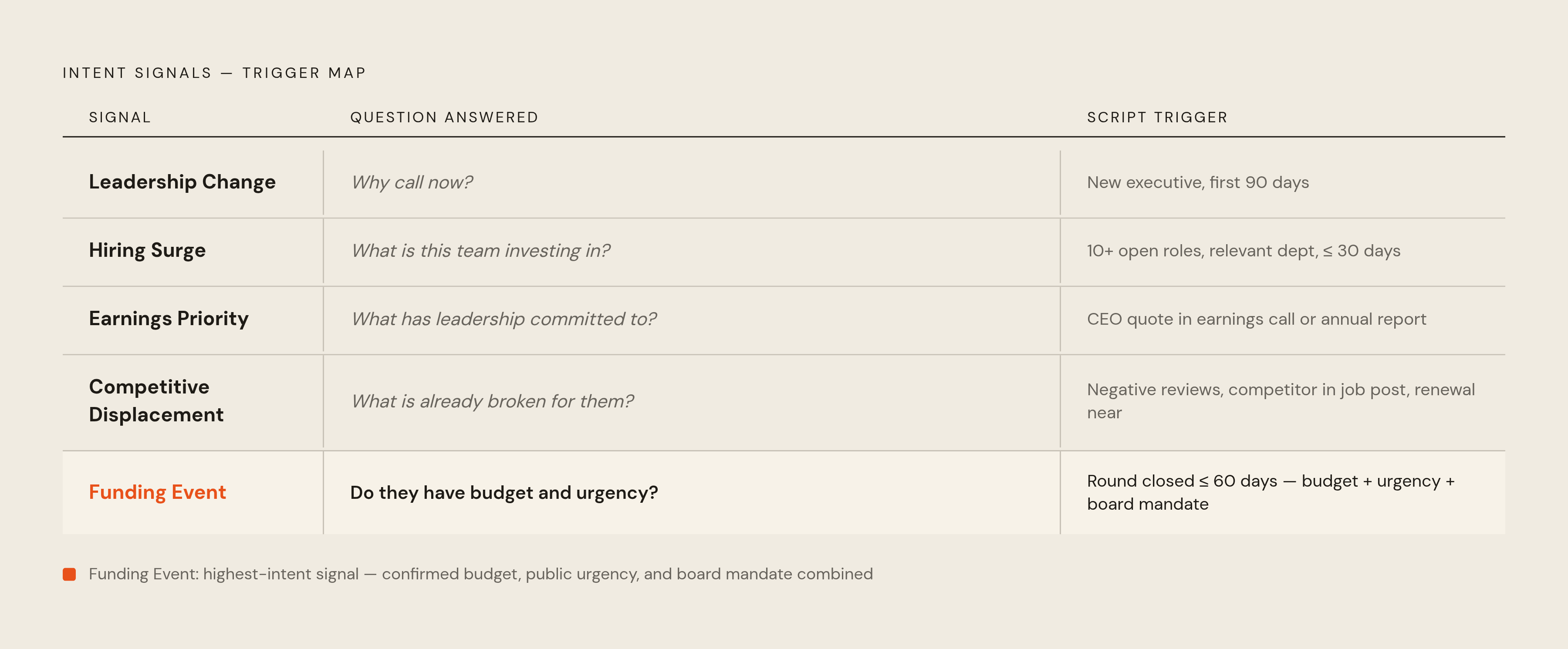
AI most reliably surfaces five signal types, each mapping to its own script structure: leadership change, hiring surge, earnings or strategic priority announcement, competitive displacement indicators, and funding event. Each one answers a different question a rep would otherwise have to guess at. A leadership change answers "why call now?" A hiring surge answers "what is this team actually investing in?" Earnings language answers "what has this organization told the public it's committed to?" For example, when "operational efficiency" appears in an earnings call, public language from a CEO to analysts creates budget alignment, signaling where spending will follow. Competitive dissatisfaction answers "what's already broken for them?" And a funding event answers the most basic question of all: do they currently have budget and urgency to spend it?
The rule that follows from this is simple to state and easy to skip under pressure: the opening line of the call should reflect the exact signal that triggered it, instead of a value proposition with the company's name inserted. Get that match wrong, lead with a hiring-surge opener on an account where the real trigger was a leadership change, and the call reverts to something close to blind cold calling with extra steps. The five sections that follow walk through each signal and the script structure it calls for.
The leadership change script: calling a new executive in their first 90 days
A new executive stepping into a role is structurally primed for vendor conversations, whether or not they're actively looking for one. New leaders audit existing tools and vendors within their first 90 days, so they are unusually receptive to conversations framed around making an early impact. That receptivity is temporary and worth building the entire script around.
The script opens by naming the transition directly rather than working around it: "I noticed you recently joined [Company] as [Title]. Congratulations on the new role." From there it bridges to the pattern the rep is relying on: when leaders step into roles like this one, one of the first things they typically evaluate is the specific area the rep's solution addresses. A social proof anchor follows, naming a similar title at a comparable company the rep already works with, and the call closes with a specific, low-friction ask: whether it's worth a short call to share what's working for teams in a similar position.
Each piece of that structure does distinct work. Acknowledging the transition proves the rep did basic homework and isn't working off a stale list. Naming the evaluation pattern reframes the call as relevant to something the executive was already going to do anyway. The customer reference signals that the rep has relevant pattern recognition. And the phrase "teams in your position" carries more weight than it first appears to: it positions the rep as someone who has seen this specific situation before. That framing makes the rep sound like a practitioner rather than a vendor, and it only works because the signal, the new hire, the first 90 days, is specific enough to support it.
The hiring surge script: calling into a team that is actively scaling
A hiring surge is a public, visible declaration that a company is investing in a function, and the script works because it treats that declaration as real evidence rather than a coincidence. The trigger condition here is concrete: an account has posted 10 or more job openings in a relevant department within the past 30 days. Hiring surges indicate investment and growth, and a team scaling that quickly tends to need infrastructure that hasn't caught up yet.
The script opens with the observable fact itself: "I noticed [Company] is hiring aggressively for [department], I'm seeing about [number] open roles right now." From there, it names the challenge that predictably comes with scaling that fast, cites a comparable customer and the specific result they saw, and closes by asking whether that challenge is one the prospect is currently running into.
That closing question is doing more work than it looks like. Rather than telling the prospect they have a problem, it invites them to confirm it themselves, and a problem a prospect names out loud carries more weight in the conversation than one the rep asserts. On the AI side, this script only works at scale because something is aggregating job posting data across sources continuously and flagging accounts the moment they cross a relevant threshold. A manual process would either miss the surge entirely or catch it well after the window of relevance has closed.
The earnings or strategic priority script: calling after a public commitment to a direction
Public companies telegraph their own priorities, often without meaning to make a rep's job easier. When a CEO tells analysts on an earnings call that something is a strategic priority, budget tends to follow that statement, and a rep who references the statement directly is working with a level of alignment no generic opener can manufacture. This script applies specifically to public companies or organizations that publish annual reports. It isn't usable against a private company with no public commentary to draw from.
The structure starts by citing the specific source: "I was reviewing [Company]'s recent earnings call or annual report, and [CEO Name] mentioned [specific quote or priority]." It then connects that priority to a pattern the rep has seen elsewhere in the industry, cites a customer who achieved a specific outcome related to that same priority, and closes by framing the ask as a conversation about how other teams are approaching the same stated focus.
That closing phrasing, framing the meeting as a look at how other teams are approaching a problem rather than a product walkthrough, lowers the friction of saying yes considerably. It positions the call as intelligence-sharing between peers rather than a sales pitch, which matters because the prospect has already, publicly, agreed that the topic is important. The specificity of the quote is what separates this script from a lazier version of itself. A paraphrase tells the prospect the rep skimmed a press release. A direct quote tells them the rep actually read the transcript, and that distinction registers immediately on a call. Finding that language at scale means scanning earnings transcripts, press releases, and filings across an entire account list, a task no rep could reasonably do by hand for more than a few strategic accounts at a time.
The competitive displacement script: calling when a competitor is showing cracks
If a prospect already shows signs of dissatisfaction with a current vendor, they aren't a cold prospect in any meaningful sense, even if they've never heard of the rep's company. Dissatisfaction might surface through negative reviews, through job postings that mention a competitor's tool, or through a contract renewal date approaching on the calendar, and approaching an account during that window measurably increases receptivity. The job of this script is to surface that dissatisfaction and offer an alternative, not to attack whatever tool the prospect is currently using.
The opening leads with directness rather than subtlety: "I'll be straightforward, I'm reaching out because we've been hearing from a lot of teams using [a comparable tool] that [a specific limitation]." That phrasing acknowledges the competitive context directly without turning the call into an argument against a named competitor, which keeps the conversation focused on the prospect's own experience rather than a debate the rep has no standing to win.
AI surfaces this signal through a few parallel channels: monitoring public reviews, analyzing language in job postings (a listing that names a competitor's tool as a required skill sometimes suggests the company is trying to bring that function in-house), and modeling contract renewal timelines. The real risk in this script is overplaying the angle. A rep's read on competitor dissatisfaction is an inference built from indirect signals. The script should invite the prospect to confirm the problem exists rather than assert it on their behalf, which keeps the conversation grounded in what the prospect actually says rather than what the data implies.
The funding event script: calling when a company has just received capital and the mandate to deploy it
A funding announcement combines three things a rep almost never gets at once: confirmed budget, public urgency, and an explicit board-level mandate to spend that capital on growth. That combination makes it arguably the highest-intent signal in this entire framework. The trigger condition is a funding round closed within the past month or two, anywhere from seed through growth equity, because a post-investment company carries both the budget and the pressure to build out infrastructure and headcount quickly.
Following the same signal logic laid out across the earlier scripts, a funding-triggered call opens by referencing the event directly: "I saw that [Company] just closed [round], congratulations. That kind of growth usually comes with a mandate to scale [a relevant function] quickly." From there it names the specific challenge companies at that stage tend to run into, moving fast without the infrastructure to support the pace, cites a comparable customer who faced the same problem after a similar round, and closes by asking whether scaling that function is a priority for the next quarter.
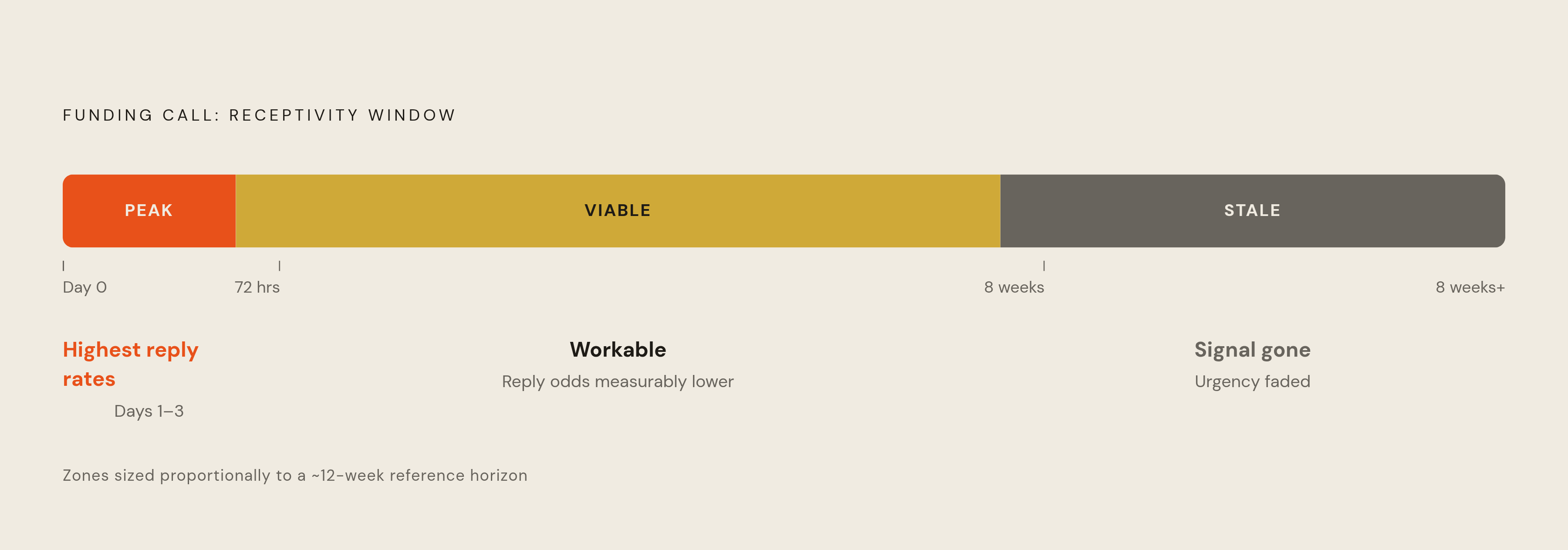
The congratulations at the open isn't a courtesy line. It signals, immediately, that the rep did the research and isn't working off a random dial list, and that signal is what earns the prospect's attention for the sentence that follows it. The time-sensitivity here is sharper than in any other script in this framework: AI monitors funding databases, press releases, and news feeds continuously and triggers an alert with pre-populated script context the moment a relevant announcement goes public, because the window of peak receptivity is narrow. The first 72 hours after an announcement produce the highest reply rates, and the broader viable window runs from roughly two to eight weeks before the urgency fades. Missing that window by even a few days measurably changes the odds of the call landing.
iOS 26's Call Screening and the Signal-Informed Script
An unrecognized number with no context attached is exactly the kind of call screening is built to catch.
A signal-informed call doesn't escape screening through some technical workaround. It survives it because the entire premise of this framework, that the call corresponds to something real and current happening at the prospect's company, is the same thing that makes a prospect willing to pick up when they do see the call, or call back when they don't. A generic list dial depends on volume to survive a world of aggressive filtering. A signal-informed call depends on relevance, and relevance is the one property screening systems are increasingly built to detect and reward. The five scripts above are built on that same premise: the call earns attention because something specific and verifiable just happened, not because the rep dialed one more number on a list.