Win-Loss Analysis Using Contact and Engagement Data
Contact and engagement data reveals what actually happened in lost deals, not what sellers remember.
The buyer, asked directly, describes a different story entirely: a champion who went quiet, a proposal that arrived too late, a stakeholder nobody on the selling side ever identified. Both accounts now live in company records as if they were equally true. They are not, and the gap between them is the subject of this piece: contact and engagement data, the record of what buyers actually did rather than what sellers chose to write down, is what makes win-loss analysis defensible rather than decorative.
CRM reason codes are structurally unreliable as a basis for win-loss analysis
When Clozd compared CRM data from closed-lost deals against direct buyer interviews, the two sources lined up only a small fraction of the time, so the overwhelming majority of recorded loss reasons are inaccurate or incomplete. That is not a rounding error or a data hygiene problem that a cleaner CRM instance would fix. The distortion runs in a consistent direction: reps underreport process failures and overreport price objections and timing, because those explanations require no self-criticism and let the conversation move on. HubSpot's compiled sales research, citing Ebsta, found that B2B reps attribute a plurality of lost deals to buyer indecision, the single most common self-reported reason and also the one that asks the least of the rep who logs it. Corporate Visions' analysis of more than 100,000 B2B deals found that sellers and buyers give different reasons for the same lost deal most of the time, and that divergence cannot be explained by memory drift alone, because it is directional and patterned rather than random noise. Buyers frequently report different reasons for lost deals than what the seller recorded in the CRM, and competitive intelligence built on that recorded data ends up pointing in the wrong direction. A rep logging a loss reason has no upside from accuracy and a real downside from honesty, so the data degrades by design rather than by negligence.
What contact and engagement data captures that self-report cannot
Engagement data records what buyers actually did, not what sellers remember or choose to report. Clozd's analysis found that CRM data from closed-lost deals aligned with first-hand buyer interviews only 15 percent of the time, which makes engagement data a different category of evidence entirely, a behavioral trace rather than a better-worded survey. That record includes who was reached and when, which contacts opened or responded, video watch-time and replay patterns, call-to-action clicks, deal-stage progression timing, and which stakeholders went quiet and at what point in the cycle. None of that can be rationalized after the fact the way a reason code can. A prospect who rewatched the pricing section of a demo recap several times is expressing something that the exit interview answer may later contradict, and a replay pattern is far harder to spin than a memory. Video engagement analytics, measured as per-viewer watch time, heatmaps of which sections got replayed, and whether a call-to-action was clicked, function as an unprompted behavioral record, a cross-check against what the buyer says rather than a substitute for asking.
Contact data quality is not a side issue here. Without knowing who sits on the full buying committee, reps cannot engage stakeholders they do not know exist, and the engagement record develops structural holes that correspond exactly to the influencers nobody ever saw. That problem is getting harder, not easier. Forrester's 2026 buyer research found that buying groups for purchases including generative AI features are double the size of buying groups for purchases that do not include such features. Engagement data now has to map a larger and more heterogeneous set of decision participants than it did even a few years ago. The CRM signal set that actually maps to outcomes, meanwhile, is narrower and more concrete than most reason-code taxonomies suggest: number of contacts engaged, time spent in each stage, discount applied, the stage where champion activity stalled, and the gap between original and final close date. Each of those is a behavioral fact. None of them is a rep's interpretation of one.
Three engagement signals that consistently separate wins from losses
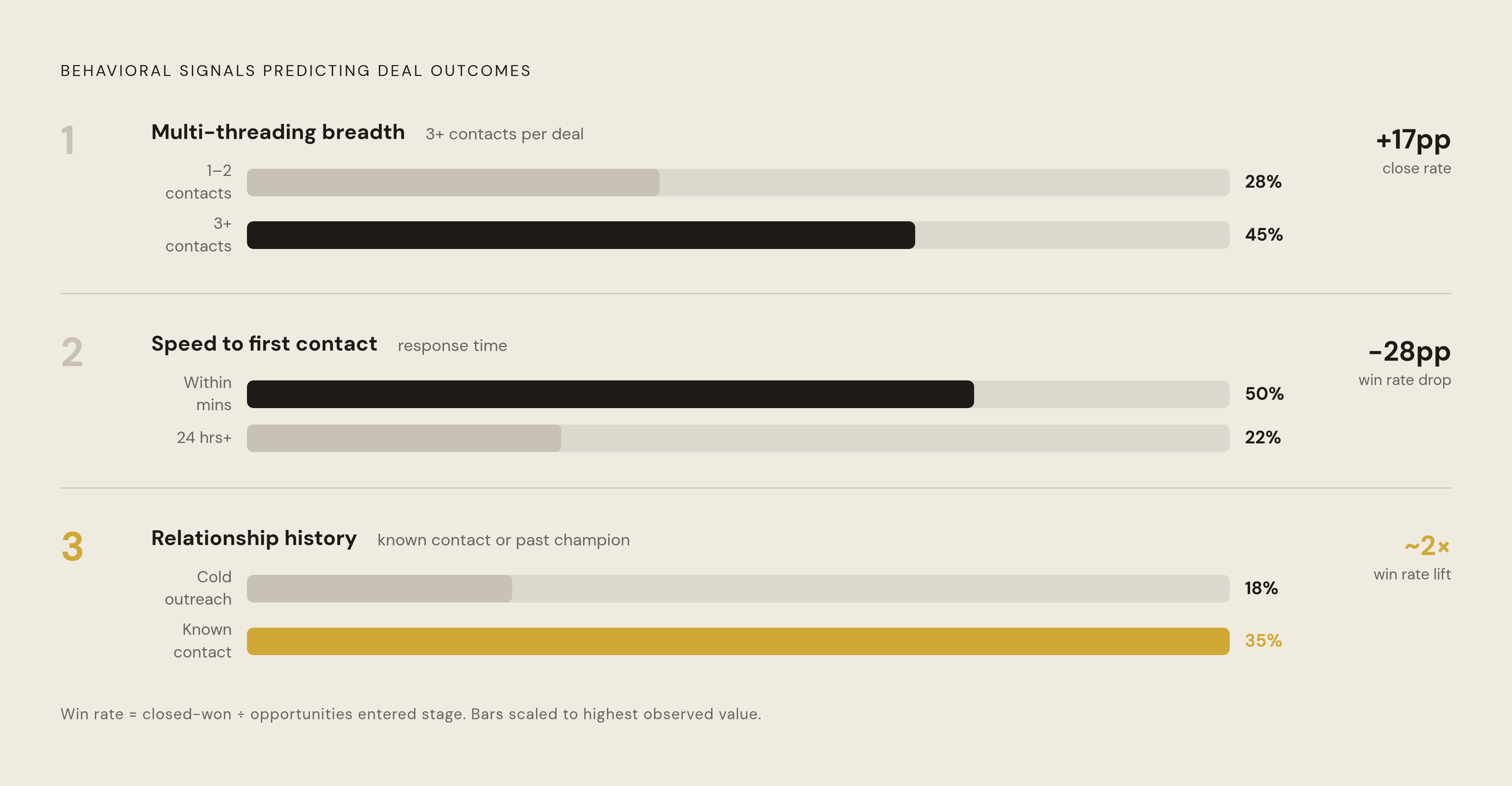
Three engagement signals recur across the deal population as leading indicators of outcome rather than retrospective descriptions of one: multi-threading breadth, speed to first contact, and relationship history.
Multi-threading breadth is the clearest of the three: engaging three or more contacts per deal produces meaningfully higher close rates, and the effect grows stronger on enterprise deals, where buying committees are larger to begin with. A single-threaded deal is fragile by construction when a buying committee spans many decision-makers: one champion's departure or one budget reassignment removes the only relationship the seller has. Multi-threading cannot happen without contact data in the first place, because the limitation sits upstream of strategy. Reps cannot thread a deal with stakeholders they do not know exist.
Speed to first engagement is the second signal, and it is measurable with none of the ambiguity a reason code carries. Responding to inbound interest within minutes correlates with a significantly higher win rate, while waiting a full day drops win rates sharply, and the timing is visible in the activity log regardless of how a rep later characterizes the deal. One specific and recoverable version of this pattern is disengagement between demo request and the live call. PaySauce and Trustero both identified that exact gap and addressed it by deploying self-guided interactive demos, so prospects arrived at the live call already engaged and pre-qualified instead of cold.
Relationship history is the third. Champify's 2025 Impact Report found that selling to known contacts, former customers or past champions who have since changed jobs, produces a win rate nearly double that of cold outreach. That signal only becomes actionable if a team actually tracks where contacts move and connects new opportunities back to prior engagement history, which makes it, again, a contact-data problem before it is a sales-strategy problem.
A fourth mechanism belongs alongside these three, even if it is less a discrete signal than a pattern the engagement record exposes. Misalignment on the fundamental proposition, not merely on price or feature checklists, is a systematic loss driver that engagement patterns can flag well before the deal closes.
The "no decision" outcome is the most underanalyzed loss in the pipeline
The biggest competitor in B2B sales is the status quo, and engagement data is the most tractable signal available for identifying which no-decision losses were actually recoverable before the deal died. Multiple studies find that between two-fifths and three-fifths of B2B enterprise pipeline ends in no decision, deals that die from inaction rather than from a competitive loss to a named rival. Most standard win-loss programs either exclude these deals entirely or lump them in with competitive losses, excluding them from the denominator inflates the reported win rate, and this masks the real scale of unaddressed status-quo losses.
Corporate Visions' analysis of B2B purchase decisions found that more than half of lost deals were winnable, a finding that only becomes useful once a team can identify what distinguished the winnable losses from the ones that genuinely were not. Engagement depth, meaning who engaged, how deeply, how recently, and whether champion activity stalled at a specific stage, is the signal that distinguishes a deal that died from neglect from one that died because of a budget decision that was genuinely final.
The sharpest evidence here comes from how buyers themselves now describe these losses. Anova Consulting Group's 2026 program data shows a shift in how buyers justify no-decision outcomes: where buyers once cited the absence of budget, they increasingly frame the loss as a financial decision they could have been persuaded on, given greater engagement. Engagement depth has moved from being a seller's retrospective analysis to being part of the buyer's own stated rationale for why the deal died. Practically, this makes stage-level drop analysis, tracking exactly where in the funnel engagement stopped, more diagnostic for no-decision losses than any reason code could be, because the disengagement event precedes the outcome and predicts it.
Conversation Intelligence and Buyer Interviews: Different Blind Spots
Conversation intelligence and structured buyer interviews are not interchangeable tools solving the same problem. They cover structurally different blind spots, and a program built on only one of them will miss, systematically, what the other catches. Conversation intelligence platforms such as Gong, Chorus, and Avoma can only analyze calls that actually happened. They cannot analyze the executive meeting the selling team was never invited to, the competitor presentation they have no recording of, or the internal champion conversation that actually determined the outcome. The most consequential decision moments in a deal are precisely the ones these platforms have no access to, and that is a structural limitation rather than a product gap that a future release will close.
The counter-argument deserves to be taken seriously rather than waved off. Traditional buyer interviews suffer from sampling bias: only buyers willing to take a post-mortem call respond at all, and those who do respond skew systematically more positive than the ones who went silent and never picked up. Research from Gong, Chorus, and the RAIN Group shows buyer recall is also materially less accurate than what a recorded transcript shows. Both of those are real weaknesses in the interview method, not rhetorical ones.
Gong's own experience is instructive precisely because Gong sells conversation intelligence for a living. Gong combined Clozd's direct buyer feedback with its own conversational intelligence to build a shared source of truth for its revenue and product teams, and Gong's co-founder and CPO acknowledged directly that conversational intelligence alone did not provide the depth of buyer perspective the company needed. The honest post-mortem requires an interviewer with no quota riding on the answer, and that is a design requirement, not a courtesy.
Cost and access shape which of these paths a team can take. Dedicated win-loss firms such as Clozd operate at a price point built for established programs with dedicated budgets, which leaves teams earlier in their program's maturity needing a different route to the same evidentiary standard.
Building a win-loss program that uses engagement data systematically, not occasionally
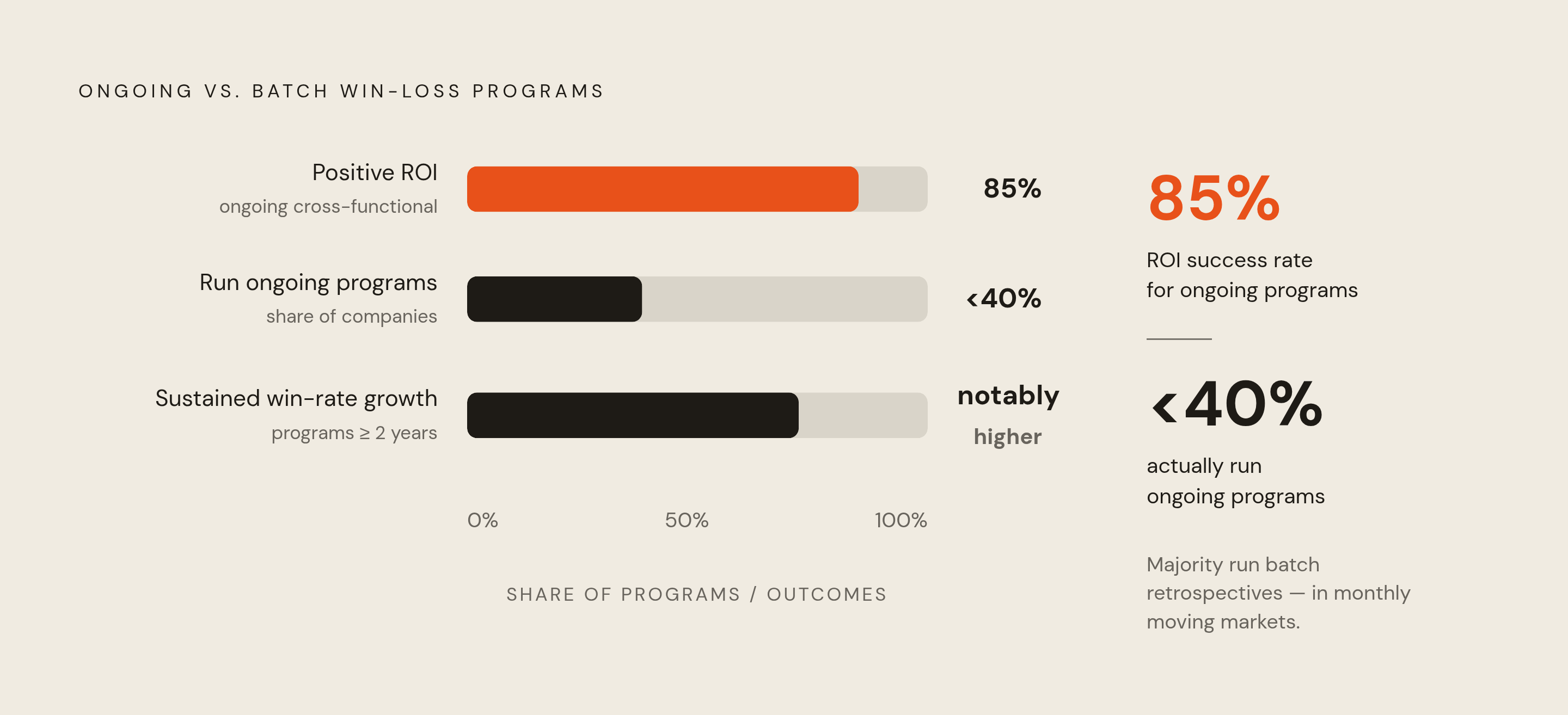
Program maturity, meaning whether win-loss analysis runs continuously and cross-functionally or surfaces only as an occasional project, predicts ROI more reliably than which method a team chooses, and engagement data is what makes the continuous version of the program actually workable. Clozd's 2025 State of Win-Loss Analysis report found that ongoing, cross-functional programs see positive ROI at a rate of 85 percent, far higher than project-based efforts achieve, and yet fewer than two-fifths of companies run programs that are ongoing at all. The rest are running batch retrospectives in markets that move on a monthly cycle. Programs that run continuously for two years or more report sustained win-rate growth at a notably higher rate than shorter programs do, which reflects a compounding effect: findings get acted on before the market shifts again rather than after.
Five decisions separate a program that produces action from one that produces a folder of interview notes nobody reopens: what the team is trying to learn, who asks the questions, what gets asked, how quickly it gets asked, and who sees the answers afterward. Skipping any one of these tends to produce exactly that folder of unused notes. On the first, a program needs two or three defined learning objectives before a single buyer gets contacted, because unfocused interviews generate data that cannot be aggregated into any usable pattern. On the second, interviews need to be led by someone with no stake in the deal, never the rep who worked it, since buyers soften their answers the moment they sense the person listening has something to lose from hearing the truth. On the third, the strongest questions probe engagement history directly, asking which stakeholders were involved, who went quiet and when, and what information arrived too late, which turns the interview into a cross-check against the behavioral record already sitting in the CRM rather than a second, disconnected data stream. On the fourth, interviews should happen within two to four weeks of the decision, because after that window buyer recall drifts and any comparison against the engagement record becomes less reliable. On the fifth, the most impactful programs distribute findings across functions rather than hoarding them: the 2025 report shows that Sales and Marketing own the majority of win-loss programs today, but Product, RevOps, Enablement, and the C-suite each pull different actionable findings out of the same underlying buyer data.
What makes the continuous model possible at all is that engagement data does not wait on interview scheduling. CRM activity signals, such as multi-threading count, stage velocity, the point where champion activity stalled, and close-date slippage, can be tracked on every single deal in the pipeline without needing a buyer to agree to a call.