CRM Integration Architecture for a Unified GTM Platform
Building a unified GTM platform requires a canonical data model before integration, not after.
Most CRM integrations fail because there's no canonical data model, no declared system of record, and no governed process for deciding which record wins when two systems disagree. Nobody says this out loud during the buying process. That silence is why it never gets fixed. Teams blame the vendor, but the vendor didn't build the architecture, and neither did anyone else in the room. The failure sits with the sequence of purchases that never added up to a system.
The pattern runs the same way almost every time. A company buys a CRM, then a sequencing tool, then a data provider, then a deliverability layer, then some workflow automation to stitch the gaps together. Each purchase makes sense on its own: a sales leader needs better cadence tooling, so she buys it, and marketing needs cleaner contact data, so it buys that too. Five purchases later, the stack resembles a hub-and-spoke diagram that nobody actually built, only implied. Salesforce, or whatever sits in the middle, looks like the system of record because it's the thing everyone logs into every morning, but every spoke around it carries its own field definitions, its own sync schedule, its own private idea of what counts as an update.
Highspot's GTM Performance Gap Report found that 85% of B2B revenue leaders say they have more sales, marketing, and enablement data than they know what to do with. Too much data, not too little, and the surplus is what gets in the way of daily operations. According to Arise GTM, the average company operates across an estimated 2,000 data silos. That figure describes an architecture failure, not a software gap that another integration will close, and architecture failures rarely announce themselves cleanly. They show up in a boardroom when marketing reports one MQL count, sales validates only a fraction of it, and finance projects an ARR figure that matches neither. Nobody in that room is lying. Everyone is reading from a system that was never told to agree with the others.
That disagreement used to be tolerable, mostly because deal cycles were slower and the gaps had time to get caught before they cost anything. It isn't tolerable anymore. Fragmentation, reconciliation labor, and the lag between a buying signal and an actual outreach action compound quietly, week over week, until the compounding produces a missed forecast that nobody saw coming, because everybody was staring at a different number on the same Tuesday.
What a canonical data model means and why most stacks lack one
A canonical data model is a single, agreed-upon schema for how companies, contacts, deals, activities, and outcomes get represented across every tool in the stack. One definition of "lead." One definition of "qualified." One definition of "closed-won" that every connected system reads from and writes to, instead of each system keeping its own private version and hoping the others stay in sync.
Most stacks skip this, because most point tools arrive with their own object model already baked in. Integrations get built by mapping fields at the moment of connection, not by conforming to a schema decided on beforehand. So "contact" in the sequencing tool and "contact" in the CRM look nearly identical on day one and drift apart within weeks, because nobody ever said which one governs when the two disagree.
Three decisions have to happen before a single integration gets built, not after the fact. First, the system of record has to be named explicitly: which tool owns the authoritative version of each object type, account, contact, opportunity, activity. It can't be assumed just because a tool happens to sit in the middle of the org chart. Second, identity resolution policy sets the rules for when two records represent the same real-world entity, using email domain matching, LinkedIn URL matching, company name normalization, and subsidiary mapping, so that "Acme Inc." and "Acme Corporation, a subsidiary of Acme Holdings" don't turn into two separate accounts running two separate pipelines. Third, write-back governance decides which systems can update which fields, and under what conditions. If that last step is skipped, an enrichment tool overwrites a manually corrected title field, or a sequencing platform updates a last-contacted date that conflicts with what the CRM already has on file.
Arise GTM's framing gets at the real diagnosis: teams aren't missing features, they're missing a blueprint, a canonical data model, declared systems of record, governed identity resolution, and orchestration that reacts to signals it can actually trust rather than whatever signal happens to arrive first.
Identity resolution breaks first and gets fixed last, mostly because it's unglamorous work with no obvious owner. Matching records across every misspelling, abbreviation, and format variation at scale is a genuinely hard technical problem, and skipping it doesn't make it disappear. It just relocates the damage downstream. The same contact gets outreach from two different reps because their records were never merged. A suppression list fails to fire because the opted-out email address doesn't match the version of the record the sequence tool happens to be pulling from. Pipeline gets double-counted in a forecast because the same opportunity lives under two account records that nobody realized were the same company.
The five-layer architecture that replaces the hub-and-spoke illusion
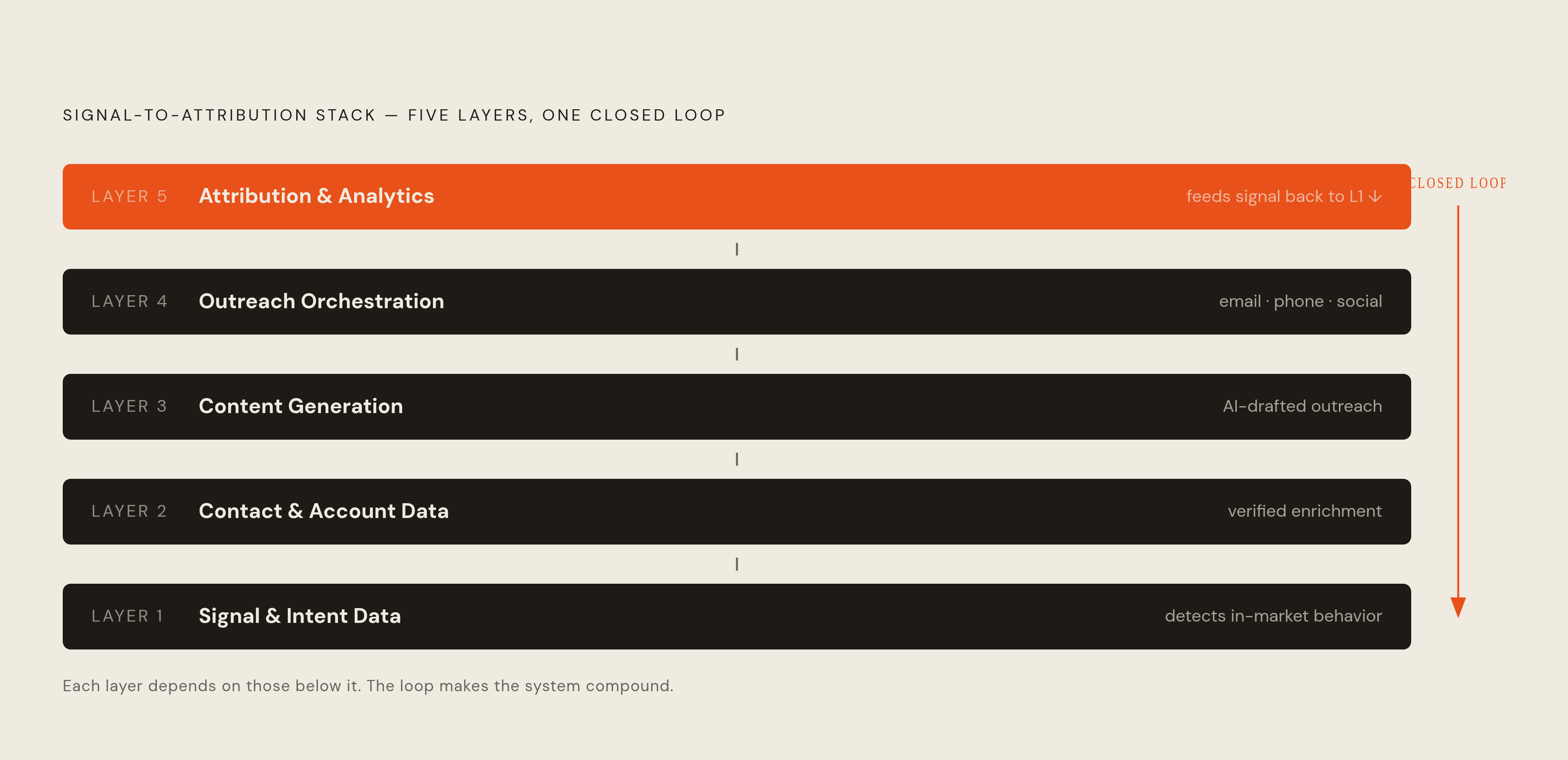
The GTM AI Platform Guide, published by thestacc.com in July 2026, lays out a five-layer framework that reads less like one vendor's pitch and more like a description of where the industry has already converged. Different vendors describe the same problem in different words, and the same structural logic is visible across their descriptions.
Layer 1 is signal and intent data, the input layer that detects behavioral evidence a buyer is actually in-market right now. If this layer is skipped, outreach reverts to a time-based cadence, touch six on day fourteen, whether or not the prospect has shown a shred of actual interest.
Layer 2 is contact and account data, the verified enrichment layer that gets refreshed continuously instead of captured once and left to rot. Apollo's proprietary database, with a vast number of contacts and a substantial number of accounts, gives some sense of the scale this layer has to operate at for a platform serving any meaningful volume of GTM motion.
Layer 3 is content generation: AI-drafted, personalized outreach grounded in whatever the layers beneath it actually contain. Content quality here is a direct function of how clean layers 1 and 2 are. A beautifully written email pulling from a stale record is still, in every way that matters, a stale email.
Layer 4 is outreach orchestration. It decides who gets which message, on which channel, and when, running email, phone, and social as one coordinated motion instead of three uncoordinated ones firing at the same prospect on the same day.
Layer 5 is attribution and analytics. It measures what actually worked and feeds that signal back into Layer 1, closing the loop. That feedback loop is the mechanism that lets the system compound in value over time instead of running the same playbook on repeat forever.
Each layer feeds the one above it, and that dependency isn't optional. Break Layer 1 and every layer above it starts producing noise dressed up as personalization. Most failed rollouts skip the signal layer entirely and try to bolt automatically generated outreach onto a data foundation that was never verified, which amounts to writing a beautifully worded letter and mailing it to an address nobody confirmed still exists.
The CRM's role changes once this architecture is actually in place. It stops sitting passively at the center of a hub-and-spoke diagram and becomes the connective tissue running between layers: the place where identity gets resolved, enrichment gets written back, signals get read against account history, and agent actions get grounded in something verified instead of guessed at.
Rules-based marketing automation, which has existed for two decades, does none of this, and mistaking one for the other is where most rollouts go wrong. A rules engine fires a sequence when a form gets submitted. It doesn't decide, in real time, who to contact, when, and with what message, based on a synthesis of signal, history, and verified fact. That decision-making is what makes the five-layer architecture agentic rather than merely automated, and it's the actual test for whether something calling itself a "platform" has earned the word. Every layer has to read from and write to the same underlying data model. A vendor who can't produce that diagram is selling a point tool wearing a platform's clothing.
How the system-of-record declaration changes what the CRM does
Declaring a system of record is a governance decision, plain and simple: which team owns the authoritative version of each object, who has permission to update it, and what happens procedurally when two connected tools try to write conflicting values to the same field at the same moment.
Growth Context, introduced at UNBOUND 2026 and covered by Aspiration Marketing in a piece published September 18, 2026, shows what this looks like when it's handled on purpose. Growth Context is described as the continuous data and logic layer that makes historical interactions, intent signals, campaign engagement, and customer attributes visible and usable across every connected tool. Every touchpoint, a blog view, a pricing page visit, a query typed into an answer engine, gets indexed and made instantly accessible to human reps and automated workflows alike. That only works because the CRM was declared, up front, as the system of record, with the logic layer built on top of it rather than as a parallel warehouse that has to be reconciled against the CRM after the fact.
Without that declaration, a vacuum forms, and specific problems fill it. The sequencing tool updates a contact's last-activity timestamp. The enrichment provider silently overwrites the title field with a new job title it scraped from somewhere. The CRM holds a third version that matches neither. Someone in RevOps spends part of every Friday reconciling all three by hand, forever, because nobody ever decided which system gets to be right.
Gartner has put a dollar figure on that manual reconciliation: data silos and poor data quality run organizations an average of $12.9 million annually, spread across lost productivity, misaligned execution, and wasted spend chasing accounts that were never qualified correctly to begin with.
Write-back discipline is the corollary to system-of-record governance. Enrichment tools and AI agents need to be configured to add to a record, not blindly replace what's already sitting there. Apollo's waterfall enrichment approach illustrates the design principle: filling actual gaps rather than overwriting a field just because a new data source returned a different value. Done right, the CRM starts behaving like active connective tissue instead of a filing cabinet. An opportunity stage updates, and the sequencing tool, the enablement platform, and the forecast all react on their own, without a human remembering to manually trigger a handoff between systems that, in theory, were already supposed to be talking to each other.
Identity resolution at scale: the unglamorous work that determines whether AI agents reason or hallucinate
IBM research cited in industry coverage found that only 19% of companies believe their own data is ready for AI to operate on. That gap almost never traces back to model capability. It traces back to entity resolution: the unglamorous work of figuring out whether "J. Smith at Acme" and "Jane Smith, Acme Corp" are the same human being.
ZoomInfo's GTM Context Graph gives a sense of what solving this at real scale actually requires: processing an enormous volume of data points daily across a large base of contacts and companies, using entity resolution to match records across every spelling variation, abbreviation, and format inconsistency that a hundred million companies can produce between them. That volume is what makes the problem concrete instead of theoretical.
Without identity resolution, three failure modes appear, reliably, in roughly this order. Duplicate outreach comes first: the same contact gets sequenced by two different reps because their records were never merged into one. Suppression failures follow, when an opt-out doesn't propagate because the email address on the opt-out record doesn't string-match the version a sequence tool happens to be pulling from. Agent hallucination comes last, and does the most damage. An AI agent grounded in unresolved, contradictory records starts reasoning from whichever version of the truth it happens to retrieve, surfacing a contact's old employer, an outdated title, or a phone number disconnected two roles ago, and presenting all of it with total, unearned confidence.
Entity resolution has to happen at the data layer, before content generation or orchestration ever get involved. It can't be patched in after agents are already live in production, because by then the agents have already been reasoning from bad data for however long the gap went unnoticed. That sequencing matters more than which vendor handles the resolution.
Seismic's reported results give a sense of what's possible once the data foundation is actually solid: a 54% productivity gain, 11.5 hours saved per rep per week, and 39% of active pipeline sourced directly from signal. Those numbers came from deploying agents on top of a verified data foundation. Apollo's approach, continuously layering buying signals and waterfall enrichment onto its proprietary contact and account base, is one mechanism for handling this.se of a vast number of contacts and a substantial number of accounts, continuously layered with buying signals and waterfall enrichment, is one mechanism for handling that resolution work on an ongoing basis, so an agent asking a question about a contact gets an answer grounded in something current, not something cached from six months back.
Signal infrastructure as the layer that activates the CRM rather than bypassing it
Buying intent data and letting it live inside the vendor's own dashboard, disconnected from everything else, is one of the more expensive mistakes a GTM team can make. Reps act on it, but the system of record never learns what actually triggered the outreach. Six months later, nobody can explain why a given account got contacted, because the reason for the contact was never written down anywhere durable.
Signal infrastructure, done at architecture scale, looks nothing like that. Autobound's signal API, as one example of the pattern, delivers more than 700 signal subtypes pulled from over 35 data sources, distributed via REST API, webhooks, cloud storage, and direct data warehouse ingestion. Signals need to flow into the canonical data model, not pile up in a silo that only one team ever checks, regardless of which specific vendor happens to demonstrate the pattern.
The stakes are rising because buyer behavior has already changed and most GTM stacks have not caught up. ZoomInfo research found that B2B buyers complete 67% of their research before ever speaking with a vendor. Static segmentation and rule-based automation were never built to catch a buyer moving that fast and that quietly, and they still can't. Signal infrastructure is the only mechanism built to catch someone that far into a decision before they've raised a hand.
Consider what a well-architected version of this looks like in practice. Multiple visitors from a target account land on a pricing page inside a defined time window. The system updates the opportunity stage in the CRM automatically, creates a task for the account owner, enriches the contact record with current information, and enrolls the account into the right sequence. None of that requires a human to spot the pattern and manually kick off the workflow, and none of it works at all unless the signal writes back into the CRM as the actual system of record, instead of staying trapped inside whichever tool happened to detect it.
Signal types to track include behavioral signals like website visits, pricing page views, and content downloads, firmographic events like funding rounds and executive hires, technographic shifts where a target account just adopted or dropped a piece of its stack, and third-party intent surges that show active research happening somewhere off the company's own website.
The test for whether any of this is architected correctly is simple to state, and unforgiving. If a signal triggers an action in the sequencing layer but never updates the CRM record, the architecture is broken. Full stop. The CRM will never be able to explain why a given sequence started, which makes attribution impossible after the fact and agent grounding unreliable going forward.
Agentic workflows that the CRM must support to function as GTM infrastructure
Agentic systems ask something of the CRM that rule-based automation never had to ask. An agent has to read from verified context, write its actions back into structured records, and update state as a multi-step workflow moves forward. The CRM has to be queryable by a machine as well as browsable by a human at a keyboard.
The GTM AI Platform Guide projects that by the third quarter of 2026, 60% of B2B revenue teams will be running at least one autonomous GTM agent in production, and that most of those same teams will still be losing money on the deployment. The agents aren't the problem. The stack underneath them was never built to support one.
Model Context Protocol, or MCP, is emerging as the connective layer that makes this workable. It lets AI agents execute multi-step workflows autonomously by connecting directly into the GTM stack. The CRM has to expose structured, queryable endpoints, not just a webhook here and a CSV export there.
The shift between the 2025 and 2026 versions of the same prospecting motion is instructive. Until recently, signals, enrichment, drafting, and sending were disconnected steps stitched together by a person doing the actual stitching. Today, an agent can monitor signals continuously, pull research from the CRM in real time, draft contextually grounded outreach, and book the meeting, pulling a human in only at the moments that genuinely require judgment rather than execution.
Apollo's agentic positioning runs on the same logic: agents that handle research, outreach, and pipeline tasks function only because a unified data layer drives them that let the system improve over time instead of repeating the same mistake on a loop. Analysis of HubSpot's Agent Hub from the UNBOUND 2026 coverage found that agents operating with embedded, business-specific CRM context achieve outreach response rates up to twice those of non-contextual outreach, according to HubSpot 2026 product data compared with outreach lacking that context. The "context" doing the heavy lifting there is the CRM's architecture, not the underlying language model, which runs close to the opposite of what most vendor pitches lead with.
Highspot's GTM Agent, launched as part of its Spring Launch '26, follows the same pattern from a different angle: it connects signals across revenue execution and turns them into specific, role-based actions for enablement, marketing, and revenue operations teams. Different product, same underlying dependency. Agent effectiveness tracks CRM data quality and governance.
The phased implementation roadmap that avoids big-bang migration failure
The instinct to rebuild the entire stack in one coordinated push is understandable, and it's almost always a mistake. "Big bang" migrations, attempting to replace every system and every integration at once, tend to freeze day-to-day operations for months, generate change-management fatigue across every team the rebuild touches, and, as Arise GTM's blueprint from July 2026 puts it, rarely succeed as planned.
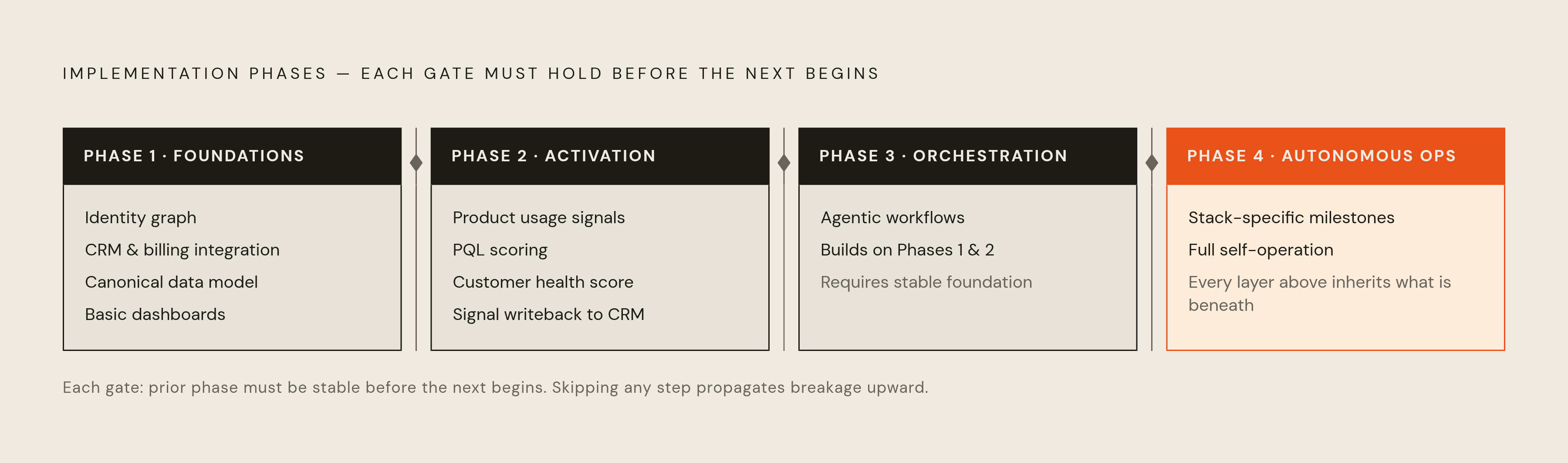
Arise GTM lays out a four-phase roadmap instead, sequenced so that no phase starts before the one beneath it is actually stable.
Phase 1, Foundations, covers the identity graph, core CRM and billing integration, and basic dashboards. This is where the canonical data model gets defined and the system-of-record declarations get made on paper, with a named owner attached to each decision. Nothing downstream should start until this phase holds, because every later phase inherits whatever's broken here.
Phase 2, Activation, brings product usage signals into PQL scoring and customer health scoring. This is where Layer 1 signal infrastructure starts writing back into the CRM in earnest, instead of sitting in a separate dashboard that only one team remembers to check on Fridays.
Phase 3 builds orchestration and agentic workflows on top of whatever Phases 1 and 2 established, though the exact milestones for that phase and the one after it depend on the particular stack and team running the rollout. What holds constant across every version of this roadmap is the sequencing logic itself: foundation before activation, activation before orchestration, orchestration before anything gets to call itself autonomous. If a step is skipped, every layer above it inherits whatever was broken beneath it, no matter how sophisticated the AI running on top claims to be.
Sources
- HubSpot UNBOUND 2026: GTM with Growth Context & Marketing Studio 2.0
- GTM AI Platform Guide 2026: Stack, Vendors, Rollout
- Blueprint for a Unified GTM Tech Stack | 360° Customer View Guide
- Top 10 GTM Data Platforms for Enterprise Sales Teams (2026)
- highspot.com
- GTM AI Context Data Foundation: The RevOps Guide for 2026