
Intent Data Integration With Inbound Scoring Models
Combine first-party, third-party, and technographic signals for scoring that actually converts.
What intent signals measure, and where each type breaks down
91% of B2B marketers now use intent data. Only 24% say it delivers exceptional ROI. Forrester's April 2026 framing calls the category "ubiquitous and consistently underutilized," and that diagnosis is right, but it's incomplete. The signals aren't the weak part. The scoring logic built around them is, and most teams never fix that because they never look past the dashboard to ask why a signal that looked hot never turned into a meeting.
The gap comes from a mechanism that repeats itself at nearly every company running an intent tool: a signal gets pulled in, dropped into a CRM field, and nothing happens next. No rep gets told what to do, when, or why. Meanwhile the buyer keeps moving. 6sense's Buyer Experience Report, surveying more than 4,000 buyers, found that 94% of buying groups have already ranked their preferred vendors before ever talking to sales, after working through an average of 13 pieces of content, almost all of it anonymous. By the time an account finally raises a hand, two or three vendors are usually already shortlisted. Fixing that means turning whatever signals already come in into a scoring setup that tells a specific person what to do next.
Intent data splits into three buckets, and each trades accuracy for reach in a different direction. Lean on the wrong one and the whole model inherits its blind spot, which is the mistake most teams make without realizing it.
First-party signals come from owned properties: website visits, content downloads, email opens, product usage. These are the most trustworthy signals available, because real behavior on real infrastructure generated them, but they only cover accounts already inside a company's own ecosystem. A pricing-page visit or a repeat demo click means something precisely because there's no ambiguity about who did it.
Third-party signals come from outside networks: publisher cooperatives, review sites, syndicated content tracked across thousands of domains. Bombora's cooperative network measures topic surges this way. G2 and TrustRadius track when a buyer is comparing vendors on a review page. These signals reach much wider than first-party data, but precision is the tradeoff. Third-party intent relies on IP-to-company matching and probabilistic modeling, both opaque by design. Someone else collected it, coverage varies by geography, and there's no clean way to audit the underlying quality.
Hybrid signals stitch the two layers together, and that's where confidence actually climbs. When an account surges on a third-party topic and visits a company's own site in the same window, that overlap means something neither signal means on its own. Warmly's layered approach reports an 88% deal advance rate on intent-flagged accounts versus 77% without the overlay, an 11-point gap that comes purely from stacking signal types rather than trusting either one alone.
Technographic intent deserves its own line. Providers like HG Insights and BuiltWith track which tech stack a company runs, and that's a sharp signal for SaaS companies selling to other SaaS companies (a churn signal on a competitor's product is about as direct as intent gets). It's a much weaker signal for generic B2B services, where a buyer's tech stack says little about what they actually need, and treating it as universally strong is a category error that appears constantly in vendor pitch decks.
None of this works without accounting for how fast a signal goes stale. Real-time signals, mostly first-party website behavior, decay in seconds or minutes. Near-real-time signals, review-site engagement and some intent-provider feeds, decay over hours. Delayed signals, the batch-processed cooperative models, decay over days or weeks. A signal fourteen days old is often already dead: the buyer picked a vendor while the data sat in a queue. 2026 has added a wrinkle on top of that. Bot and AI agent traffic has pushed false-positive rates up across the board, so a single intent spike from a single contact almost never means anything by itself. The real work is weighting each type of intent data inside a model that accounts for freshness, fit, and signal clusters together, rather than trusting any one feed to speak for itself.
The seven signal categories with meaningful half-lives and what each one triggers
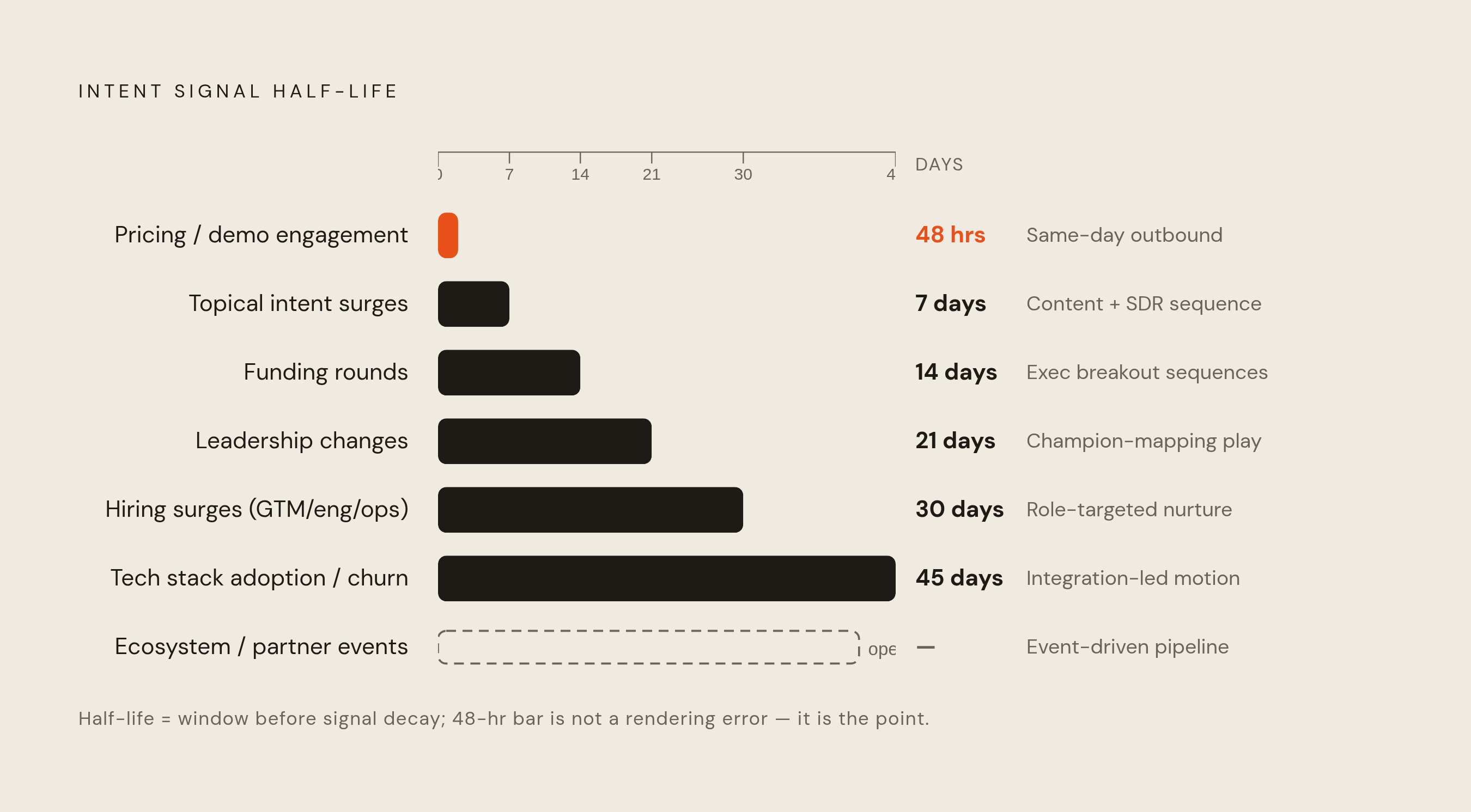
Across dozens of agent deployments Explorium has instrumented, seven signal categories account for more than 80% of agent-sourced pipeline. Each one carries a documented half-life, and that half-life decides whether the signal is still worth acting on by the time someone gets to it.
Funding rounds carry a 14-day half-life and trigger executive breakout sequences. Hiring surges on GTM, engineering, or ops roles carry a 30-day half-life and trigger role-specific outbound. Leadership changes at C-suite or VP level decay on a 21-day step function and trigger warm intros paired with a value hypothesis. Tech stack adoption or churn carries a 45-day half-life and triggers displacement plays. First-party engagement on pricing, docs, or demo pages carries a 48-hour half-life and triggers same-day outbound. Topical intent surges via cooperative or review-site networks carry a 7-day half-life and trigger category-framed sequences. Ecosystem or partner events trigger co-sell motions.
The 48-hour window on pricing and demo engagement is the tightest clock in the stack. Same-day outbound is the only way that signal gets used before it expires, full stop. Compare that to tech stack churn at 45 days, which stays actionable for the better part of a month and a half. Treating those two signals as equally urgent is the most common architecture mistake in the category: intent data isn't one urgency tier, it's seven, and a scoring model that flattens them into a single number throws away the information that made them worth collecting.
Building the four scoring dimensions that separate real buyers from noise
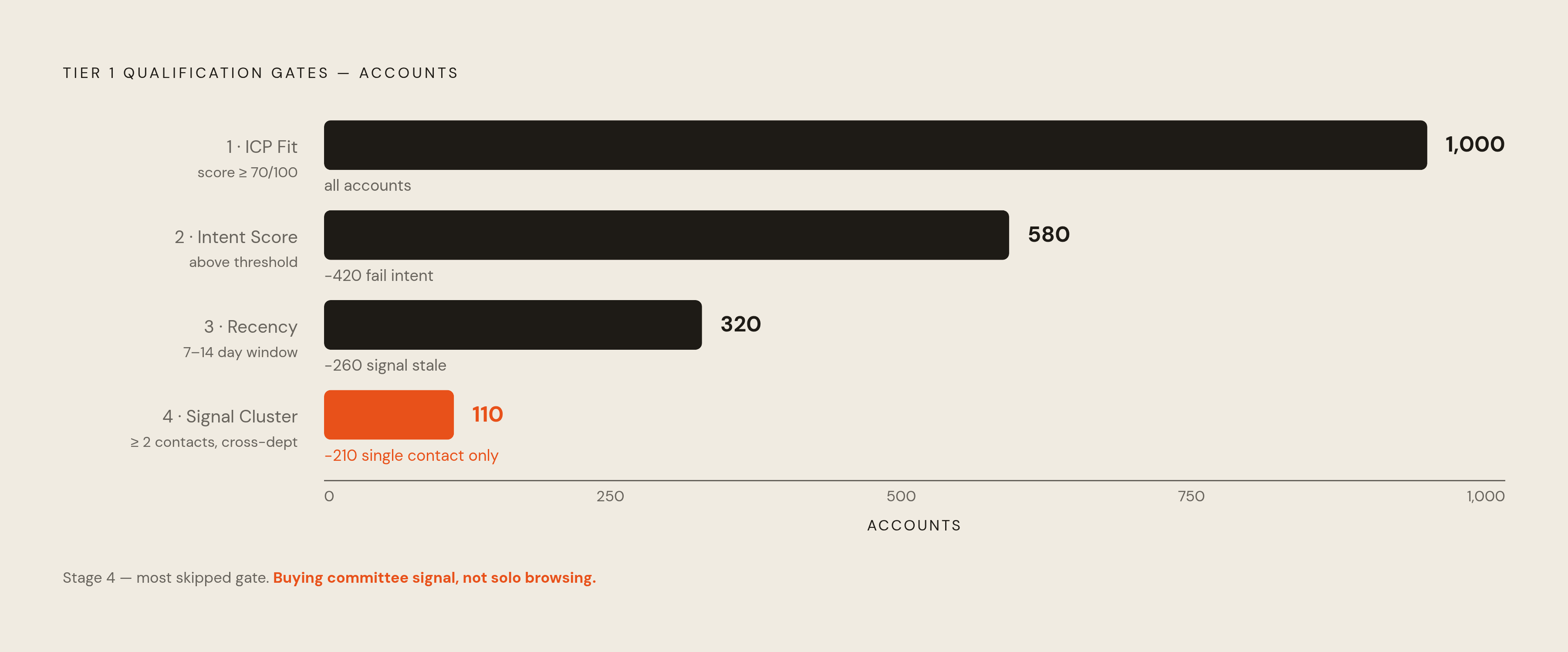
Intent without fit is noise. A ten-person company surging on searches for "enterprise CRM" is not a real buyer no matter how loud the signal gets, because fit is the gate and intent is only the accelerator. A working scoring model needs four dimensions, and all four have to clear their bar before a lead moves anywhere. Skipping one degrades the model into exactly the kind of dashboard described above: plenty of activity, none of it converting.
ICP fit comes first. Firmographic and technographic fit has to clear a minimum threshold, with 70 out of 100 cited as a representative gating floor, before intent signals even get evaluated. That keeps off-ICP accounts out of a rep's queue no matter how much noise they generate.
Intent score comes second, and it has to clear a defined threshold above baseline activity, not just register above zero. A single page view shouldn't score the same as a sustained pattern of engagement. The threshold exists to filter out passive browsing that looks like intent but isn't.
Recency comes third. Signals need to fall inside a defined freshness window, commonly 7 to 14 days for a 0-to-30-day play, and signals outside that window should decay in weight rather than vanish. A 20-day-old signal still carries some information. It just shouldn't carry as much as one from yesterday.
Signal cluster comes fourth, and it's the dimension most models skip. Most models miss the buying committee forming in front of them. A real buying signal requires activity from at least two contacts at the account, not just one person acting alone. One person downloading one whitepaper at a 500-person company is mildly interesting and nothing more. Three people across two departments engaging in the same week means a buying committee is assembling, and that pattern is what should push the account to the top of the queue. Account-level scoring, not contact-level scoring, has to anchor the whole model for this reason: outbound B2B runs as an account-based motion, and scoring individuals in isolation misses the committee dynamic that actually predicts a deal.
Combining signal types compounds the noise reduction, because each type fails differently and the failures rarely overlap at the same moment. Third-party topic surge, first-party engagement, and firmographic fit together cut false positives far more than any single source alone. Start simple, though: a basic scoring model running in production beats an elaborate one sitting untouched in a spreadsheet. Agents running decay-weighted composite scoring on a unified data layer converted 47% higher and cut cost-per-meeting by 32% against flat-scored agents pulling from fragmented feeds. The scoring architecture and data layer were the key variables that differed between the two approaches.
Mapping scores to time-horizon tiers so sequences match buying stage
Once the four dimensions produce a score, that score gets placed in a time-horizon tier, and the tier decides what sequence fires and how fast it fires.
Tier 1 runs 0 to 30 days, hot. High ICP fit, high intent score, and a signal cluster forming inside 7 to 14 days push an account into high-touch sequencing with same-day routing and direct rep assignment. First-party pricing or demo engagement belongs here by default, given its 48-hour half-life. Anything slower and the window's already closing by the time a rep even sees the alert.
Tier 2 runs 31 to 90 days, warm. Solid ICP fit paired with moderate intent calls for mid-touch nurture with rep-personalized touchpoints rather than full outbound intensity. Most teams treat Tier 2 as a fallback bucket instead of building it a sequence with its own logic, and that's exactly where pipeline quietly gets left on the table. As buyers conduct more self-education before engaging a seller, Tier 2 carries real pipeline weight and deserves its own deliberate sequence logic.
Tier 3 runs 91 to 180 days, research-stage. Early topical research and tech stack signals decaying over 45 days belong in automated, content-led nurture. The handoff SLA from nurture to outbound has to map onto this window specifically, or in-market accounts that aren't yet urgent slip through the cracks unnoticed.
Speed matters most in Tier 1, and OpenPhone supplies the measurable proof of it. Before intent workflows were layered in, leads sat in queue for an average of 2.5 days before a demo got scheduled. After third-party intent and automated workflows went in, speed-to-lead dropped by 67%, driving a 17% lift in inbound conversion and a fivefold drop in misrouted leads. That result comes from a scoring architecture that tells someone to act while a signal is still alive. It isn't a marginal gain squeezed out of a dashboard upgrade.
Gating matters just as much as speed. Only accounts clearing all four dimensions together, fit, intent, recency, and cluster, should trigger a high-touch sequence. Mid- and low-tier accounts shouldn't eat rep capacity that Tier 1 needs. Tier assignment should govern channel choice too, not just sequence intensity: channel selection for Tier 1 accounts should account for regional compliance requirements rather than defaulting to a single outreach method. Building that distinction into the tier logic up front avoids compliance problems that are far harder to unwind later.
The technology stack requirements for this architecture
None of the scoring logic above survives contact with a fragmented tech stack, and this is where most of the theory quietly falls apart in practice. On unit economics alone, a five-vendor stack stitched together after the fact runs roughly $39.30 per meeting booked. A unified credit pool running through one connected system runs closer to $7.96, a fivefold gap before even counting the engineering hours lost to schema glue code and billing reconciliation, which teams commonly report costing 10 to 15 hours a week. The 47% conversion lift and 32% cost reduction from the earlier A/B test held every variable constant except one: the data lived in a unified layer or a fragmented one. Decay-weighted scoring simply doesn't compute correctly against five disconnected feeds running five different refresh cadences.
The stack that supports this architecture needs three capabilities, and none of them is optional. Signal ingestion has to run at the right cadence for each type: real-time for first-party behavior, near-real-time for review-site signals, batch processing acceptable only for the slower categories like tech stack churn. Routing has to be CRM-integrated and ownership-aware, respecting territory rules and existing account ownership instead of firing alerts blind. Runway achieved a 400% increase in lead volume and a 10% lift in inbound conversion, scaling GTM workflows roughly tenfold more efficiently, by enriching leads, checking rep ownership inside the CRM, and firing instant Slack alerts with calendar links attached. The score itself has to write back into the CRM as a field a rep can actually see and act on, not stay locked inside the intent platform's own dashboard where nobody but the RevOps team ever looks.
Model Context Protocol is emerging as the connective standard here. MCP servers from providers like ZoomInfo let AI agents and assistants, including Claude and ChatGPT, pull verified account and intent data directly into the tools teams already work in, cutting out a layer of middleware that otherwise introduces staleness between systems. That matters more as GTM execution shifts from rule-based automation toward agentic workflows: an agent perceives an intent signal, decides how to route it, launches a sequence matched to the account's signal history, updates the CRM, and schedules follow-up without waiting on manual approval at each step. Apollo offers a database of 240M+ contacts and 30M+ accounts, and positions its platform as an integrated system for prospecting and outreach rather than a fragmented multi-vendor stack.
Intent data provider options mapped to scoring architecture requirements
Forrester's Wave for Intent Data Providers named five Leaders: Intentsify, which posted the highest overall Current Offering score and earned the maximum possible score on 12 of 21 evaluation criteria, along with Bombora, Informa TechTarget, and Demandbase. Fit to a scoring architecture, not the Wave ranking by itself, determines how well the model performs day to day. That fit shapes lead prioritization and routing based on segment and use case.
Enterprise B2B companies running a coordinated ABM motion across advertising, email, and sales outreach should look at Demandbase, which scored 34 out of 40 on growleads.io's eight-criterion scorecard. It combines account graph data, intent signals, and advertising execution under one roof, and its Agentbase layer adds orchestration agents that coordinate across channels. Pricing runs roughly $65,000 to $300,000 a year, with a median near $65,000, quote-only. Its intent signal taxonomy is less transparent than Bombora's or G2's, and that opacity should be weighed against the platform's broader execution range before signing anything.
Mid-market companies don't need that range, and shouldn't pay for it. Bombora layered with G2's buyer intent data is the pragmatic entry point. Bombora's Company Surge tracks thousands of B2B topics across a cooperative network of publishers, while G2 supplies review-based signals from buyers actively comparing vendors on its platform. Combined, the two are positioned to capture substantial enterprise platform value at a fraction of the cost, with Bombora pricing running $25,000 to $75,000 a year per autobound.ai's figures. That pairing gives a mid-market team enough signal coverage to build a real four-dimension scoring model without the implementation overhead of the largest enterprise platforms, where buyers at smaller ARR levels routinely end up using a fraction of what they're paying for.