Multichannel Sequence Design for B2B Outbound in 2024
Sequential architecture—not just channel presence—converts deals that parallel outreach misses.
What multichannel sequence architecture means
Most B2B sequences fail because the channels run in parallel instead of in order. Nobody tells a rep when to escalate, when to back off, or when to just wait another day. The channel isn't the problem. The architecture around it is, and most teams never bother to build one.
Consider the math: 80% of deals need five or more follow-ups to close, yet most reps quit after two or three touches. That's a structure problem, not a motivation problem, and structure can actually be fixed, unlike "try harder."
Having a presence on email, LinkedIn, and the phone is not the same thing as having a sequence. Plenty of teams check every channel box and still get noise instead of conversation, because nobody decided the order, the spacing, or the rules for what happens when a prospect does, or doesn't, respond.
A real sequence architecture has four working parts. The channel layer decides which platforms are in play. The sequence layer sets the order those channels appear in and the gaps between them. The signal layer feeds in data (an email open, a pricing page visit, a new funding announcement), and the system uses that data to keep going, speed up, or stop. The escalation logic turns those signals into rules: move this account up in priority, add a phone call, cut the interval in half.
None of that lift comes from just being everywhere at once. It comes from sequencing. A call lands better after a relevant email already sat in someone's inbox, and an email reads as more credible once a prospect has seen a clean LinkedIn touch and heard a short, professional voicemail. Each channel makes the next one work harder. The sequence itself is the product here. Any single touch, sitting on its own, is just a part on a shelf.
The three foundational channels and how each earns its place in the sequence
Email is still the workhorse. It carries detail, it's searchable, and it puts the pitch in writing where someone can come back to it later. Cold email on its own typically averages around a 3 to 4% reply rate. Personalized campaigns, ones that reference something specific about the account, can push reply rates to 8 to 15% and meeting conversion to 2 to 5%. That gap settles the volume-versus-quality argument in favor of quality, full stop.
Phone is the most direct way to create urgency, but it depends entirely on timing. Calling a stranger cold prompts one reaction: "who is this?" An email and a LinkedIn touch that have already put a name in front of someone change the footing a call starts on. Save the cold ring for accounts where the deal size actually justifies the friction.
LinkedIn does the quiet work of warming everything else up. A connection request, a comment on a post, a profile view: none of it asks for much, but all of it chips away at the "cold" part of cold outreach before the email even lands. The order that falls out of these three channels isn't complicated: LinkedIn first, because it's low-friction and builds name recognition, email next, landing with a slightly warmer prospect, phone last, once there's actual context to justify the interruption. SMS, direct mail, and video can layer on top of this, but only once the three core channels are actually coordinated. Adding a fourth channel to a broken three-channel sequence just adds noise, not pipeline.
Setting the right number of touches and intervals by deal tier
Touch count isn't a fixed number. It scales with deal size and how many people sit on the buying committee. Mid-market targets do best with 10 to 12 touches spread over four to six weeks, while enterprise accounts warrant 12 to 18 touches stretched across eight to twelve weeks. Smaller deals run tighter: 12 to 15 touches over three to four weeks, mixing short emails, focused blocks of calls, and a handful of social touches that all reinforce the same point.
Spacing shifts as the sequence goes on. Early, in roughly the first two weeks, emails should land two to three days apart. Later, that gap stretches to four or five days, since urgency naturally fades and hammering someone daily just reads as desperate. Day one deserves its own structure: a phone call backed by a same-day email, front-loading the highest window of interest before it cools.
Reasonable benchmarks put reply rates in the single to low-double digits and meetings booked in the low single digits. Fall short of those and the problem is usually deliverability or targeting.
Using intent signals to determine when to trigger, escalate, or pause a sequence
A static sequence treats every prospect the same regardless of what they're actually doing. This is why it underperforms. A signal-triggered sequence treats behavior as an input. Entry signals include funding announcements, hiring surges (a "RevOps Manager" posting is a tell), technology changes, competitor displacement, and leadership turnover.
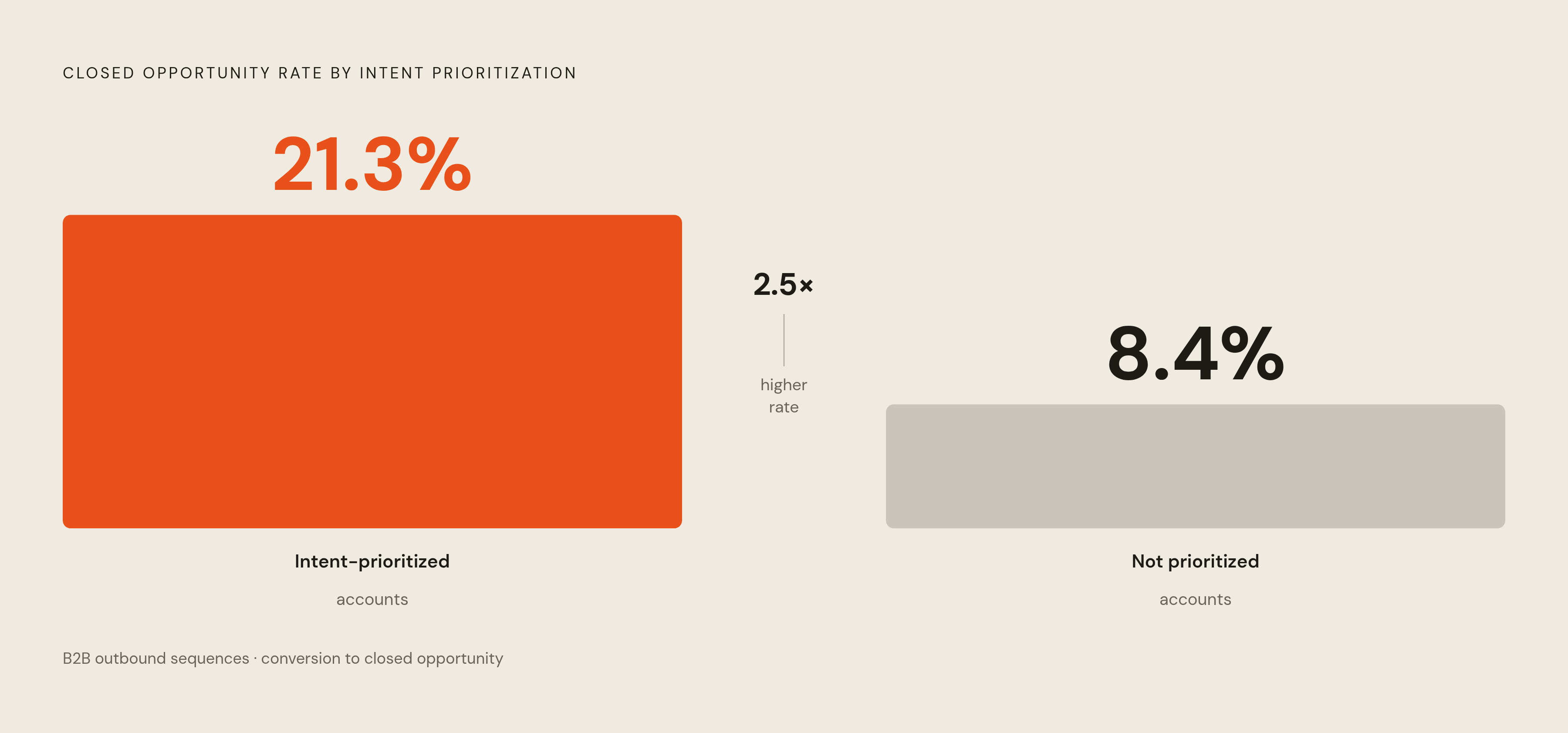
The performance gap here is hard to ignore. A 2024 study on B2B buying behavior found intent-prioritized accounts converted to closed opportunity at 21.3%, against 8.4% for accounts not prioritized by intent signals, roughly two and a half times the rate. A separate ABM benchmark survey found intent-flagged accounts closed meaningfully faster than baseline.
Inside a live sequence, the logic runs three ways. Escalate, add a call, shorten the gap, when a prospect opens an email multiple times, clicks a link, or visits a pricing page. Pause when there's no open after three attempts, when an email bounces, or when an out-of-office reply signals bad timing rather than disinterest. Personalize mid-sequence when a new signal arrives (a funding round, a relevant new hire) and inject a touch that speaks directly to it. AI research agents can now watch for these signals around the clock and fire a touch the moment a prospect crosses a threshold someone has already defined. The rule still comes from a person. The agent just watches for the moment to apply it.
Designing touches that match where a buyer is in their self-directed evaluation
A Gartner survey found 61% of B2B buyers actually prefer a rep-free buying experience. A sequence that pushes for a meeting on every single touch loses the majority of buyers who'd rather research on their own first, at their own pace, before anyone gets on a call with them. Pushing hard early is the most common mistake in sequence design, and it's the one that costs the most volume.
The fix is sequencing assets the same way you sequence requests. Early touches, roughly days one through five, should carry a short personalized video, a one-page brief on the problem, or a relevant piece of content, aimed at relevance rather than a close. Mid touches, days eight through eighteen, can carry heavier material, such as an ROI calculator, a comparison framework, a case study, or an interactive demo link, meant to help the buyer evaluate the option in front of them. Late touches, from around day twenty-two onward, shift to de-risking the decision through pricing, a peer review summary, and a plain description of what implementation actually looks like once the contract is signed.
What a prospect clicks on tells you where they stand. Someone who opens a case study is signaling mid-evaluation behavior, and the next touch should respond to that rather than march ahead on a fixed script. This gets more complicated at scale, since the average B2B deal runs across multiple stakeholders, with enterprise deals involving a wide range of cross-functional decision-makers. That means different assets for different roles inside the same account, deployed on a coordinated timeline, so a champion, a finance stakeholder, and a technical evaluator each get material that speaks to their own concerns. Done well, multiple people inside an account start comparing notes on a solution without anyone on the sales side manually stitching the conversation together.
Data quality as the starting point for every sequence, not channel selection
None of the architecture above matters if the contact record is wrong. A perfectly designed sequence sent to the wrong person, or to someone who left the company eight months ago, is a small brand-damaging event on its own. Repeated across a list of a few thousand, those small events stack into a real problem, and this is where most teams actually lose the deal before the first touch even lands.
B2B contact data is widely reported to decay at a significant rate each year. Research on email list decay consistently shows a large share of addresses go bad within a year. Going more than 90 days between verification passes means a real chunk of every send lands on records that are already stale, since B2B contacts change roles with enough frequency that lists go stale faster than most teams expect. The person a rep thinks they're targeting has often already moved to a different company.
Validity's research found that a significant share of CRM users lost revenue directly because of bad data, with unreliable records costing companies meaningful pipeline each quarter. A workable hygiene cadence verifies active pipeline and sequence-enrolled contacts weekly, sweeps the full CRM contact layer monthly, and runs a complete re-enrichment pass quarterly. A waterfall approach on enrichment, querying several specialized data providers in sequence rather than relying on one source, produces far more accurate contact information than any single platform manages alone. Cap enrichment at 10 to 15 actionable fields, hiring signals, funding updates, tech stack, rather than stuffing records with data nobody uses, since an overloaded record just becomes harder for a system, or a rep, to act on. Stale data quietly produces stale signals, and stale signals drive the wrong escalation call at exactly the wrong moment.
AI's role in sequence execution alongside sequence design judgment
AI doesn't replace sequence design. It speeds up whatever design is already in place. Running AI against a strong go-to-market motion compounds the strength. Running it against a weak one just makes the weakness move faster, and most teams shopping for an AI tool tend to skip past this point.
Inside a sequence that's actually built well, AI agents can handle ICP matching across large contact databases, watch for signals like funding rounds or job postings in real time, draft personalized messages that reference an actual trigger instead of a mail-merge field, sort replies and route follow-ups, and log meetings straight into the CRM. The distinction that matters is between early rules-based automation, which just executed a fixed script, and agentic systems, which read a signal, decide on the next action, and pursue a goal with far less hand-holding. The sequence adjusts itself within rules a person set up front, instead of grinding through a fixed schedule regardless of what's happening on the other end.
None of that works on bad data. Validity's report found 45% of CRM data isn't AI-ready, and an agent working off that data will happily email someone who quit five months ago, prioritize an account based on outdated firmographics, or personalize a message around an initiative that's already dead. Data quality has to come before AI in the build order, not after it. Salesforce's State of Sales research found 83% of sales teams using AI reported revenue growth over the past year, against 66% of teams that weren't using it. That 17-point gap reflects AI working inside a sound system, not AI acting as some standalone fix. The human role shifts from doing the execution to managing the exceptions: reviewing escalation flags, handling the senior-stakeholder relationships that still need a real person on the line, and making the judgment calls an agent can surface but shouldn't be the one to close.
Apollo is a working example of this stack in practice. Its AI agents research accounts, build signal-enriched lists against a database of contacts and accounts, write outreach personalized to an actual trigger, and only prompt a human when the moment actually calls for one. That's the architecture this piece has been describing, running as a product instead of a whiteboard sketch.
Building the sequence architecture: a practical starting framework
Start with the ICP and split it by tier: industry, company size, tech stack, growth stage, the specific pain being solved. Tier decides touch count and interval rules downstream, so get this step right before touching anything else.
Next, build signal-enriched contact lists instead of starting from a static upload. Sequences should trigger off events, not demographics alone, and a waterfall enrichment pass should run before the first touch ever goes out the door.
Then map the channel sequence by tier. SMB and transactional deals do well with 8 to 12 touches over a compressed window: email-heavy, LinkedIn for warm-up, one or two call blocks mixed in. Mid-market deals call for 10 to 12 touches over four to six weeks, with email and phone front-loaded, LinkedIn running throughout, and asset delivery landing mid-sequence. Enterprise deals need 12 to 18 touches over eight to twelve weeks, multi-threaded across several stakeholders, phone brought in early for senior contacts, with the asset sequence matched to whatever role each person on the buying committee actually plays.
Finally, define the escalation and pause rules before any of this goes live, not after the first batch of prospects has already gone quiet. Skipping that step leaves a longer list of touches, sent in order, hoping for the best, which is the exact failure mode this whole framework is built to avoid.
Sources
- Best AI Digital Sales Agents for GTM Strategies (2026) | Landbase
- What Is the Most Effective Multichannel Outbound Strategy? - Cykel AI
- What Makes an Outbound Sales Sequence Work in 2026? | Apollo
- What's the Ideal Cadence for Multi-Channel Outbound? | Apollo
- How Do You Build an Outbound Sales Sequence? | Apollo
- reply.io
- apollo.io
- aisdr.com