Sales Stack Consolidation for Mid-Market Revenue Teams
Cutting tool sprawl saves reps 60% of their overhead time and teams millions annually.
Mid-market revenue teams have a tool problem, and the problem is the number of tools, not the tools themselves. It's the number of them. According to crono.one, the average mid-market outbound team runs 8 to 12 separate tools to do what used to take three or four, and the broader B2B picture is worse: the average sales org now manages 12 to 25 tools across its go-to-market operation, per digitalsalespro.net. This piece lays out what that sprawl actually costs, how to audit a stack down to what's load-bearing, and what a rebuilt stack needs to cover for every role that touches it.
What this costs in rep time before a single dollar of spend is examined
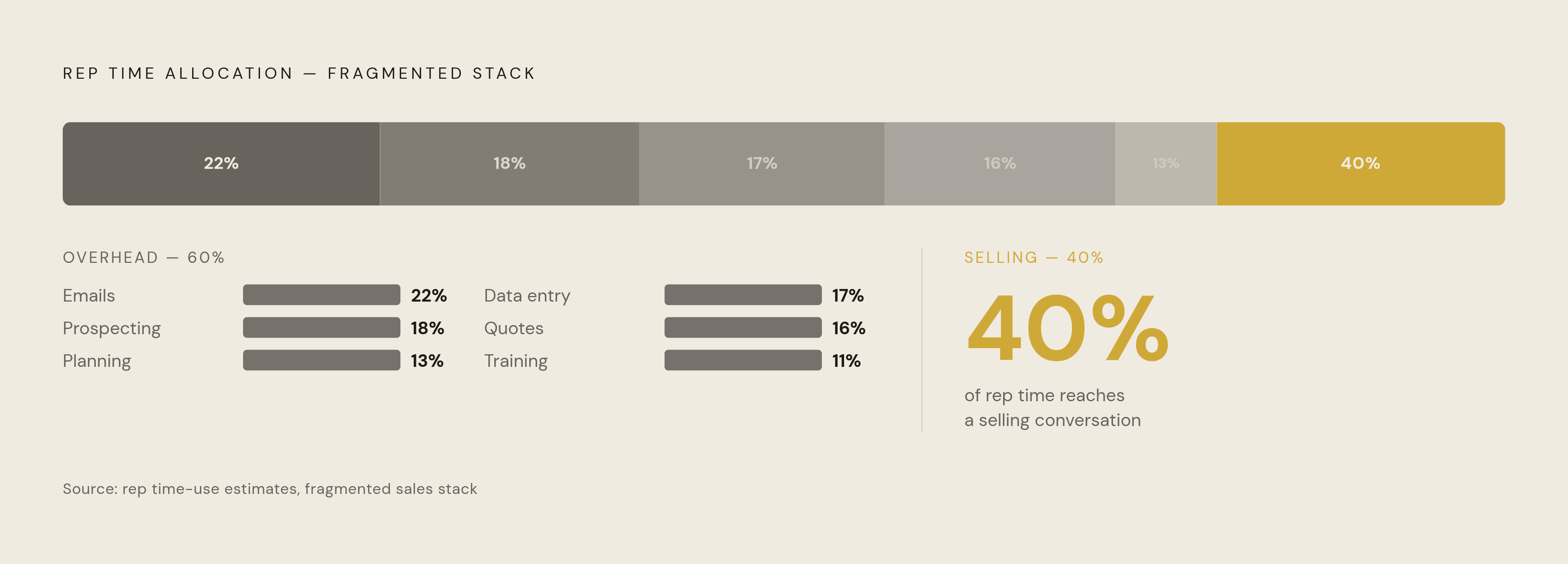
Start with the plainest number available: reps spend 60% of their working time on tasks that aren't selling. That splits out into writing emails (22%), prospecting (18%), manually entering data (17%), building quotes (16%), planning (13%), and training (11%). None of that is closing. None of it is even talking to a prospect. It's the overhead a fragmented stack imposes just to keep the machine running.
Other research points in the same direction from a different angle: reps lose substantial time each week to CRM updates, approvals, reporting, and call logging. That's not a rounding error in a productivity report, that's a significant portion of the week gone before a rep has said a word to a buyer.
Reps working across 10 to 13 platforms a day report feeling overwhelmed, 71% of them, because juggling that many systems produces the mistakes that follow. Reps working across 10 to 13 platforms a day report feeling overwhelmed, 71% of them, and that overwhelm doesn't just slow people down, it produces mistakes: missed follow-ups, outreach that's inconsistent from one prospect to the next because the rep lost track of which sequence they're in or which tool holds the latest note. Gartner has traced this straight through to quota. Seventy percent of sellers say they feel overwhelmed by the sheer volume of sales technology, and sellers who report that overwhelm are 43% less likely to hit quota. It's a documented chain: too many tools, cognitive overload, missed number. It's a documented chain: too many tools, cognitive overload, missed number.
The full financial cost of running a fragmented stack
Move past rep time and look at what the stack costs in dollars, and the picture gets worse, not better. A 2025 report analyzing 938 B2B companies put the average sales tech stack at 8.3 tools, running $187 per rep, and found that 73% of those companies had overlapping tool functionality wasting roughly $2,340 annually. That's licenses paying for capability that's already covered somewhere else in the stack.
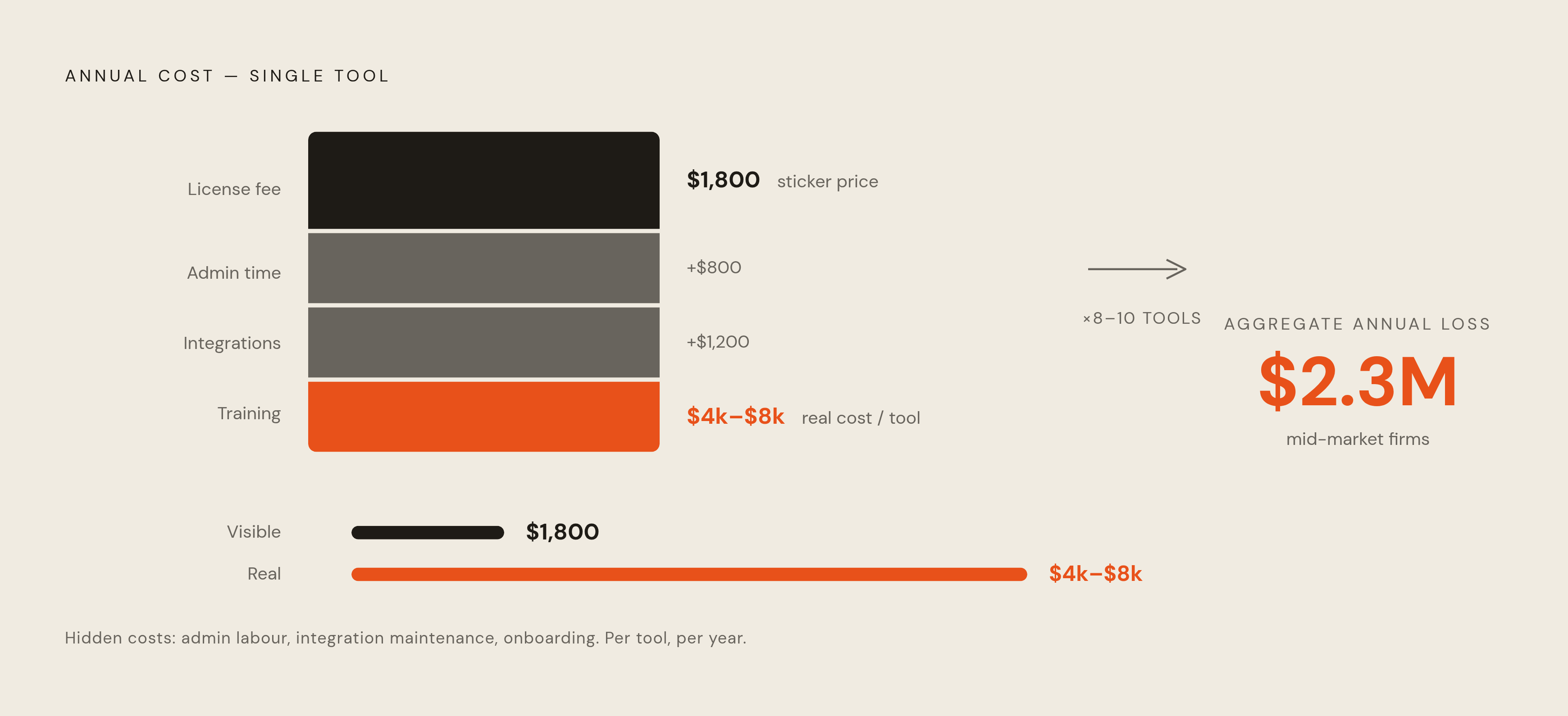
License cost is the visible part. The overhead isn't. Managing that sprawl, reconciling data between tools, chasing down why a lead in the CRM doesn't match the lead in the enrichment tool, training new hires on six systems instead of two, runs another 1 to 2 hours a week at roughly $100 an hour in loaded labor cost, according to the Forrester Tech Consolidation Report. That adds $300 to $800 on top of the license spend, pushing the real blended cost of the stack to somewhere between $1,300 and $2,800 per rep per month, and often higher.
Which is why the "cheap tool" is a trap: com's framing on this holds up, because a $150-a-month point solution looks like nothing on a budget line, but once someone counts the admin time, the integration babysitting, and the training cost, that tool runs $4,000 to $8,000 a year in real terms. Multiply that across eight or ten tools and the math stops being trivial. Mid-market firms lose an estimated $2.3 million a year, in aggregate, to software redundancy, the productivity drag it creates, and the support overhead needed to keep it patched together.
Why consolidation has become a strategic priority now, not a future agenda item
Something's shifted. The trend is visible in performance data: the teams already performing best have gotten there first, running 7 to 8 tools by choosing platforms that cover multiple functions instead of stacking point solutions on top of each other.
Finance is part of why this is happening now rather than later. A growing share of CFOs now require formal ROI justification for significant SaaS renewals, which means the conversation revenue leaders have been putting off is now a procurement requirement, not a nice-to-have. Nobody gets to quietly renew a tool nobody remembers approving anymore.
The deeper driver is AI readiness, and this is the one that changes the stakes. Research consistently finds that data strategy is a critical bottleneck for AI readiness, and a meaningful portion of organizational data sits inaccessible because it's locked in silos. Fragmented stacks are the reason. An AI agent can't build a reliable forecast, or run outreach with any intelligence, if contact data lives in one tool, engagement history sits in a second, and call recordings are stored in a third. Unified data is a precondition agentic AI requires. It's the precondition for the thing working at all.
How to audit a stack before deciding what to cut
Cutting tools without a map is how a team trades one problem for another. A cut made blind can strip out a capability nobody realized was load-bearing, and the fix afterward costs more than the tool did. The audit has to come first, and it runs in five steps.
Start by mapping utilization: every active tool, checked against who's actually logging in and what they're doing with it. This is where the dead weight becomes visible in the audit: tools that got bought for a use case that never materialized, or that three people on the team use out of a headcount of thirty. Then map the data flows: where does a record get created, where does it get updated, and where does it get read by a human trying to make a decision. This is where handoffs break.
Every time a lead moves from one system to another, from a data provider into the CRM, from the CRM into a sequencing tool, from the sequencer into a LinkedIn tool, that's a point where something can go wrong. Formatting breaks. A field doesn't map cleanly. The lead sits in an export file for six hours before anyone loads it into the next system, and by then the timing on an intent signal has expired. License cost doesn't show this. Only mapping the actual handoffs does, and in a stack with eight to twelve tools, there are a lot of handoffs to check.
From there, pick the anchor platforms, the one or two systems that cover the highest-value capability clusters, and everything else gets judged against whether it earns a place next to them. Assign clear ownership next: a RACI structure for who owns data hygiene, who administers each tool, who tracks adoption, split across Sales, Marketing, and Customer Success so nothing falls into the gap between departments. Then decommission on a real timeline, retraining the team on the consolidated workflow rather than hiring a specialist to babysit whatever's left.
It helps to think of the stack in seven functional layers: data and lead sourcing, contact enrichment, sales engagement, LinkedIn and social, CRM, calling and dialers, and AI and intent. Every tool in the stack should map cleanly to one of those. A tool that doesn't map to any layer, or that duplicates a layer another tool already covers, is a cut candidate by default.
What the replacement stack needs to cover by role
Fewer tools isn't automatically a win. If the evaluation happens at the platform level, "which vendor has the most features," instead of the workflow level, "does the SDR have what she needs to send an email without opening three tabs," consolidation can quietly strip out capability the team actually used. The right question isn't how many tools survive the cut. It's whether every role has what it needs in one place.
For an SDR or BDR, that means one source of verified contact data, full stop, no cross-checking a name in ZoomInfo against the same name in Apollo before hitting send. It means running a sequence across email, LinkedIn, and phone natively, inside one workflow, instead of manually stitching three tools together to touch a prospect three different ways. And it means intent signals and buying triggers appear inside the prospecting screen the rep is already working in, not in a fourth tool that has to be checked separately and manually cross-referenced.
For an AE, the requirement is context and visibility. Full engagement history needs to be there before every call, not scattered across tools the AE was never given a login for. And a standard pipeline forecast shouldn't require a RevOps analyst building a custom report every time a VP asks for one; if it does, the stack is failing the AE before the AE even opens it.
RevOps carries the broadest requirement. A single analytics view across email, phone, social, and chat turns attribution into something straightforward instead of a guessing exercise stitched together in a spreadsheet. Governance needs to work without a large team behind it: tools that function out of the box, not ones that need an integration engineer on staff to keep running. And every additional tool in the stack is another API to monitor, another data mapping to maintain, another security review, another contract to renegotiate at renewal. Cutting a tool doesn't just save the license. It removes an entire category of ongoing work.
What the platform landscape looks like for mid-market teams evaluating consolidation
For mid-market teams doing this evaluation, the sources point to a fairly consistent set of platforms, judged on prospecting, enrichment, engagement, CRM integration, AI capability, and fit for a team that isn't enterprise-resourced. The pricing sweet spot, per landbase.com, is around $59 to $150 per user per month, or a mid-market enterprise tier above that.
The.one 2026 guide names Apollo.io as one of the more accessible entry points for outbound data, particularly for US-focused teams. It covers prospecting, enrichment, multichannel sequencing, and CRM sync inside a single platform, which directly answers the stitching issue described above: replacing a separate data provider, a separate sequencer, and a separate intent tool with one platform removes the handoffs where data gets lost or attribution breaks. Apollo cites close to 100,000 paying customers on its own insights page. For RevOps specifically, the appeal is a single analytics view and data governance that doesn't require ongoing custom integration work between the prospecting and engagement layers.
HubSpot shows up on landbase.com's list of the top ten sales tech stack platforms for mid-market teams in 2026, and its relevance here is as a CRM anchor that extends into marketing automation and pipeline management, which cuts down the number of systems RevOps has to govern separately. It's evaluated, along with dozens of others, by landbase.com across more than 40 platforms on integration depth and mid-market fit.
Landbase.com's top ten list also includes Salesforce, and crono.one's 2026 guide notes it remains the most commonly used CRM system of record among mid-market teams running structured outbound, alongside HubSpot. Mid-market teams often end up paying for Salesforce complexity they never use, so the audit question is not whether Salesforce is a capable platform, since it is, but whether that CRM layer earns its cost relative to lighter alternatives built for a team this size.
The measured return from consolidation across cost, productivity, and pipeline
Put the pieces together and the return on consolidation appears in three places at once, not one. Cost drops first and most visibly: eliminating the overlap found in 73% of companies studied, and collapsing the $1,300 to $2,800 blended per-rep monthly cost into a single platform fee, is arithmetic a CFO can check in an afternoon. Productivity follows once reps get back a meaningful share of the 60% of their time currently lost to non-selling work, particularly the manual data entry and reporting that a unified platform removes by design rather than by discipline. Pipeline quality improves last: when the handoffs between systems disappear, so does the lag and data loss that used to sit between a signal firing and a rep acting on it, and when intent and engagement data live inside the same workflow reps already use, follow-up gets faster and forecasts stop being a guess dressed up as a number. None of these three gains is theoretical. Each one is the direct, traceable undoing of a cost documented above: less overlap, less overhead, fewer broken handoffs. Consolidation, done off a real audit rather than a budget mandate, is one of the few moves in revenue operations where the return is this legible.
Sources
- Why Are Revenue Teams Consolidating Their GTM Stack? | Apollo
- Best Sales Tech Stack For Mid-Market Sales Teams in 2026 | Landbase
- The Ultimate Outbound Sales Tech Stack for Mid-Market Teams (2026 Guide)
- Sales Tech Stack Bloated? How to Cut Tools and Boost Revenue 30% (2026) | Digital Sales Pro
- Sales Tech Stack Consolidation 2026: What Buyers Demand
- Tech Stack Consolidation: RevOps Playbook