Revenue Attribution Models for Multichannel Outbound Programs
Why your outbound budget decisions are based on broken data.
A $50,000 deal touches a LinkedIn ad, a cold email two days later, a discovery call, and closes three months after that. Whichever attribution model a team runs against that sequence decides which of those four touches gets credit, and which channel survives the next budget review. That is the entire stakes of this piece: not a measurement debate, but a funding decision dressed up as one.
Outbound is built to be multi-touch. Cold calls warm a name, email nurtures it, LinkedIn re-engages it, retargeting closes the loop. A single-touch model run against that architecture erases the coordinated sequence, replacing it with a single channel that happens to sit at the start or the end of it. Research consistently finds that most B2B marketing teams still lean on last-touch attribution despite near-universal agreement that it undercounts the journey. Most outbound budget decisions, in other words, get made on data that was structurally wrong before anyone opened a dashboard.
How the major attribution models distribute credit differently across the same outbound journey
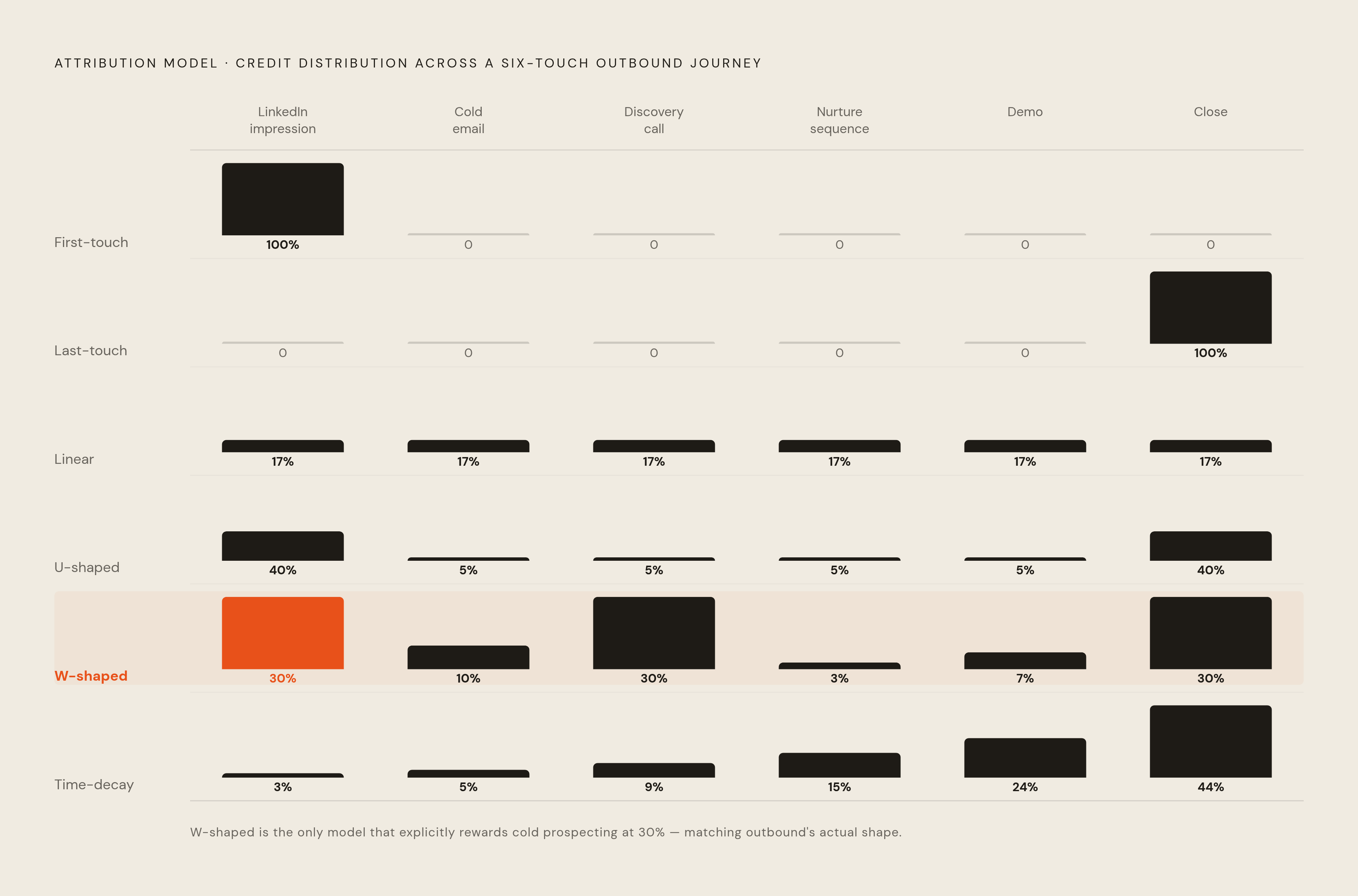
Take one prospect and run the same path through every model: a LinkedIn content impression, a cold email, a discovery call, a nurture sequence, a demo, then a close. Watch how differently each model tells that story.
First-touch attribution hands 100% of the credit to the LinkedIn impression. That is useful for a narrow question, namely which channels generate net-new pipeline, but it says nothing about what actually moved the deal forward and shouldn't drive budget on its own. Last-touch does the opposite, crediting the final sales call or demo in full and erasing the outbound motion that built the opportunity in the first place. Both are easy to build in most tools. Both also ignore the bulk of the buyer's actual path; that's the point Factors.ai's overview of revenue attribution makes.
Rule-based multi-touch models split the difference, with varying honesty. Linear attribution spreads credit evenly across every touch, which sounds fair until you notice it treats a cold email open the same as a booked demo. U-shaped, or position-based, attribution gives the largest shares of credit to the first and last touches and splits the remainder across whatever happened in between, which at least respects the two moments that matter most but still shortchanges the qualifying conversations in the middle.
W-shaped attribution is the model built for outbound's actual shape. Understory's outbound attribution research describes a model that assigns 30% to the initial prospecting touch, 30% to opportunity creation, 30% to the closing activities, and spreads the last 10% across nurture, demos, and proposals in between. That first 30% matters because position-based models concentrate weight on the bookends while linear models spread it evenly, and neither specifically recognises the cold prospecting touch that started the conversation. Time-decay attribution, which weights recent touches more heavily, works fine for short sales cycles but punishes the same early outreach for the crime of happening early.
Then there's data-driven attribution (DDA), which assigns credit based on each touch's measured effect on conversion probability rather than a fixed formula. Improvado's guide to multi-touch attribution notes that Google Analytics 4 made DDA the default and, in November 2023, demoted first-click, linear, time-decay, and position-based models to comparison-only status. Improvado's research also found data-driven models produce roughly 6% higher conversion outcomes than rule-based ones, but only where there's enough data to train the algorithm. The number that actually matters here: most platforms need 300 to 400 monthly conversions before DDA output can be trusted, and most mid-market B2B outbound programs never get close to that volume.
Lining the models up by what they reward and what they miss reveals a pattern fast. First-touch rewards awareness and punishes everything downstream. Last-touch rewards the close and erases the setup. Linear rewards participation and ignores weight. Position-based rewards the bookends and shortchanges the middle. W-shaped rewards prospecting, opportunity creation, and closing in equal measure, which is exactly outbound's shape. Time-decay rewards recency and penalizes the cold outreach that started it all. DDA rewards actual incremental influence, assuming there's enough volume to calculate it honestly.
Why outbound programs break standard attribution assumptions before any model is applied
Before any model gets applied, outbound already violates the assumptions most attribution tooling was built on. Start with time. B2B sales cycles commonly run 6 to 9 months and involve several stakeholders, yet plenty of attribution setups still default to 30- or 60-day windows. A deal that closes well after the attribution window has shut either gets credited to nothing or gets misattributed to whatever touch happened to fall inside the window, which is often a late, low-effort one that had little to do with actually winning the account.
Understory's research pegs the workable window for B2B SaaS outbound at 90 to 180 days, against the 30-day norm common in consumer marketing. That range is built to capture prospects who go quiet for months and then resurface, a pattern outbound programs run into constantly and one that a 30-day window simply cannot see. It's built to capture prospects who go quiet for months and then resurface, a pattern outbound programs run into constantly and one that a 30-day window simply cannot see.
Then there's the challenge of selling to a buying committee. Outbound rarely sells to one person. It sells to a buying committee: an economic buyer, a technical evaluator, someone in procurement, sometimes a champion who has no budget authority but plenty of internal influence. Attribution built around individual contact records misses this by design, tracking one person's clicks and calls while three other stakeholders quietly shape the outcome off the record. Getting this right means measuring at the account level and tracking cross-role engagement patterns.
Coordination is its own failure point. When paid media, SDR sequences, and LinkedIn outreach run as separate workstreams with separate tracking, the prospect experiences one continuous outreach effort while the systems recording it see three disconnected ones. The attribution chain doesn't bend at the handoff between channels, it snaps, and Understory's research points to unified measurement across every proactive touchpoint as the practical fix for this fragmentation.
A plainer, more mechanical problem causes all of it: sales engagement platforms like Outreach and Salesloft mostly live outside the CRM's native tracking, and most attribution tools don't integrate deeply with them. So the calls, emails, and LinkedIn messages that make up the actual substance of an outbound motion are also the touchpoints least likely to get captured cleanly. If a rep doesn't log an activity, or two systems don't sync, no attribution model downstream can fix that. The model is only ever as good as the activity data feeding it, and outbound's data has more gaps than most.
The dark funnel problem: what no attribution model can see in an outbound program
Even a perfectly built model only measures what gets logged, and a meaningful share of a B2B buyer's journey happens before any system logs anything. Research consistently finds buyers complete a substantial portion of their purchase process before ever talking to a sales rep. The cold email that a CRM marks as "first touch" may really be the moment a buyer who was already most of the way decided finally chose to respond.
Related research adds a sharper edge to that point: many B2B buyers already have a front-runner vendor in mind before the formal buying process even starts. For outbound teams, that raises an uncomfortable question about every logged "first touch." Did the cold email open the deal, or did it just land in an inbox that was already warm from something no dashboard recorded?
Dark social compounds the gap. SparkToro's research on dark social referrals finds that visits from TikTok, Slack, Discord, Mastodon, and WhatsApp arrive with no referral data at all and get logged as direct traffic, alongside a large share of Facebook Messenger visits. Peer recommendations and private community conversations drive real B2B pipeline, and none of it appears in any dashboard a marketing team can see.
Generative AI has opened a newer version of the same hole. A prospect who asks an AI tool to compare outbound platforms generates no attribution signal whatsoever, and that gap has grown as AI research tools have become more common in how buyers evaluate vendors.
Self-reported attribution is the closest thing to a patch. Research on B2B SaaS attribution has found that directly asking prospects how they heard about a company consistently surfaces pipeline that digital tracking never caught. For outbound specifically, that answer is diagnostic: a cold email that actually started the relationship and one that just happened to land after the buyer had already made up their mind elsewhere produce very different outcomes worth distinguishing.
None of this should paralyze anyone. It should calibrate expectations. Every model in this piece measures a slice of reality, and teams who know exactly which slice they're looking at make sharper calls than teams who mistake the dashboard for the whole picture.
Matching attribution model to sales cycle length and conversion volume
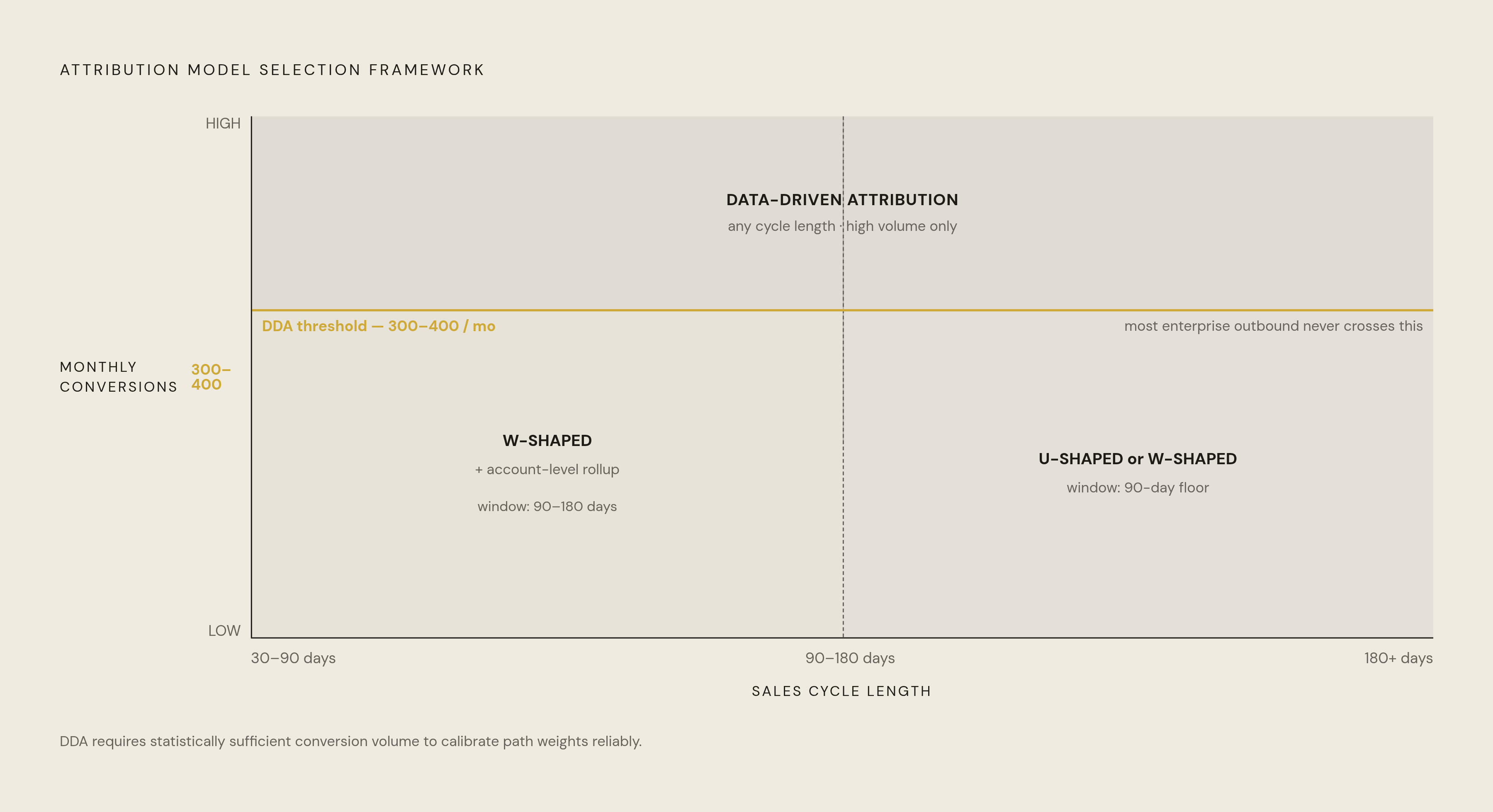
Model choice comes down to two variables: how long the sales cycle runs, and how many conversions happen each month. Team size, tech stack, and budget affect how a model gets implemented, not whether it's the right one to pick.
For shorter cycles, 30 to 90 days, demo-driven motions with moderate monthly volume, U-shaped or W-shaped attribution holds up best. Both the initial awareness touch and the conversion touch carry real weight in a cycle that short, and the middle genuinely does matter less. Time-decay looks appealing here but quietly punishes the early outreach that got the sequence moving. A 90-day attribution window is the floor; anything shorter will systematically undercount what actually happened.
Longer cycles, 180 days and beyond, with committee-based buying and a low number of annual deals, call for W-shaped attribution paired with account-level rollup. Understory's research shows that W-shaped fits because it credits prospecting, opportunity creation, and closing at 30% apiece, which are the three stages where outbound programs actually win or lose deals. Layer account-based attribution on top: aggregate every touch across every member of the buying committee, attribute it to the account rather than any single contact, and weight by role. DDA isn't an option here. The 300-to-400 monthly conversion threshold Improvado's 2026 research identifies as necessary for reliable algorithmic output is simply out of reach for most enterprise outbound programs, which don't close that many deals in a year, let alone a month. Understory's guidance puts the window at 90 to 180 days for these cycles, and for genuinely long enterprise sales, tracking first-touch in parallel is worth doing just to catch awareness sources that fall outside any window at all.
High-volume outbound programs are the exception where DDA earns its keep. Once conversion volume clears that 300-to-400 monthly threshold, Improvado's 2026 research shows data-driven models outperform rule-based ones by a measurable margin. That said, DDA's trustworthiness depends directly on the identity data feeding it. Match rates below 60% scatter a single prospect's activity across several "ghost" identities, and Improvado's research is blunt about the consequence: below that line, no model, however advanced, produces anything usable.
Zoomed out, the case for getting this right is significant. Improvado's 2026 figures show multi-touch attribution adoption climbing to 75% of companies, up from 58% in 2024, and that adoption tracks with a 14% to 36% improvement in cost per acquisition and an average 19% ROI lift in year one. Whether an implementation delivers those numbers or just sits there depends entirely on whether the model matches the cycle length and volume it's being asked to measure. For contrast, Gartner's UK Digital Marketing Survey found only 24% of UK B2B organizations currently run multi-touch attribution at all, a useful marker for any team trying to gauge where its own market sits on the maturity curve.
Why attribution alone cannot prove causation
Attribution answers a correlation question: which touches were present when a deal closed. It cannot show whether those touches actually caused that deal to happen. Treating the two as interchangeable is where a lot of budget gets wasted.
Brand search is the textbook version of this mistake. It reports high ROAS in nearly every attribution model, because the click on the branded ad happens right before conversion. Incrementality testing often shows that pausing a branded campaign produces little change in revenue, because those buyers were already searching for the company by name and would have converted regardless. Attribution rewarded a channel for being present, not for causing anything.
Webinars run into the same trap from a different angle. Marketing mix modeling might show webinar spend correlating with pipeline at the aggregate level, which looks like proof the webinars work. An incrementality lens on the same program can reveal a different picture: attendees may already be deep into active sales cycles before they ever register. The webinar may not have created the demand at all, simply appearing alongside intent that other channels had already generated. Without an incrementality layer to catch that, a team keeps funding the webinar and starves the content program actually doing the work.
The measurement setups holding up best in 2026 combine three layers rather than leaning on one. Marketing mix modeling gives a portfolio-level read on what's working across the program as a whole, built on aggregated data and privacy-safe by construction, which matters more every year as cookie-based tracking keeps eroding. Incrementality testing supplies the causal check: holdout experiments that isolate whether a channel changed buyer behavior or simply rode along with a conversion that would have happened anyway. Platform and multi-touch attribution round it out as the tactical layer, useful for the week-to-week optimization of individual sequences even though it can't answer the bigger causal question on its own.
MMM's return to relevance isn't incidental. Google open-sourced its Meridian tool in February 2025, following Meta's release of Robyn back in 2023, and the IAB published a vendor-neutral "Modernizing MMM" best-practice guide in December 2025, a strong sign the approach has gone from niche to standard practice. For B2B outbound specifically, that modeling has to treat pipeline and qualified leads as intermediate outcomes rather than modeling closed revenue alone, and it needs to account for a lag between the first outbound touch and the closed deal that can run months longer than anything in a typical consumer MMM setup. Porting over a B2C model wholesale doesn't work.
None of the companies actually getting measurable CAC reduction and ROI improvement have found a perfect attribution model, because one doesn't exist. What they've built instead is a model good enough for tactical decisions, backed by incrementality tests that catch its blind spots, backed further by qualitative data like self-reported attribution that fills in whatever the other two still miss.
Implementation prerequisites that determine whether any model produces usable data
None of this works without a data foundation solid enough to carry it, and identity resolution is the first load-bearing piece. Match rates below 60% scatter one prospect's activity across multiple "users" who are actually the same person, and according to Improvado's research, every model becomes unreliable below that line no matter how sophisticated the math behind it.
Marketing automation and CRM integration comes next, and it has to run both directions. Bi-directional sync between the marketing platform and the CRM is the foundation everything else sits on, according to Understory's research; without it, even a well-chosen model fails at the data layer before it ever gets the chance to prove itself.
UTM discipline is smaller in scale but no less consequential. Standardized naming across every outbound channel, paid ads, email sequences, LinkedIn outreach, is what makes cross-channel journey mapping possible at all. Inconsistent UTM tagging is where attribution chains break quietly, without triggering any alarm, which makes it one of the harder failures to catch after the fact.
Sales engagement platforms are the last, and thorniest, piece. Tools like Outreach and Salesloft sit outside standard attribution tracking by default, and there are three real ways to close that gap, each with a real cost. A CRM-centric approach has reps log every activity manually, which is simple to set up but only as reliable as rep discipline, and rep discipline is never perfect. Platform consolidation folds every touchpoint into one integrated system, trading some flexibility for a much simpler data flow. Understory's research finds that custom data pipelines, ETL feeds running from the sales engagement tool straight into a data warehouse connected to the attribution platform, deliver the most complete picture of the three, but they need real data engineering capability to build and keep running.
Choosing the right attribution model without any of this in place won't matter, since the output will still be noise regardless of which one gets chosen. The output will still be noise, just noise with a more convincing name attached to it.