AI Agent Memory and Feedback Loops in GTM Platform Design
Memory architecture is what separates pilot agents from production-ready revenue systems.
AI Agent Memory and Feedback Loops in GTM Platform Design. Effective GTM platform design now depends on treating AI agent memory and feedback loops as core infrastructure, not add-ons, because stateless agents that reset between sessions cannot learn from outcomes, personalize at scale, or compound intelligence across the revenue cycle.
Why stateless agents cannot serve as GTM infrastructure
Every API call to a large language model resets the context window, and when the session ends, whatever state existed goes with it, a hard reset with no persistence. That's the model working exactly as designed, and the distinction matters: memory is not something broken that needs fixing. It's the model working exactly as designed, and the distinction matters: memory is not something broken that needs fixing. It's an architectural layer that has to be built deliberately, on top of a model that was never going to remember anything on its own.
Skipping that layer costs money, and that cost appears fast in GTM workflows. A sales assistant agent or a sales-ops assistant spends the opening minutes of nearly every session re-establishing facts it already covered last week, down to details as basic as which database the deal data lives in. At enterprise scale, that re-establishment gets expensive in a literal sense: queries routinely burn 50,000 to 100,000 tokens re-injecting organizational context before the model does a single unit of reasoning. And the "same" customer often isn't the same customer at all, depending on which system answers the question. CRM, billing, support, and call transcripts each hold a different version of that account, and an agent trying to assemble a coherent picture at runtime inherits the latency, the stale fields, and the identity conflicts baked into that fragmentation.
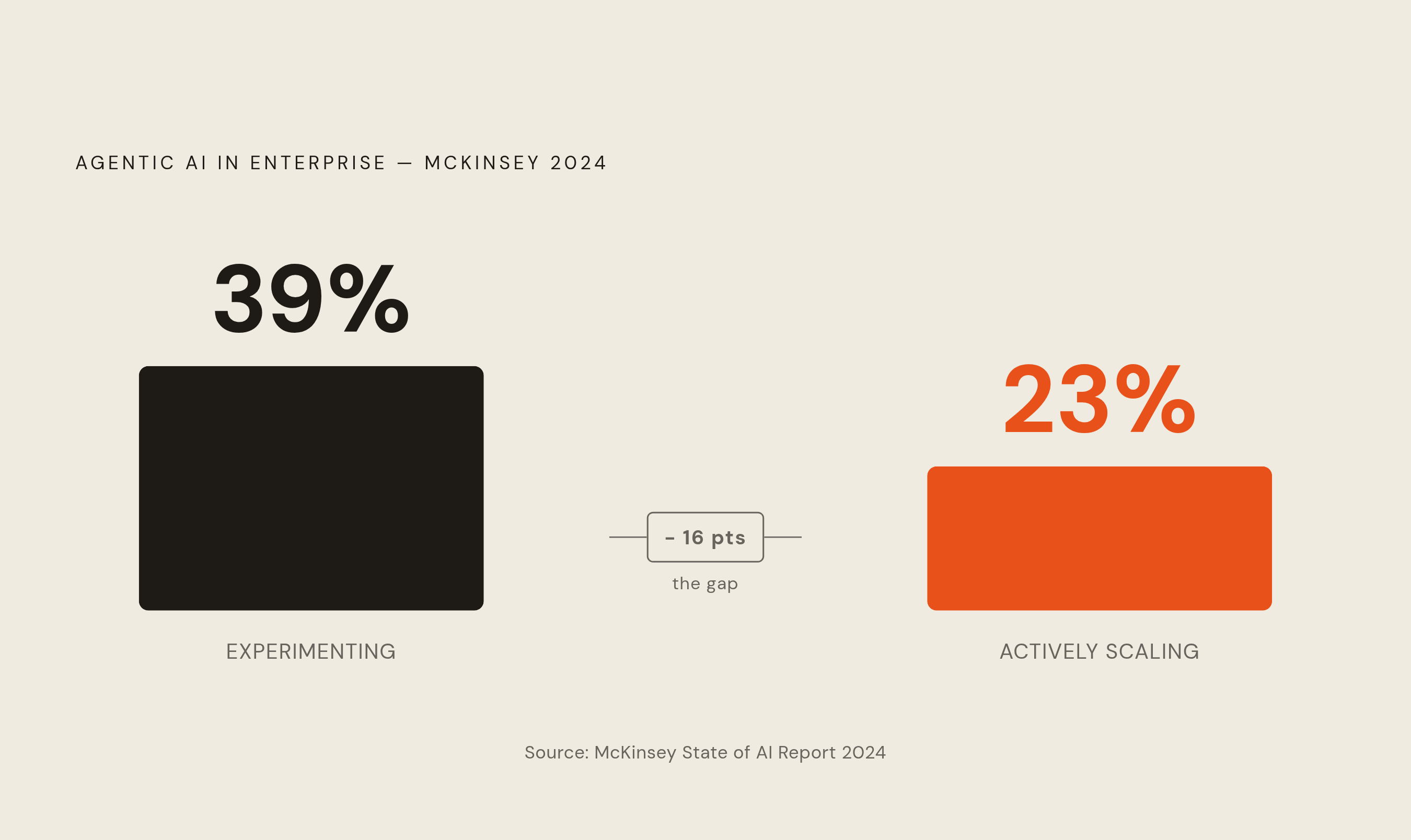
Gartner projects that 40% of enterprise applications will integrate task-specific AI agents by the end of 2026, up from less than 5% in 2025, one of the steeper adoption curves enterprise software has produced https://thenuancedperspective.substack.com/p/designing-agentic-memory-in-2026. Adoption and production readiness are not the same thing, though. McKinsey's State of AI Global Survey found only 23% of organizations actively scaling an agentic system in a business function, while 39% remain stuck in experimentation https://thenuancedperspective.substack.com/p/designing-agentic-memory-in-2026. That gap between piloting an agent and trusting it with a live revenue process is, in large part, a memory problem. Agents that can't retain what happened yesterday can't be handed anything that compounds, and this maps to the gap between the 23% of organizations actively scaling an agentic AI system and the 39% still experimenting, a gap memory architecture addresses. What this costs in practice for GTM:.
What memory architecture means in an agent system
IBM defines AI agent memory as the ability to store and recall past experience in order to improve decision-making, perception, and performance over time. That means memory gets added as a distinct system component, sitting alongside the model rather than inside it.
Think of that component in three layers. At the bottom sits storage infrastructure: vector databases, graph databases, relational stores, the physical containers. Above that sits the memory framework, the logic deciding what gets written, when it gets pulled back out, how it gets updated, and when it gets thrown away. Above that sits the purpose-built memory layer, the governed system that applies those rules in production, with access control, provenance tracking, and some notion of time built in. Most vendor demos only need the first layer, and that's precisely why so many of them look impressive on stage and fall apart in a live pipeline. Production GTM systems need all three, because a sales agent making a pricing recommendation in front of a real prospect has to be able to say where that number came from and how fresh it is.
The payoff for getting this right is not marginal. Memory architectures have been shown to lift accuracy by roughly 26% while simultaneously cutting latency and token cost, a rare case of a system improvement that doesn't force a trade-off between speed and quality https://thenuancedperspective.substack.com/p/designing-agentic-memory-in-2026. Better answers for less compute is why memory is moving from a research curiosity to a line item in enterprise architecture reviews.
A memory system, to function at all, has to perform five operations: storing, retrieval, updating, compression, and forgetting. Most engineering teams build the first two and stop. That's where the trouble starts. Without updating, an append-only store lets old and new versions of the same fact sit side by side indefinitely, and the agent is left guessing which one is still true. Without compression, retrieval quality quietly erodes as the store grows, because relevant signal gets buried under accumulated noise. Forgetting is probably the most underrated operation of the five: it's what keeps stale or simply wrong entries from clogging every future retrieval with garbage nobody bothered to clear out.
The four memory types mapped to the GTM revenue cycle
The academic scaffolding here comes from the CoALA framework, now the standard reference point for reasoning about agent memory, and from a 2026 survey of memory systems for LLM-based agents that extends the taxonomy to five cognitive types: sensory, working, episodic, semantic, and procedural. GTM platform design mostly lives in three of those, working, episodic, and semantic, plus whatever gets architected as durable long-term storage to support them.
Working memory is the active context window: the observations, retrieved facts, and tool outputs available to the agent for its current reasoning step. In a GTM setting, that's the live state of a deal, the call transcript in progress, the enrichment data just pulled, the tasks still open. It vanishes the moment the session ends, and that's not a flaw to solve with better retrieval. It's a budget problem. Every additional fact loaded into that window competes for finite space against everything else the agent needs to reason about right now. Stuffing in more context because more context feels safer floods the window and degrades the reasoning teams meant to improve.
Episodic memory is different in kind. It's the record of what actually happened and when: session logs, decisions made, actions taken, outcomes observed after the fact. This is what lets an agent stop reacting to each new deal in isolation and start reasoning by precedent, pulling on which outreach sequences worked for which persona, which objections came up at which stage, and what a specific account's buying committee actually said across its last three calls. The retrieval mechanism for episodic memory has to differ from the one used for facts, and this is where a lot of production systems quietly fail. Semantic similarity search, the workhorse of most vector retrieval, will happily rank a session that mentioned "pricing" in a passing aside above the actual pricing negotiation from two weeks prior, because the two texts look alike on the surface. Recency belongs in episodic retrieval as a first-class signal, not an afterthought bolted onto a similarity score.
Semantic memory holds the facts that don't change session to session: domain knowledge, standing preferences, hard constraints. A budget cap of $50,000, a stated preference for email over phone, the fact that the real decision-maker is a VP of Engineering and not a VP of Sales: none of that should need re-explaining by the rep every time a new session starts. This is the memory type retrieval-augmented generation was actually built for, and content-similarity search is the right tool for it, in sharp contrast to episodic memory where that same technique misfires. Mixing episodic logs into a semantic index degrades retrieval quality on both sides, because the index ends up optimized for neither temporal precision nor factual stability. Keeping the two separate isn't a nice-to-have engineering preference; an agent that knows the deal is capped at $50,000 does not need the rep to repeat that information, along with details like preferred channel being email and the decision-maker being VP Engineering not VP Sales, every session.
How feedback loops close mid-task
A standard prompt-response exchange runs in a straight line: input goes in, output comes out, done. An agentic system runs in a loop instead: observing, reasoning, acting, checking the result, repeating until it hits a goal condition or runs out of budget. That loop structure is what separates an agent from a chatbot with tool access, and it's also where most of the meaningful engineering happens.
The inner loop handles task execution, the observe-reason-act-check cycle most deployed agents live inside today. The outer loop kicks in when the inner loop gets stuck, and instead of retrying the same failed approach on repeat, it resets the plan. Microsoft's Magentic-One architecture makes this split explicit: a single Orchestrator agent runs an outer loop managing a Task Ledger for high-level planning, and an inner loop managing a Progress Ledger for execution. When the inner loop stalls, the outer loop rewrites the Task Ledger and generates a new plan, which is specifically what keeps the system out of what Microsoft calls "insistent failure," an agent stubbornly repeating a strategy that has already failed.
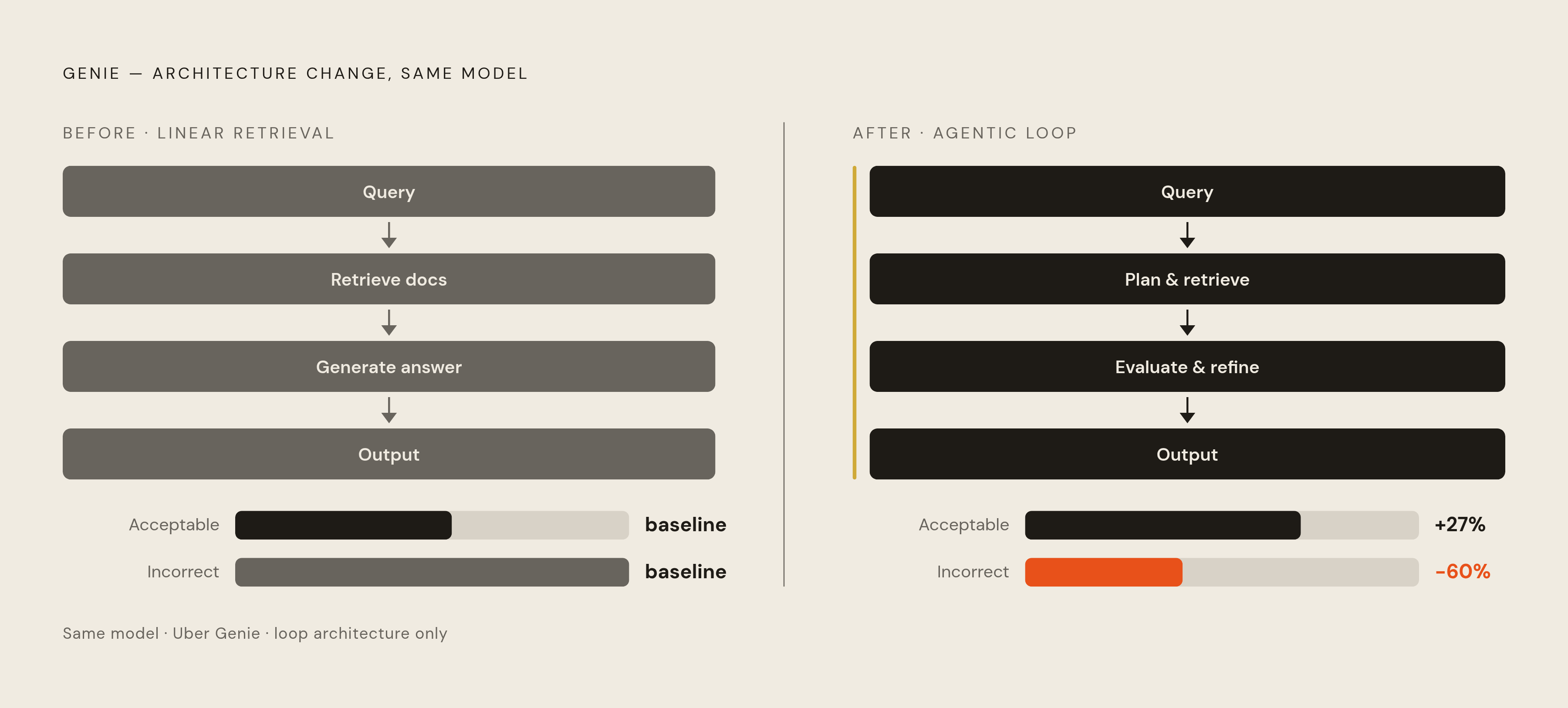
Uber's experience with its internal Genie tool is a useful data point on what that architectural shift is worth in practice. Rebuilding the tool from a standard retrieval pipeline into an agentic loop, same underlying model, different structure, produced a 27% increase in acceptable answers and a 60% reduction in incorrect ones https://revengine.substack.com/p/what-is-a-looping-agent-and-where. No model upgrade. Just a different loop, which is the whole argument in miniature: the intelligence gain came from architecture.
Improvement within a single run and improvement across separate runs are structurally different problems, and conflating them is where a lot of teams waste engineering time. Within a run, the Reflexion framework has an agent write a natural-language post-mortem after a failed attempt and prepend that note to its next try. On HumanEval, that technique alone took GPT-4's pass rate from 80% to 91% https://revengine.substack.com/p/what-is-a-looping-agent-and-where. It's cheap, and it works, but only inside the current session. It buys nothing for tomorrow's session, because there's no memory layer carrying the lesson forward. Getting an agent to run today, retain what it learned, and come back tomorrow measurably better requires memory architecture, full stop, and that's the specific engineering problem GTM platform design has to solve on purpose rather than hope emerges from a well-written prompt.
Five production memory architecture patterns and their GTM trade-offs
There isn't one correct memory architecture for GTM agents. There's a spectrum, and the patterns in production today span it from 72.9% accuracy at 17.12 seconds of p95 latency down to 66.9% accuracy at 1.44 seconds https://thenuancedperspective.substack.com/p/designing-agentic-memory-in-2026.
Pattern one is in-process, working-memory-only: everything the agent needs is in the context window, no external storage at all. It suits single-turn tasks well, one-shot enrichment lookups or research queries that don't need to remember anything past the current call. Its ceiling is hard and close: it can't personalize across sessions and can't compound intelligence over time. The pilot looks convincing and the six-month production deployment falls apart.
Pattern two is a flat external vector store, a single vector database doing top-k semantic retrieval. It's a solid fit for semantic memory: account facts, ICP definitions, product documentation, knowledge that doesn't shift week to week. As the store grows, retrieval quality drifts downward without compression or forgetting built in, and because episodic and temporal information need a different ranking approach entirely, a flat semantic store simply cannot serve episodic memory, no matter how it's tuned. Teams that try anyway end up with an agent that ranks a stray mention of pricing above the actual negotiation transcript, the exact failure mode described above.
Pattern three is tiered memory, the model popularized by Letta and MemGPT, organizing memory into hot, warm, and cold tiers that the agent itself manages. Main context functions like RAM; external storage functions like disk. Self-hosted deployments of this pattern typically run on PostgreSQL with the pgvector extension. It fits long-running account agents well, along with coding assistants built for GTM engineering teams and any stateful system expected to accumulate knowledge across repeated interactions rather than starting fresh each time. The trade-off is structural: this pattern tends to shape the whole application around it, since memory management becomes part of the agent's execution loop instead of sitting off to the side as an external service. That makes it far easier to design in from the start of a new build than to retrofit onto a runtime that already exists.
Before any of the accuracy or latency numbers, one question decides among these patterns: is the system being built a one-shot tool, a personalization engine, or something meant to get sharper the longer it runs? Answer that first. Teams that skip the question and go shopping for the highest accuracy score on a benchmark chart tend to end up with pattern two doing episodic memory's job badly, or pattern three bolted onto a task that never needed persistence in the first place. The accuracy-latency spread across these five patterns is real and merits study, but it only means something once the question of what the agent is for has already been answered. In Salesforce's State of Sales research, 83% of sales teams using AI reported revenue growth in the past year https://thenuancedperspective.substack.com/p/designing-agentic-memory-in-2026. 66% of sales teams that don't use AI reported revenue growth in the past year https://thenuancedperspective.substack.com/p/designing-agentic-memory-in-2026. There is a 17-point gap in revenue growth between sales teams using AI (83%) and those that don't (66%) https://thenuancedperspective.substack.com/p/designing-agentic-memory-in-2026. McKinsey's analysis estimates effective and scaled AI deployment can lift productivity by 3%–5% annually https://thenuancedperspective.substack.com/p/designing-agentic-memory-in-2026. On the STALE benchmark, the system marked stale facts as worth acting on only ~3% of the time https://thenuancedperspective.substack.com/p/designing-agentic-memory-in-2026. AlphaEvolve produced a 23% speedup on the FlashAttention kernel used to train Gemini https://revengine.substack.com/p/what-is-a-looping-agent-and-where. Sub-200ms retrieval at large graph sizes is claimed by Zep https://evermind.ai/blogs/8-best-ai-agent-memory-frameworks-for-developers-in-2026. Zep reports 94.7% on LoCoMo benchmark https://evermind.ai/blogs/8-best-ai-agent-memory-frameworks-for-developers-in-2026. Zep reports 90.2% on LongMemEval benchmark https://evermind.ai/blogs/8-best-ai-agent-memory-frameworks-for-developers-in-2026. The average number of new GTM engineering job listings per month in 2025 was 100 https://www.aibuilderclub.com/blog/gtm-engineering-guide. Deepline's walkthrough shows that combining skip tracing and public datasets for identifying restaurant owners achieved a hit rate of 77 to 79% https://www.aibuilderclub.com/blog/gtm-engineering-guide.