B2B Contact Database Decay Rates and Refresh Cadence Planning
Field decay rates vary sharply, making one refresh schedule ineffective.

- Written by
- Priya Subramaniam
- Published
- November 2, 2026
- Reading time
- 8 min read
What this covers
B2B contact database decay rates and refresh cadence planning are inseparable. A useful refresh schedule must follow how quickly individual fields become unreliable, rather than treating every record as a single perishable unit. How often checks run should depend on field volatility, sector and record priority, with job changes, bounces and campaign sends triggering verification between checks.
Why B2B contact data decays faster than most teams assume
A stale CRM record looks like a correct one until an outreach attempt exposes the difference. An old email address still sits in its cell, and an out-of-date title still passes through targeting filters. The record gives no visible warning by itself.
Human mobility drives much of this degradation. Job changes, promotions and restructures alter the relationship between a person, a role and an organization. A single departure can invalidate an email address, a direct phone number, a job title and a reporting structure together. Acquisitions, rebrands and closures can affect whole groups of records, so decay often arrives in clusters.
Employee tenure does not provide a safe refresh interval. The BLS Employee Tenure in 2026 release places median tenure at 4.1 years in January 2026, up from 3.9 years in January 2024. That measure describes time with an employer. Promotions and restructures can change the details used for outreach even when an employee stays with the company.
Which fields decay fastest and why the rate differs sharply across them
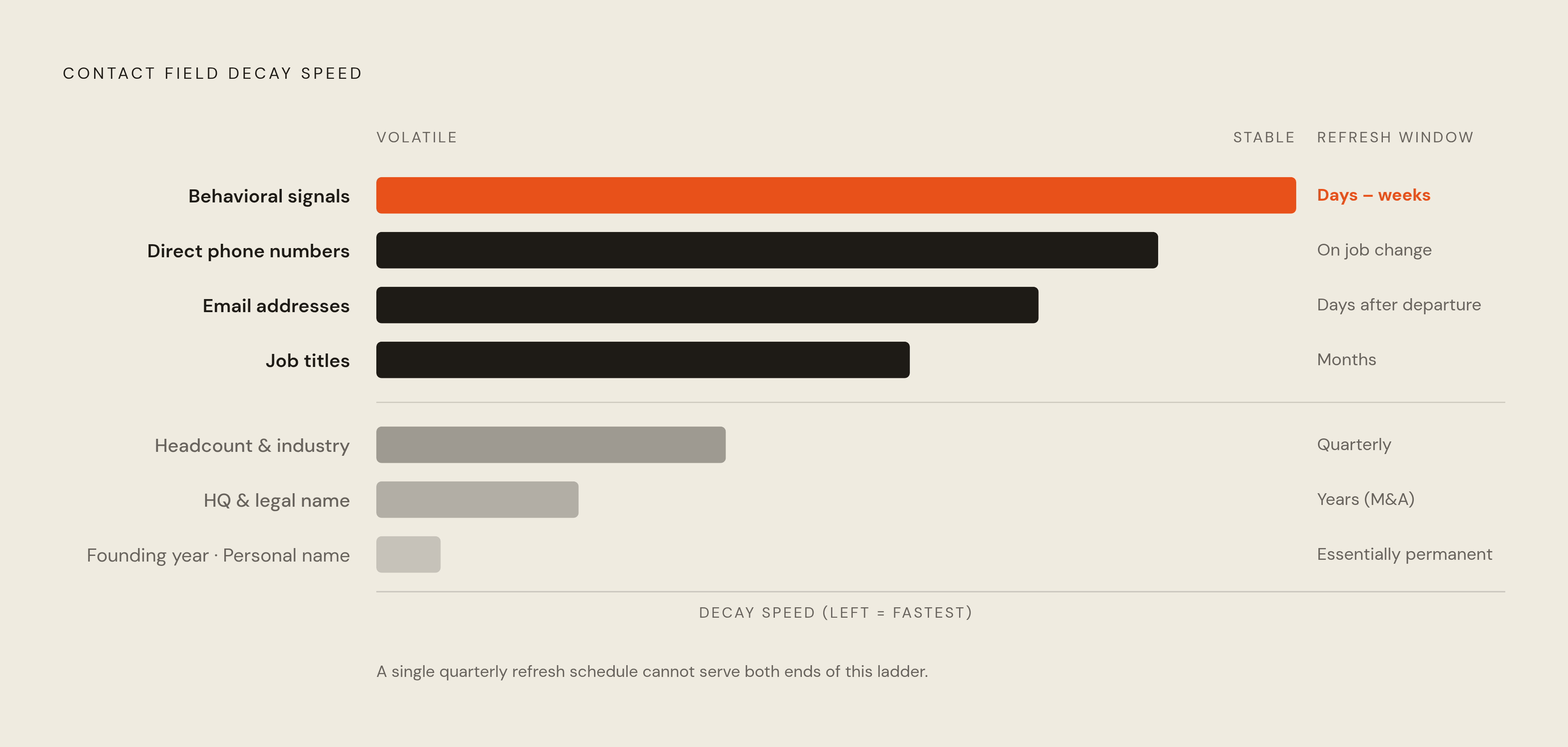
Behavioral and intent signals have the shortest useful life. They can expire within days or weeks, making them a separate category from structural contact details. A signal may have been accurate when captured but no longer describe current interest.
Among structural contact fields, direct phone numbers are especially volatile. Derrick’s 2026 benchmark identifies them as the most volatile contact field because they are tied to a particular role and desk. A job change can invalidate the direct line even when the person remains reachable on mobile. Email addresses are also highly exposed, as they are typically deactivated within days of departure. Email is therefore often the first clear sign that other fields in the record have gone stale too.
Job titles change through promotions, restructures and role eliminations, including changes that leave an email address working. Reachability is not the same as targeting accuracy. Firmographics tend to change more slowly than these contact fields, but some attributes change much more often than others. Headcount and industry classification drift as companies grow or pivot, while headquarters and legal name change with relocations and M&A.
Founding year is essentially permanent, and personal name is among the most stable contact attributes. These fields form the slow end of the hierarchy. Their accuracy can make a record look sound even when its role-and-organization details are wrong. A field-level assessment therefore distinguishes completeness from fitness for outreach, rather than allowing stable attributes to mask volatile ones.
How sector and seniority create multiple decay curves inside a single database
A database containing both SaaS and manufacturing contacts does not age uniformly. Technology and SaaS contacts face frequent role changes, acquisitions and company rebranding, while manufacturing and government contacts generally sit in more stable workforces. The SaaS segment may degrade at several times the rate of the manufacturing segment. A quarterly refresh for both groups treats them as though they change at the same rate.
That creates two errors at the same time. The stable segment receives checks it may not yet need, while the volatile segment accumulates errors between scheduled updates. Aggregate accuracy can conceal the imbalance because healthier records dilute the visible effect of a deteriorating segment.
Seniority adds another dimension within each industry. A promotion can change a contact’s place in a seniority-based audience without changing their employer. Teams therefore need to check roles and titles even where people tend to stay with the same employer. The database is better understood as a portfolio of segments, each with a different exposure to change, than as one population governed by one decay curve.
What stale data actually breaks downstream — and why AI amplifies the damage
Stale data consumes sales capacity before it becomes a reporting problem. Apollo’s analysis describes reps spending significant time re-verifying records and conducting manual research, taking time away from outreach. Routing then compounds the loss. A contact who moved from marketing into sales can keep receiving marketing nurture, while a company that grew into enterprise remains in a mid-market workflow.
Reporting inherits those errors. Duplicates split activity across profiles, and departed contacts remain attached to accounts they have left. Forecasting and budget decisions then rely on a picture of the account that is wrong. A working workflow is not evidence of accurate data.
AI increases the speed and reach of this failure. For teams already using AI sequences or lead scoring, this is a present operating risk. A model does not inherently recognize that an input field is stale, so it can use an obsolete value as the basis for action. The ability to generate thousands of tailored messages in minutes can therefore produce thousands of personalized errors.
Scoring models can prioritize accounts using outdated firmographics, while personalization references strategic initiatives from prior fiscal years. More capable execution acts on the underlying premise faster and across more records.
Even a correctly filtered segment of senior technology decision-makers quietly loses the buyers it was meant to reach as people change roles. The filter still operates on the stored values, so its technical correctness conceals the audience’s deterioration. Without verification of the underlying fields, targeting logic cannot distinguish the intended buyer from an outdated description of that buyer.
Why a single refresh cadence always miscalibrates against a field-differentiated decay curve
A quarterly database refresh applies one interval to at least five distinct decay speeds. Re-verifying a founding year monthly has little value, while trusting a direct phone number for a year leaves a volatile field unchecked. Running the whole cycle more often would take more work and leave that mismatch in place.
Vendor terminology can obscure the same problem. Datamagnet’s 2026 benchmark identifies ambiguity in “continuous” refresh claims, including providers that actually update records quarterly. Accuracy claims also commonly describe the point of verification. A correct check does not guarantee that the value remains correct when a campaign begins.
The objection to continuous enrichment deserves a direct answer. It can be expensive and difficult to audit, particularly if every field receives the same treatment. But universal continuous enrichment is not the only alternative to quarterly cleanup. A tiered model checks fields often when they change quickly and are in active use, with more time between checks for stable attributes.
Derrick’s benchmark frames accuracy as a moment. A check made today gives fresh evidence that a contact is accurate, but six months later that same contact has only the old check to back it up. The architecture must account for that elapsed time as well as the field’s exposure to change. Scheduled verification provides the baseline, and event-driven checks address changes that do not respect the calendar.
A field-level refresh cadence framework — matching interval to decay rate
A practical framework begins with field volatility, then adjusts for industry and record priority. These intervals are planning defaults. Behavioral and intent signals should be re-evaluated within days to weeks of capture and should not remain active beyond their natural expiration window. Direct phone numbers and email addresses in active pipeline records need to be verified before a campaign, and those in high-velocity segments need checks at least monthly.
Job titles need to be checked when inbound leads enter the system, each month for active prospects and again when a job-change signal appears. Firmographics can usually follow a slower baseline. Headcount and industry classification warrant quarterly audits because they drift more slowly but still affect segmentation. Headquarters city, founding year and legal name can follow annual or event-triggered review, with relocations and M&A prompting checks before the annual cycle.
A monthly enrichment baseline is appropriate for technology and SaaS segments because of their greater exposure to organizational and role changes. Record priority provides another adjustment. Apollo’s operating model framework calls for hot pipeline records to be verified each month, or each week for Tier 1 active pipeline contacts. Its broader recommendation for monthly enrichment concerns high-value prospects and active pipeline contacts, rather than a recommendation limited to named verticals.
The full database still needs a quarterly audit covering deduplication, suppression and re-enrichment of cold segments. Inbound leads require enrichment and normalization at form fill, in real time. An annual governance review should revisit field strategy, SLA ownership and refresh responsibilities. Each of these checks has a different job, so pre-send checks and real-time intake validation are still needed alongside a quarterly audit.
When a job change, hard bounce, intent spike or campaign send is detected, it should trigger a check of the fields involved. Datamagnet’s benchmark favors trigger-based checks because decay is unevenly distributed over time. The schedule catches routine drift, while triggers bring checks forward when there are signs of change or a record is about to be used.
A specific record’s last verification date deserves scrutiny. Validation depth also deserves scrutiny. The same benchmark identifies SMTP-only email checks as structurally limited because they can label genuinely inconclusive results as valid. It reports that layered validation, including SMTP, carrier lookup and human review where warranted, outperforms single-method checks.
How to implement and sustain the cadence as an operating model, not a cleanup project
Implementation begins where data enters the system. Real-time validation and normalization at form fill prevent defects that cost more to correct after entry. That control establishes a sound starting point from which scheduled and triggered verification can maintain the fields that outreach and routing depend on.
Verification at the moment of use addresses a different gap. An enrichment API that actually re-verifies a record at request time removes the interval between that check and the request. A stored snapshot cannot offer the same recency merely because it was accurate when saved. Manual research still has a role for high-stakes named accounts, but automated enrichment must handle the volume layer if maintenance is to scale.
Ownership and measurement keep the cadence operational. Field-level accuracy rates, bounce rates by segment and the age distribution of last-verified dates show where maintenance is slipping. Database-wide averages alone are not enough. Annual governance reviews should reassess SLA ownership and refresh responsibilities, while the operational metrics guide attention between those reviews.
Tooling must support both scheduled checks and programmatic triggers. Apollo’s operating model framework describes always-on hygiene through pre-send, inbound, monthly, quarterly and annual actions. The platform is one example of the relevant category, combining a continuously enriched contact database with enrichment integrated into the outreach workflow. The selection criterion is whether those capabilities support the required field-level intervals and point-of-use checks.
The framework creates value only when these controls become routine. A cadence documented in a spreadsheet and reviewed annually is not an operating model. Keeping data accurate takes clear responsibility for checks, a way to measure how long it has been since verification and checks built into the points when records enter the system or drive action.