Routing Inbound Leads to the Right Rep Using Enrichment Data
Enriched data is the foundation that makes lead routing actually work.

- Written by
- Marcus Thibodeaux
- Published
- October 15, 2026
- Reading time
- 12 min read
What this covers
The problem isn't volume, and it isn't rep performance. A routing engine is only as good as the fields it reads, and the fields available at the moment of form submission are almost never sufficient to make a defensible assignment decision. A typical inbound form captures a name and a work email. From those two data points, a rules engine cannot determine company size, territory, ICP tier, or account ownership, which are the four inputs every routing decision actually requires. The system isn't failing to route. It lacks the raw material to route correctly.
The data that does arrive is often stale before it's captured. A contact who submitted a form with clean data six months ago may now work somewhere else, at a company that has since been acquired, under a title that no longer exists. What sits in the CRM record is a snapshot, not a live signal.
Misrouting is the quiet consequence. A lead lands with the wrong rep, the wrong territory, or the wrong sequence because a firmographic field was empty or stale. The failure traces back to the data, not to any rep's follow-through. Until the record carries enough verified context to feed a routing decision, every assignment engine downstream inherits the same blind spot.
What enrichment actually appends, and why those fields are the ones routing logic needs
Enrichment is not a research convenience bolted onto the sales motion. It is the production layer that supplies the specific fields routing rules consume: company size, industry, revenue range, tech stack, funding status, seniority, and account match status. Each of those fields maps to a discrete routing decision, which means enrichment and routing are not separate workflows. They are two stages of one system.
The argument for which fields matter is a matter of specificity. Not everything an enrichment provider appends is useful at the moment of assignment. Six categories carry the load, each unlocking a distinct decision.
Contact data determines the seniority tier and the rep assignment level. A vice president of sales at a mid-market company warrants a different first touch than a manager at an enterprise account, and verified title is the field that makes that distinction possible. Without it, the routing engine can only guess, and it guesses wrong often enough to matter.
Firmographic data drives territory and ICP-tier routing. Company size, revenue band, industry, and headquarters location are the raw inputs for geographic assignment and tier classification. A rules engine that lacks these fields cannot place a lead in a territory or score it against the ICP, regardless of how sophisticated the remaining logic is.
Technographic data routes leads to specialist reps or into competitive sequences. A lead whose stack matches an integration partner belongs in a different sequence entirely. The stack information is the trigger that determines which sequence fires.
Intent signals and behavioral data operate differently from the structural fields above. A contact who visits the pricing page repeatedly or downloads a competitive comparison is signaling in-market status, and that signal should override the default tier placement. Behavioral data extends the same logic across the lifecycle, triggering stage-based routing rather than only initial assignment.
The takeaway for anyone designing a routing pipeline is that enrichment serves two masters at once. It qualifies the lead, and it segments the lead. Both operations feed the same downstream engine, but they require different fields, and conflating them produces logic that looks comprehensive on paper and fails in production.
How a pre-handoff enrichment gate works before any rep sees the record
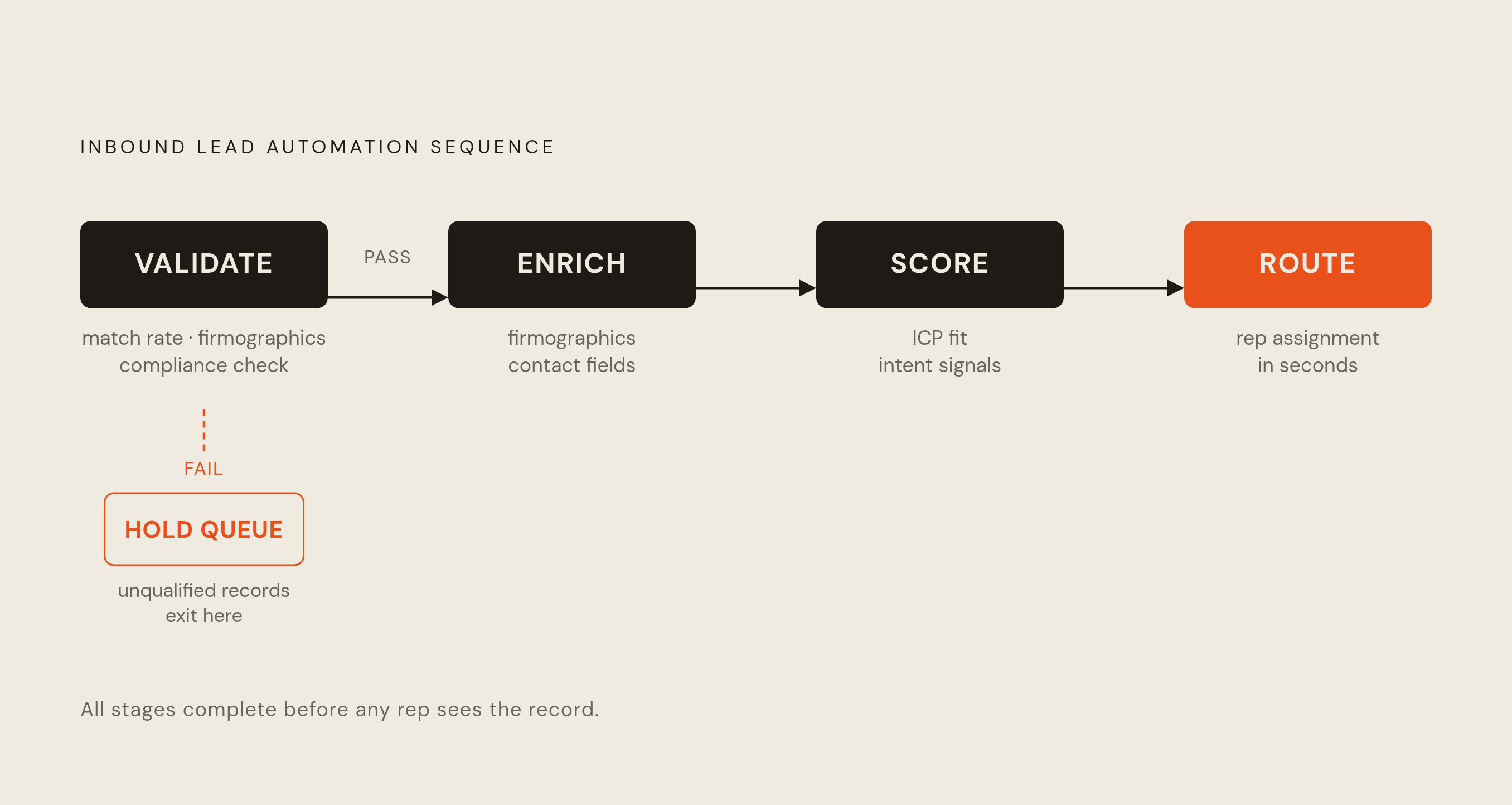
The mechanics matter because the timing does. Contacting an inbound lead before conversion probability drops is a race measured in minutes, and any process that requires human research inside that window loses the race before it starts. The answer is a pre-handoff enrichment gate: an automated checkpoint that every inbound lead passes through before CRM assignment, with no human touching the record until the sequence completes.
The sequence has four stages: validate, enrich, score, route. The API response returns firmographic and contact fields, which are written to the CRM record. All of it happens within seconds.
Apollo's 2026 pre-handoff enrichment guide describes this as event-driven architecture, and the distinction from nightly batch syncs is operational, not cosmetic. By the time the enrichment lands, the moment of highest intent has already passed. Event-driven enrichment compresses that window to the network latency of an API call.
The gate also serves a filtering function that is easy to overlook. Leads that fail validation thresholds, whether for low match rate, missing key firmographic fields, or compliance flags, enter a hold queue rather than being pushed to reps. That single design choice prevents SDRs from working unqualified or unconsented records, and it keeps the routing engine clean by ensuring that only records which passed validation ever reach the assignment stage.
The architecture is replicable precisely because it is linear. A reader should be able to sketch it on a whiteboard as four boxes and four arrows: form, webhook, enrichment API, scoring engine, routing rule, rep. The sophistication lives in the sequencing, not in the number of components.
The routing cascade: how enriched signals map to assignment rules in priority order
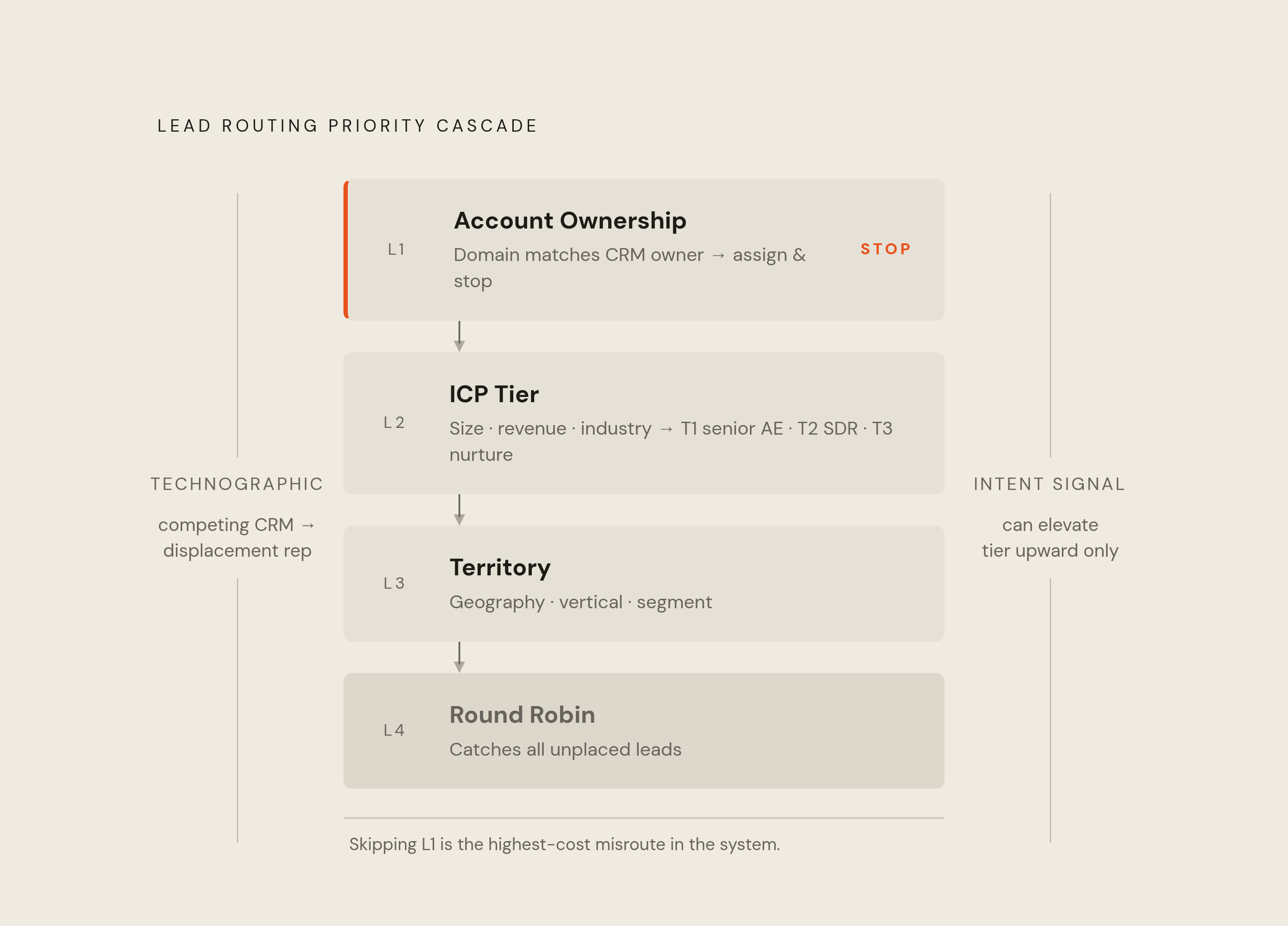
Enrichment does not route leads. It feeds the rules engine that does, and the rules must be layered in priority order or the logic collapses on edge cases. The cascade that follows is a decision tree, not a menu. Each layer activates only if the layer above it failed to resolve the assignment.
Account ownership wins first. If the inbound lead maps to an existing account with an assigned owner, the lead goes to that owner, full stop. Territory and tier are irrelevant at this layer. Account match is the highest-priority signal because a current customer or an active opportunity reaching a new-business rep represents a failure that no downstream scoring can repair. The check requires company domain data, which is exactly the field enrichment supplies.
ICP tier wins second. With account ownership unresolved, the rules engine classifies the lead by tier. Scoring a lead into a tier without company size, revenue, and industry is guessing dressed up as automation.
Territory wins third. Only after ownership and tier are both resolved does geography, vertical, or segment-based assignment take over. The reason for the ordering is that territory logic optimizes rep workload, while ownership and tier logic optimize revenue. Workload optimization should never override revenue optimization in the same rules engine.
Round robin breaks ties. The round robin is not a strategy. It is the mechanism that catches what the cascade could not place, and it should be last precisely because it is the least informed assignment available.
The expanded role of ICP-tier routing is a direct consequence of enrichment economics. Enrichment has become cheap enough to score every lead at intake, not just the ones that look promising on form data alone. That means classification can now happen before assignment, universally, rather than selectively.
Two modifier layers sit alongside the main cascade. The routing rule should reflect that elevation. Technographic signals route laterally: a lead on a competing CRM goes to a displacement-trained rep, while a lead on an integration partner's stack goes to a different sequence entirely. ZoomInfo's inbound lead generation guide makes the underlying point explicit when it specifies that routing and follow-up speed are what determine whether high-intent leads become pipeline. The cascade is the operational mechanism that converts that principle into assignments.
Where routing breaks even with enrichment in place
Enrichment-driven routing fails in predictable ways, and planning for those failures is as important as building the cascade itself. Each failure mode is better understood as a design requirement: something the system must be built to withstand, not a reason to distrust the approach. Match rate is the first failure point. If a lead's company name is incomplete, misspelled, or submitted as a personal email address, the enrichment API cannot find a match. An unenriched record then routes on empty fields, reproducing the exact misrouting the system was built to prevent. The enrichment gate protects against this partially through the hold queue, but the queue itself is an admission that some percentage of inbound traffic will never be enrichable at intake.
Domain variants and subsidiaries break account ownership matching. A lead from a subsidiary's email domain may not resolve to the parent account, which sends an existing customer to a new-business rep even though the CRM contains the account. The ownership check fails because the matching key, the domain, doesn't align with the entity structure.
Field standardization failures corrupt scoring. "VP of Sales," "Vice President, Sales," and "Sales VP" are the same role but can be treated as separate values by a scoring model that has not normalized job title taxonomy. The result is a systematic skew in ICP-tier assignment: identical seniority gets scored differently depending on how the title was entered.
Timing dependency is a structural risk. The enrichment that arrives moments later does not re-trigger routing. The lead sits in the wrong queue indefinitely, and the sequencing error is invisible unless someone audits the pipeline.
Compliance creates a silent failure mode. When enrichment appends data to one record while a duplicate unconsented record moves through the pipeline untouched, consent is recorded on the wrong object. Routing proceeds on a record that should have been held, and the violation is often undetectable without an explicit consent-verification rule.
Fallback logic is not optional. Without explicit fallback rules, leads drop silently. The cascade just described handles the common paths, but edge cases are a structural feature of inbound routing, not an anomaly.
The operational answer to several of these failures is cross-signal reasoning. ZoomInfo's enrichment tools guide positions it as a key differentiator that replaces the manual CSV joins across multiple systems that teams relying on competitors or DIY enrichment stacks must perform. Reasoning across signals means the system can use secondary data to resolve what primary fields leave ambiguous, which is precisely what the failure modes above demand.
What the enrichment pipeline looks like when it runs end to end: a concrete example
The architecture described in the previous sections produces measurable gains in production, and the pattern across the documented cases is consistent. The operational win comes from eliminating the manual step between enrichment and routing, not from better data alone. Zendesk used LeanData for routing automation and saw a compression in lead routing time from 45 minutes to about eight minutes, an 82 percent reduction. The reps were not working faster. The gap between form submission and assignment simply closed.
Kintsugi, using Surface, automated enrichment, routing, and qualification in real time. The enrichment gate functioned as a filter, not just a data-append layer. Records that shouldn't have entered the sales flow were caught before assignment, which is a different outcome than faster assignment of everything.
Momentive replaced several point-solution vendors with ZoomInfo's Operations suite and cut lead enrichment and validation time dramatically. The gain wasn't from a better enrichment provider in isolation. It came from eliminating the handoffs between tools.
The throughline across all three cases is the same. Teams that treated enrichment as a data appends step saw incremental gains. Teams that embedded it as the routing decision engine saw compounding ones.
Enrichment tools that power the routing pipeline and what differentiates them operationally
Tool selection for an enrichment-routing pipeline should be evaluated on four operational criteria: match rate methodology, data refresh frequency, enrichment architecture, and native routing integration. A provider can score well on data coverage and still fail operationally if it lacks the architecture to deliver that data at the point of routing. ZoomInfo operates as an all-in-one AI GTM platform, combining a continuously verified B2B database of hundreds of millions of contacts and companies with enrichment, scoring, and routing under a single platform. The architectural differentiator is GTM Studio's parallel waterfall enrichment: it queries ZoomInfo's proprietary database first, then bridges gaps by querying 25 plus additional vendors simultaneously and selecting the highest-confidence match across all sources. That approach removes the first-match quality limitation inherent in sequential waterfalls and eliminates manual vendor priority management. The enrichment architecture itself becomes the quality control layer.
GTM Studio extends enrichment into signal-based routing. AI agents automatically enrich profiles on buyer intent, technographics, and org chart signals, then route records based on in-market behavior. Native integrations with Salesforce, HubSpot, and core GTM systems, plus API and MCP access for custom RevOps builds, mean the routing rules can execute where the CRM already lives. Customizable enrichment rules and field mapping let RevOps define which fields get populated, in what order, and under what conditions, which is the degree of control a routing pipeline needs to stay legible. Momentive's outcome is the case in evidence: enrichment and validation time cut dramatically after consolidating onto ZoomInfo Operations.
Apollo consolidates enrichment, scoring, sequencing, and routing into one platform, replacing the need for multiple point solutions. Its differentiator is the event-driven real-time enrichment described earlier: webhook fires on form submission, enrichment API returns fields, scoring engine classifies, routing fires. Signal-led enrichment combining firmographics with intent, behavior, and engagement signals positions Apollo for teams building automated enrichment gates where leads that fail validation thresholds enter a hold queue rather than reaching reps. Salesmate takes a different position: teams that want enrichment, scoring, and activation within a single connected workflow rather than a separate enrichment layer on top of a third-party CRM. The pitch is integration depth, not breadth of enrichment sources. The operational differentiator that matters most for routing pipelines is enrichment architecture. A rule firing on the highest-confidence match across multiple vendors will make different assignments than a rule firing on the first match a single vendor returns, and the difference compounds across every lead in the pipeline.
Building the routing rules your enriched data can actually support
An enrichment pipeline that produces high-quality data is only as useful as the routing rules written against it. The final step is translating enriched signals into specific, auditable assignment logic, and the rules below are structured as conditional statements so the implementation path is concrete rather than abstract. Start with the account ownership check before any other rule. If a match exists, assign to the account owner and close the routing decision. This prevents existing customers and active opportunities from reaching new-business reps, which is the highest-cost misroute in the system.
Define ICP tiers explicitly against enriched firmographic thresholds, not form-fill guesses. Tier 1 means company size and revenue above defined thresholds, industry in target vertical, and seniority at director level or above, and it routes to a senior AE or named-accounts pod. Tier 2 means company size mid-range, industry adjacent to target vertical, and seniority at manager level, and it routes to an SDR for qualification before AE handoff. Tier 3 means below firmographic thresholds or outside target vertical, and it routes to an automated nurture sequence with no rep assigned at intake.
Layer intent and behavioral signals as priority modifiers that can override tier assignment upward, never downward. If a Tier 2 lead shows strong in-market behavior, route it to Tier 1 treatment. The modifier is asymmetric by design: intent should only accelerate a lead through the system, never slow one down.
Build explicit fallback rules for every edge case identified earlier. If enrichment returns no result, route to the hold queue with a 24-hour review SLA. These rules are not nice-to-haves. They are the difference between a visible failure and a silent drop.
Normalize job title and industry taxonomy before enrichment feeds the scoring model. This is a data governance step, not a tool selection step, and no enrichment provider will do it for you. The scoring model is only as consistent as the taxonomy it consumes.
Audit routing outcomes quarterly against enrichment match rates. The failure may live upstream. ZoomInfo's inbound lead generation guide frames fast routing and follow-up as the decisive variable in whether high-intent inbound leads become pipeline, and the rules in this section are what operationalize that speed without sacrificing assignment accuracy.
The routing rules should be treated as living logic audited against outcomes, not set-and-forget configuration. Every quarter, compare routing outcomes against enrichment match rates per segment, identify where assignments diverge from intent, and adjust the rules accordingly. The enrichment pipeline feeds the routing engine, but the routing engine feeds the revenue outcome, and the feedback loop between them is the mechanism that keeps both honest.