Inbound Lead Response Time and Its Effect on Pipeline Conversion
Inbound leads lose qualification odds by 60x if you wait over 24 hours to respond.

- Written by
- Dmitri Voloshyn
- Published
- October 12, 2026
- Reading time
- 10 min read
What this covers
A director at a target account fills out a demo request form at 10:14 a.m. on a Tuesday, and the form submission is the top of a cliff, with the prospect's receptive state beginning to fall the moment attention shifts somewhere else. Delay doesn't slow the conversation down. It ends the mental commitment that made the conversation possible.
The psychology behind this is straightforward: inbound leads are structurally different from outbound contacts in a way that makes this decay especially fast. An inbound lead arrives already self-declaring that interest, actively and in the present tense, and that immediacy is precisely what makes the window so short. They don't need convincing. They need contact while the intent that brought them to the form is still live.
The shape of that decay is not linear, and treating it as if it were is where most response-time thinking goes wrong. They drop by an order of magnitude between a five-minute callback and a thirty-minute one, a finding that has held up across repeated study. That is a cliff, not a slope: the gap between "fast" and "a little slow" matters far more than the gap between "slow" and "very slow. Everything that follows in how pipeline leaders should think about response time starts from that asymmetry.
What the five-minute rule proves
The five-minute rule did not emerge from a marketing slide. It traces to Dr. James Oldroyd's Lead Response Management Study, conducted with InsideSales around 2007, which tracked more than 15,000 leads across six companies. That study found firms responding within five minutes were far more likely to make contact with a lead, and far more likely to qualify it, than firms that waited thirty minutes. It is the origin point for the standard the rest of the industry now cites.
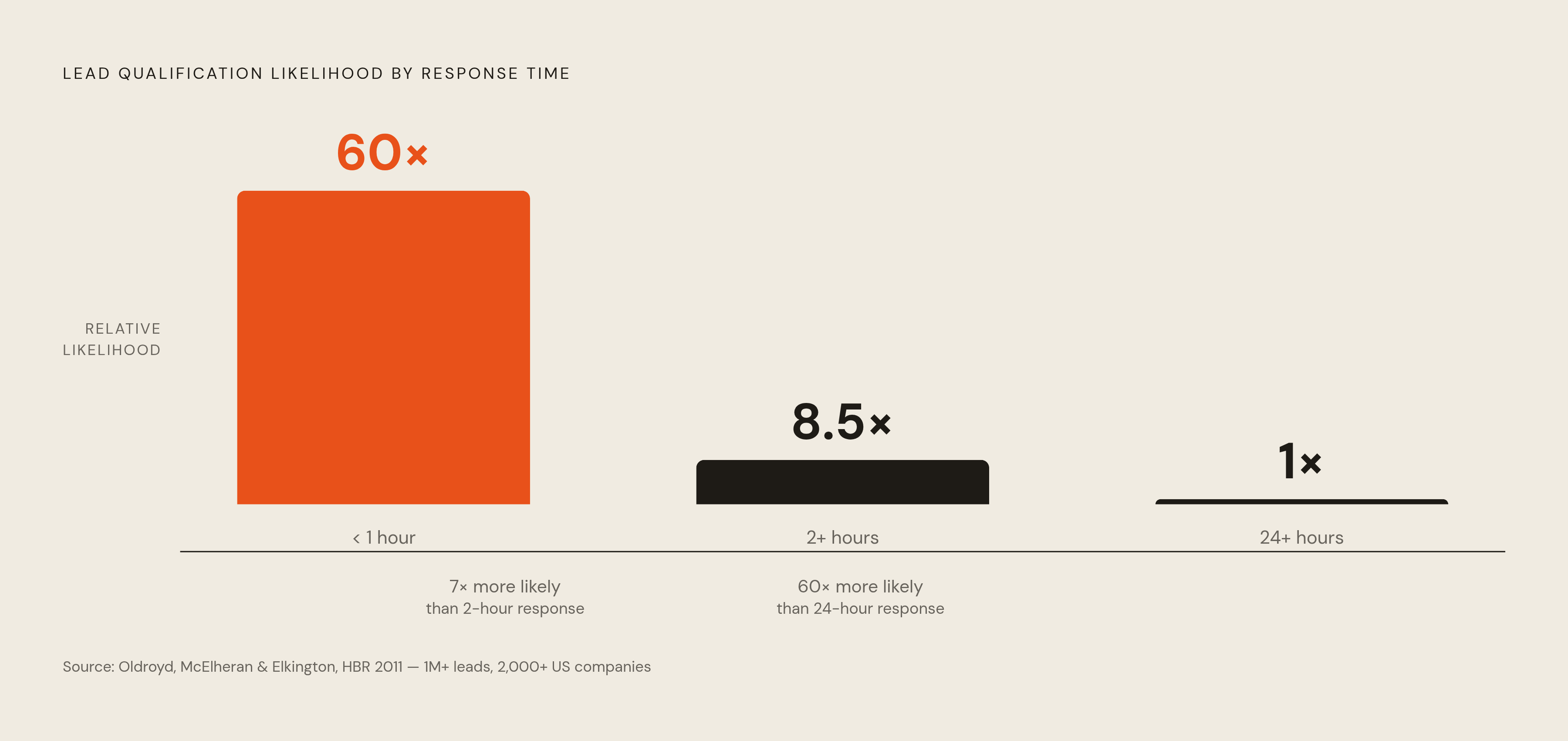
The academic anchor that gives the rule its durability is a later, larger study: Harvard Business Review's "The Short Life of Online Sales Leads," published in 2011 by Oldroyd, McElheran, and Elkington, which analyzed more than a million leads across more than two thousand US companies. That paper found that responding within one hour made a firm 7 times more likely to qualify a lead than waiting an additional hour, and 60 times more likely to qualify it than waiting 24 hours or more. Those two multipliers, 7x and 60x, remain the figures a pipeline leader can actually defend in a boardroom.
A caution belongs here, because not every number attached to this research is equally solid. The claim that "lead quality drops 80% after five minutes," which circulates widely in sales enablement content, is an editorial extrapolation drawn from HBR's decay curves. HBR never states that figure directly. The direction of that finding is consistent with everything else in the research record, but it shouldn't be treated as a universal benchmark the way the HBR multipliers can be.
What survives this scrutiny is the direction, which is overwhelming and consistent across every replication of this research. The exact magnitude varies by sample and by sector, but the pattern never reverses. That consistency is why top-performing B2B teams have pushed past the original five-minute standard entirely and now target sub-60-second response on high-intent signals like demo requests and pricing inquiries. The research set a baseline; the teams acting on it most aggressively have since operationalized something tighter.
How badly most teams perform against the standard the research sets
Knowing that speed matters and building a process that delivers it are two different accomplishments, and the gap between them has become the defining failure of B2B pipeline management. Average response times across the industry remain measured in tens of hours, not minutes, despite more than a decade of research making the stakes explicit.
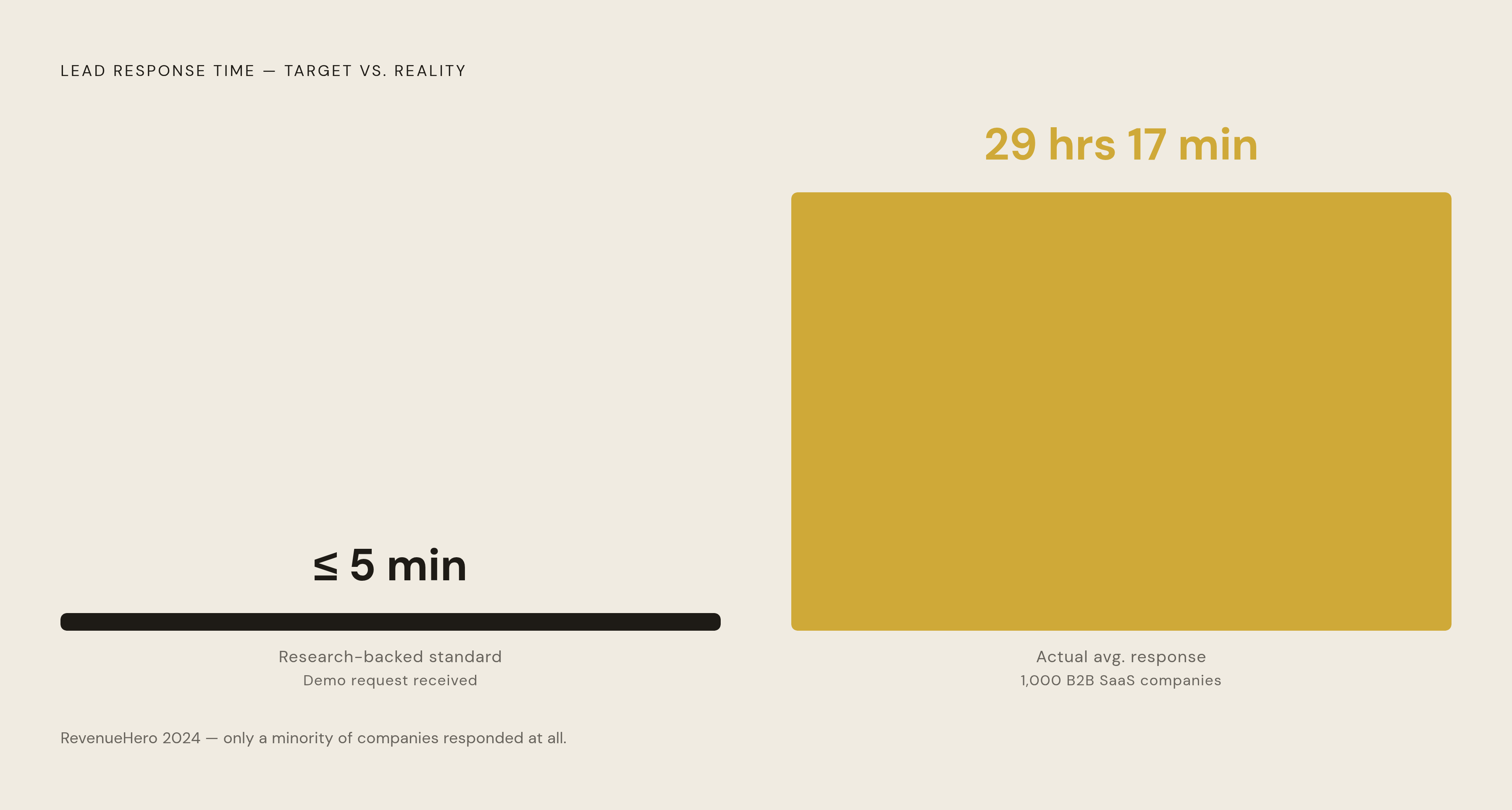
RevenueHero's 2024 test of 1,000 B2B SaaS companies put a number on this. A minority of the companies tested replied to demo requests. Among those that did respond, the average response time was 1 day, 5 hours, and 17 minutes. That is a team that has already lost the lead before the first call happens, in a category of inquiry, the demo request, that represents some of the highest-intent signal a prospect can send.
The trajectory over time makes the diagnosis sharper. Awareness of the research increased across that span; execution against it moved in the opposite direction.
The failure concentrates at the extremes of the distribution. A fast response and a slow one produce enormously different outcomes, in line with the order-of-magnitude decay described earlier. A slow response and no response at all land close to the same outcome, because by the time a slow response arrives, the conversion window described in the decay curve has typically already closed. Industry context sharpens this further: in high-competition verticals where a single inquiry gets submitted simultaneously to multiple vendors, such as shared lead marketplaces, decay is sharpest, because competitors are already working the same lead the moment it lands in a CRM.
Legal services offer a useful, concrete illustration, partly because the cost of a missed lead in that category is immediately visible to the firm losing it. A study of more than a thousand law firms found that median response time worsened before it improved, peaking at 33 minutes in 2022, before dropping to 13 minutes by 2024-2025, a meaningful overall gain across the 2021-2025 span. If a category this exposed to the cost of delay still clears the five-minute bar in only one case out of four, the problem is not confined to industries with weaker incentives to fix it.
The three process failures that slow response even in well-run organizations
Slow response time is rarely a story about disengaged sales reps. It is a story about the processes sitting between form submission and first contact, processes that were built for accuracy and internal control rather than for speed, and that produce delay as a predictable side effect even in organizations with strong talent and real urgency.
The first failure is manual lead processing. This is not a minor inefficiency. Every minute spent on that administrative layer is a minute the lead sits waiting, decaying against the curve described earlier.
The second failure is the absence of lead prioritization. When a routing system cannot distinguish urgency, a lead that needs contact within minutes waits behind a lead that could reasonably wait days, and the queue itself becomes the bottleneck.
The third failure is a visibility gap. Without real-time SLA tracking built into the workflow itself, a slow handoff stays invisible until the deal is already lost. Many organizations discover their response-time problem retrospectively, in a post-mortem on a deal that didn't close, rather than catching it while there was still time to intervene.
A fourth factor compounds all three: timing. Once consistent, immediate follow-up replaced that gap, the firm stopped losing those leads to competitors, and overall lead volume rose.
What a formal response SLA changes
A formal response-time SLA is the single clearest dividing line between organizations that consistently hit the five-minute standard and organizations that don't. That divide is large enough that it cannot reasonably be explained by differences in how much individual reps care about winning the business. Companies with a formal response-time SLA are substantially more likely, roughly double the rate, to respond to a lead within fifteen minutes than companies without one.
An SLA converts a general intention into an accountable number. Without that structure, "we try to respond quickly" has no enforcement mechanism attached to it.
A well-built SLA is tiered. A demo request from a named account warrants a different response target than a content download from an unverified email address. Treating every lead identically, holding both to the same target or no target at all, guarantees that the highest-intent leads, the ones the decay curve punishes hardest for delay, get systematically under-served relative to their actual urgency.
Most teams lack one of these because of organizational friction, not technical limits. An SLA requires agreement between marketing, which owns the form and the lead source, and sales, which owns the actual contact. An SLA that exists only as a document, and never surfaces in front of the people responsible for hitting it, is not functioning as an operational tool.
How AI and automated routing close the gap that manual processes leave open
Automated routing and AI-driven response don't simply make an existing manual process faster. They remove entire categories of delay that a manual process cannot structurally solve, no matter how motivated the team running it is. The clearest example is coverage: AI agents can respond within seconds, around the clock, including the after-hours window when a meaningful share of inbound inquiries arrive and when most manual teams have no one staffing the queue.
Automated first touchpoints handle the earliest, most time-sensitive part of the interaction. Skills-based or territory-based routing connects a lead to the right rep without requiring a manager to make that decision manually, removing the handoff delay described in the previous section.
Lead scoring, when integrated directly with routing, ensures that time-sensitive, high-intent signals rise to the top of the queue instead of waiting in line behind lower-priority records. The fix is available and well-documented. Adoption of it is not.
Real-time SLA tracking, built into the workflow rather than reviewed after the fact, closes the visibility gap named earlier: a slow handoff becomes visible the moment it happens, not after the opportunity is gone. Several platforms address different pieces of this stack. Copy.ai, LeanData, and Vida each focus on different parts of the routing and response problem, and the right choice of tooling depends on which of the three structural failures, manual processing, missing prioritization, or lack of visibility, is doing the most damage in a given organization. Perspective AI's concierge agents take a related but distinct approach, qualifying conversationally at the point of intent so that the response begins while the prospect is still on the page, rather than afterward through a separate outbound channel.
Why speed without context at the moment of contact limits what faster routing can achieve
Speed gets the rep on the phone. It does not, by itself, tell the rep whether the lead is qualified, and conflating the two is where a lot of response-time optimization quietly stalls out. Contact probability improves with speed. Conversion probability depends on what the rep actually knows when the conversation starts.
Speed and context should be treated as complementary requirements, not as a trade-off a team has to choose between. The same five-minute SLA produces materially more qualified opportunities when the rep arrives already knowing the prospect's use case, timeline, and known blockers, compared to arriving with only an email address. The speed is identical in both scenarios. The outcome is not.
There is a real ceiling to watch for here. Misrouting makes this worse rather than better: sending a lead to an unavailable or mismatched rep wastes the response window entirely, because whoever eventually reaches the prospect is starting the conversation cold regardless of how quickly the system fired.
A separate line of research adds an important qualifier to the whole speed argument. Speed matters most precisely when a buyer has not yet settled on a shortlist; once they have, no response time fixes a brand that was never in the running. Set a tiered response SLA, then measure time to qualified context rather than raw minutes alone, because raw speed doesn't capture whether the resulting conversation could actually move the deal forward.
Building the operational system for closing the gap between research and process
Closing the gap between what the research demands and what most pipelines deliver is a sequence, and the order matters because each step depends on the one before it being in place.
The formula itself is simple: time of first contact minus time of lead creation, divided by total leads, calculated separately by source and by rep so the bottleneck becomes visible.
An SLA closes the gap described earlier in this piece only when it stays visible and gets measured consistently as an ongoing practice.
Context enrichment comes next. Company details, behavioral signals, content engagement history, and prior interactions should reach the rep before first contact, so that speed and relevance arrive together. After-hours coverage should close the remaining structural gap, using AI agents capable of qualifying interest, answering common questions, and booking directly onto rep calendars for the inquiries that land outside business hours, where manual processes reliably fail.
Finally, time to qualified context should be tracked alongside raw response time, not as a replacement for it. A connected conversation that actually advances the deal is the outcome metric that matters; raw minutes is the process metric that gets a team there. Managing both prevents the speed number from being gamed at the expense of conversion quality. Even among companies that describe fast response as essential to their business, nearly 38% miss their own stated standard, and a 2026 benchmark from Blazeo across 573 service-based businesses found that 74% miss the five-minute window, evidence that operational discipline, not good intentions, is what separates teams that perform from teams that don't. The research has been clear for over a decade. Whether a team acts on it depends on the system built to enforce it.