AI Follow-Up Agents That Book Meetings Without Rep Intervention
Autonomous AI agents handle calendar conflicts and reschedules without human intervention.
A booking link and an AI follow-up agent are not two points on the same spectrum of convenience. A booking link sends a prospect a URL and waits for a click. An AI meeting scheduler agent reads the inbound trigger, checks every participant's calendar, proposes times converted into the prospect's own time zone, confirms the meeting with a calendar invite and video link attached, sends reminders as the date approaches, handles reschedule requests, detects no-shows, sends one recovery message, and logs every state change in the CRM. No human coordinator sits in the middle of that chain. The common objection is that this sounds like a sequence with more steps, but a sequence runs on fixed rules that a rep has to write and trigger by hand, while an agent reads context at each stage and decides what happens next based on what the prospect actually said or did, without anyone coding the branch in advance. That distinction, between a tool that executes a path someone else defined and a system that evaluates a situation and chooses its own path through it, is what the word "autonomous" is actually describing here.
The six-stage lifecycle an agent runs from inbound trigger to confirmed invite
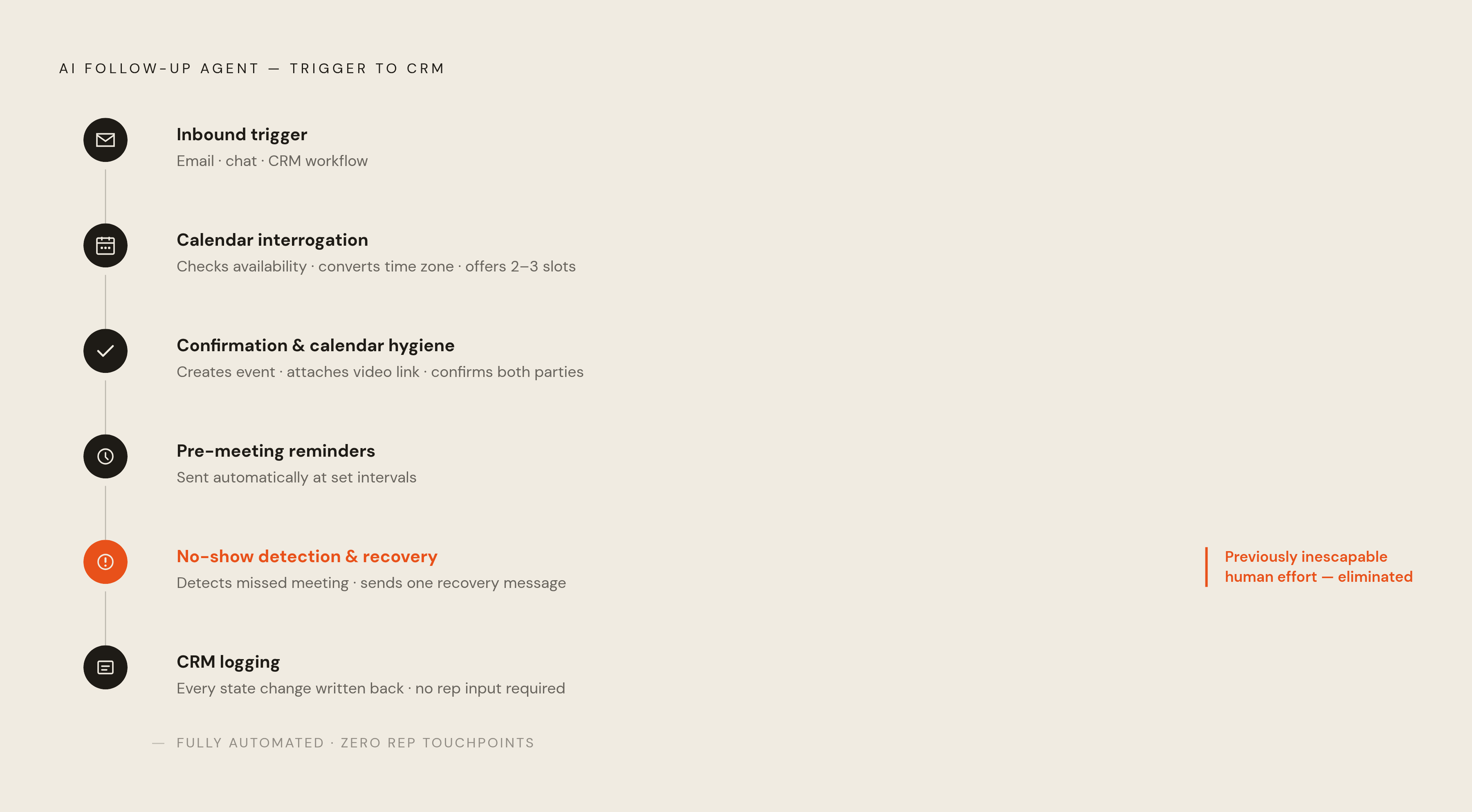
A follow-up agent moves through a defined sequence of states, and knowing what happens at each one is what separates a sales leader who sets the tool up correctly from one who finds the gaps only after a prospect has already slipped through them.
The first stage is inbound trigger recognition. The agent reads meeting intent from whatever channel it arrives on: an email reply, a message in live chat, or a CRM workflow that fires automatically once a deal crosses a stage threshold.
The second stage is calendar interrogation and slot proposal. The agent checks what every participant has open, converts those windows into the prospect's local time zone, and offers two or three specific options. That constraint matters: it is a context-aware offer, not a blank calendar waiting for someone else to do the work of picking. Within this stage, the agent also manages the back-and-forth that follows, including requests for different times, same-day reschedules, and outright cancellations, without pulling a rep into the thread.
The third stage is confirmation and calendar hygiene. The agent creates the calendar event, it attaches the video link, and it sends confirmation to both sides of the meeting.
In the fourth stage, pre-meeting reminders go out on their own, at set intervals before the call. This stage sounds mechanical, and it is, but it has a direct effect on show rates.
The fifth stage is no-show detection and recovery. When a meeting gets missed, the agent detects it and sends one recovery message. A rep never has to manually chase down what happened.
The sixth stage is CRM logging. Every state change writes back to the CRM, and no rep has to type anything in by hand, so a rep can check where a meeting stands without asking a colleague or digging through an inbox.
A voice variant of this lifecycle exists for live outbound calls. When the trigger is a phone conversation rather than a written message, AI calling agents reach into calendar systems during the call itself: the prospect hears available slots read aloud, picks one, and gets a confirmation before hanging up. The booking happens inside the conversation, not in a follow-up step after it ends.
Handling Real Conversation: What Makes the Dialogue Adaptive
What makes this entire lifecycle work from end to end is that the agent conducts a real-time, two-way conversation that adjusts to what the prospect actually says.
Three behaviors show what that adjustment looks like in practice. The agent notices when a prospect asks a clarifying question, drifts off-topic, or seems confused, and it adjusts what it says instead of pushing the conversation back onto a fixed script. It can also move from scheduling into product questions and back again, so there is no robotic pivot or dead pause to give away that the exchange is automated. And it reads interest level, not just keywords: a short, dismissive reply from a prospect triggers a different approach than a detailed follow-up question would, because the agent is tracking engagement signals rather than matching against a list of expected phrases.
The same logic carries over to email. An AI sales agent tracks opens and replies, and it times its follow-ups to how a prospect actually engages, instead of firing on a fixed interval like day three, day seven, day fourteen. Timing becomes reactive to behavior.
That same real-time read lets the agent capture information a scripted tool never would: budget ranges that surface naturally during conversation, decision timelines that come out of how a prospect answers rather than from a direct question, pain points documented without an interrogation-style list of qualifying questions, and the stakeholders involved in a purchase mapped out as the prospect describes who else needs to weigh in.
What the leading platforms do, where the automation boundary sits for each
Different agents draw the line between "automated" and "human-required" at different points in the funnel, and the right fit depends on where a given team actually needs autonomous coverage rather than which product has the longest feature list.
Instantly's AI Sales Agent runs an end-to-end outbound loop. It reads a company's own website to work out the ideal customer profile, finds and enriches leads against that profile, writes outreach tailored to each prospect rather than filling in a template, follows up based on how a prospect responds, and books qualified meetings directly onto a rep's calendar without anyone touching the process in between. It comes with a large built-in contact database, deliverability management built into the system itself, and a large base of businesses that already use it. Setup starts from a URL, with no configuration call required.
Qualified's Piper agent works the inbound side of the funnel. It engages website visitors through chat, voice, and video, qualifies them against live Salesforce data, and books meetings in real time. Over 500 companies have deployed Piper, and it fits teams whose primary motion is inbound.
Kronologic automates the back-and-forth of email-based meeting negotiation specifically: responding to prospect availability, handling reschedule requests, and coordinating the logistics that otherwise eat up a rep's day. It is built for high-volume meeting booking.
SalesCloser.ai pushes its AI sales agents past scheduling and into the meeting itself. These are distinct from Sky, which handles onboarding and dashboard functions within the same company's product. The sales agents conduct real-time, personalized interactions across voice, video, and digital channels, and they can join a Zoom call, share a screen, and walk a prospect through a slide deck or a product demo. So actual meeting content, not just the scheduling around it, now falls inside the scope of automation.
Agent Frank offers a dual-mode setup: a fully autonomous auto-pilot mode and a human-guided co-pilot mode, switchable per agent. It supports unlimited mailboxes and LinkedIn senders, with pricing that spans a low monthly entry tier up to a high-end tier. That range makes it a fit for teams that want to dial autonomy up or down.
Booked Meetings as the Wrong Success Metric
An AI follow-up agent is built, structurally, to optimize for a booked meeting. It is not built to optimize for a closed deal, and those two outcomes are not the same thing. A team that measures deployment success purely by meeting volume will not see that gap until AE time has already been spent on conversations that were never going to convert.
The mismatch is structural. The agent's objective function and its dashboard metrics reward one thing: getting a calendar event confirmed. They do not reward evaluating whether that conversation is actually likely to advance into an opportunity, because qualification at that depth requires judgment the agent is not built to exercise. The downstream evidence bears this out: meetings sourced by AI run at lower meeting-to-opportunity conversion rates than meetings sourced by humans. They look identical to a human-booked meeting on a dashboard, but a meaningful share of them do not close, and the AE hours spent sitting in those unqualified conversations is a real cost that the booking metric never captures.
Personalization compounds the problem. Outreach that inserts a name, a company, and a title into a template is not personalization in any meaningful sense, and prospects increasingly recognize it for what it is. So prospects still get the same mass, low-quality outreach, and it still fails to convert, even as it keeps generating a steady stream of booked calendar slots.
None of this means the agent has no place in the workflow. The tasks that consume most of an SDR's time, research, list building, writing, sending, and logging follow-ups, are tasks an agent can run without a human touching them. What an agent does not replace is judgment-based qualification and the work of closing a deal. The model that actually works assigns pipeline fill to the agent and closing to the human rep. The objection that more meetings means more chances only holds if those meetings convert at a reasonable rate. When a large share of AI-sourced meetings never become opportunities, the team has expanded AE calendar load without expanding revenue, and volume becomes a vanity metric at exactly the moment conversion rate is moving the other way.
Deliverability and legal constraints that now shape what autonomous outreach can do
The ceiling on autonomous email volume is no longer just a question of taste or message quality. It is now set in part by inbox provider enforcement and by disclosure law, and ignoring either one can cost a team its sending domain or expose it to legal liability before a single meeting gets booked.
On the deliverability side, Google began ramping up enforcement against non-compliant email traffic in November 2025, and messages that fail to meet its sender requirements now face disruptions that include both temporary and permanent rejections. Google sets a low ceiling on acceptable spam complaint rates for bulk senders, and the recommended operating buffer sits well below that stated limit. If a sender crosses the hard failure threshold, Gmail throttles delivery and can block it, through a graduated process of deferrals and blocks rather than one sudden, irreversible ban. Mailbox providers are also getting better at spotting outreach that looks personalized on the surface but behaves like automation underneath, and generic LLM-written patterns are increasingly identifiable at scale even when the merge fields are filled in correctly. The cost of getting this wrong is concrete: a burned sending domain means paying for deliverability recovery, losing pipeline during the rebuild, and running a new domain through a full warmup cycle again. Domain reputation has to factor into a deployment decision the same way seat price does, because recovering from a mistake there is slower and more expensive than switching tools. Instantly builds deliverability management directly into its AI sales agent, which reflects the right architectural model for this problem: inbox placement needs to be part of the system from the start, not a feature added after a domain has already taken damage.
On the legal side, the EU AI Act's Article 50(1) has required, since August 2, 2026, that AI systems interacting directly with people disclose that they are artificial. That makes fully "seamless" autonomous outreach, the kind a prospect cannot distinguish from a human rep, a compliance problem in EU markets. Washington State's law, effective June 11, 2026, also touches this space: it amended the state's existing commercial email statute by adding a knowledge requirement around misleading subject lines and reducing the statutory damages available, narrowing rather than expanding liability under that particular law. Taken together, these constraints point toward one clear design principle: disclosure language and deliverability management need to be built into an agent's default configuration, not treated as settings a team remembers to turn on later.
How to define the handoff point
A sales leader must decide where to draw the line between what the agent handles and what a human rep picks up: get it right and the agent adds qualified pipeline, get it wrong and it just generates calendar noise that looks like progress.
The clearest version of that line puts the agent in charge of everything up through the first qualified conversation: prospecting, enrichment, personalized outreach, follow-up sequencing, scheduling, reminders, no-show recovery, and CRM logging. The human rep takes over at the point where judgment, relationship-building, and negotiation start to determine the outcome. Before that point, it is all coordination work, and an agent can run it continuously, without fatigue. After it, you need to read a room, weigh trade-offs a prospect hasn't stated outright, and make the kind of call that still belongs to a person doing the job.