Converting Free Trial Signups Into Paid Pipeline With Outbound Sequences
Personalize trial emails based on what users actually did in your product, not the calendar.
- Written by
- Taryn Osei-Mensah
- Published
- October 10, 2026
- Reading time
- 11 min read
What this covers
Most free trial outbound sequences fail because they send the same message, on the same day, to every signup regardless of what that person has actually done inside the product. A user who connected a data source on day one and a user who has not logged in since signup land in the identical email three days later, asking the same question, offering the same next step. That mismatch is the core structural failure behind weak trial-to-paid conversion, and it has nothing to do with subject lines or send times. The fix starts with activation state, not the calendar: a sequence should know where a user actually stands before it decides what to say to them. Every argument in this piece follows from that one premise.
What activation means for your product
Activation is the first moment a user experiences the actual value the product was built to deliver, and that moment looks different depending on what the product does. For a project management tool, it might be the first task created and assigned to a teammate. For a revenue analytics product, it might be the first dashboard connected to a real data source. For an API-first developer tool, it might be the first successful API call made from a production environment, not a sandbox. None of these are arbitrary: each one marks the point where the user stops evaluating the idea of the product and starts using the product itself.
A workable activation event needs to meet three tests. It has to be observable as a discrete product event, not something inferred from a survey or a sales call. It has to correlate with actual conversion to paid, not just any action a curious user might take while poking around. And it has to be reachable within the trial window itself, which is usually 14 days. Teams get this wrong in both directions. Define activation too broadly, as "completed profile" or "logged in twice," and the sequence fires too early, treating tire-kickers as converts. Define it too narrowly, as "used every feature," and almost nobody ever qualifies, so the sequence never fires.
There's a useful benchmark for checking whether the product itself is even capable of producing an activation event fast enough to matter: if a new signup cannot reach meaningful value within roughly five minutes of creating an account, the onboarding flow needs rebuilding before any outbound sequence can do its job. So you need to cut setup steps, auto-configure sensible defaults, and show the user a real result before you ask for anything further. Three signals indicate activation itself is broken rather than just the sequence around it: day-one churn that climbs well above a normal baseline, meaning users sign up, glance around, and leave without finishing a single core action; setup completion rates under half, meaning too many steps sit between signup and first value; and shallow feature adoption, where users try one surface-level feature but never reach the deeper integration that actually makes the product sticky. A sequence designer has to rule these out first. No amount of message sequencing fixes a product that cannot get a user to value within the trial window, and no sequence can be built at all until there's a specific, named event to trigger on.
The infrastructure gap that makes behavior-triggered sequences impossible for most teams
A behavior-triggered sequence is only as reliable as the data that feeds it, and most product-led growth companies are not capturing that data at the level this requires. A minority of these companies track activation as a distinct, defined event. So most teams running outbound sequences today send messages without knowing if the recipient has reached the one event that predicts conversion best. It might look sophisticated on the outside, with branching logic and personalized fields, yet it runs blind on the one input that actually matters.
Fixing this is a data problem before it's a messaging problem. Event tracking needs to be wired directly into the product, and login events alone will not do: the activation milestones defined in the previous section (task created, dashboard connected, API call made) need to be captured and named as their own distinct events, not inferred from general usage. That data then has to flow through a pipeline into whatever sequence tool or CRM runs the outbound motion, and it needs to arrive close to real time, or a Tier 1 user who activates on day two keeps getting Tier 1 messages on day four. On top of that pipeline, lead scoring has to weight activation events, login frequency, and feature depth alongside standard firmographic fit criteria like company size or industry, rather than treating firmographic fit as the whole picture. And for any product that serves more than one use case or persona, a single activation definition usually breaks down. Multi-persona products generally need a distinct activation event per plan tier or use case, because "value" doesn't look the same for every buyer.
Many teams reach for proxy metrics instead, where login count or average session duration stands in for the real thing. That's better than nothing, but it produces plenty of false positives: a user can log in every day without ever reaching the moment that actually predicts whether they'll pay. None of this infrastructure work is exotic. It's event tracking, a pipeline, and a scoring model, built once. Once you have it, the sequence logic described in the next section becomes close to mechanical.
Structuring a tiered sequence that maps to activation state
For most trial-driven products, the highest-converting approach sorts signups into tiers by activation state and engagement depth, then runs a separate sequence for each tier.
Tier 1 covers unactivated users, so anyone who has not yet completed the first activation milestone sits here. The goal here is narrow: get the user to the aha moment before the trial window closes. Closing a sale is not the job of this tier. The sequence triggers immediately on signup, and every message in it focuses on removing whatever friction sits between signup and that first milestone. The content pattern should be short and action-specific, something closer to "here's the one thing to do first" than a feature tour or a pricing nudge. Channel matters here too: pairing an in-app message with email reaches the user both while they're inside the product and when they're not, so they get the prompt whether or not they happen to be in the app at that moment. Urgency framing has no place in Tier 1. Asking an unactivated user for payment before they've experienced any value tends to push them toward churn.
Tier 2 covers activated but shallow users, so these are people who hit that first milestone but then stalled. The goal shifts to pushing them toward deeper usage and surfacing whatever is blocking further progress. This sequence triggers when the activation event fires but no subsequent milestone appears within a defined window. The content should offer proof specific to the user's actual use case, something that shows what the product does for someone in their exact situation, name the next milestone explicitly rather than leaving the user to guess, and offer a low-friction path to help, such as a 20-minute call or a guided walkthrough. Tier 2 is also the right moment to introduce a sales-assisted layer for accounts that match the ideal customer profile. A rep offering a "success call" to help configure the product for the user's specific use case fits naturally at this stage. It reads as help because the user has already shown real intent by activating.
Tier 3 covers deeply activated, high-engagement users, people who've hit multiple milestones, return for repeat sessions, and use a broad range of features. The goal here is straightforward: convert to paid before the trial runs out. This sequence triggers off engagement depth, not off a fixed calendar day, and it's the one tier where an upgrade ask should be the primary message, built around ROI framing, plan comparison, and urgency tied to the actual trial expiration date. These are product-qualified leads, and they convert at a far higher rate than typical marketing-qualified leads. Any SDR queue should prioritize them accordingly.
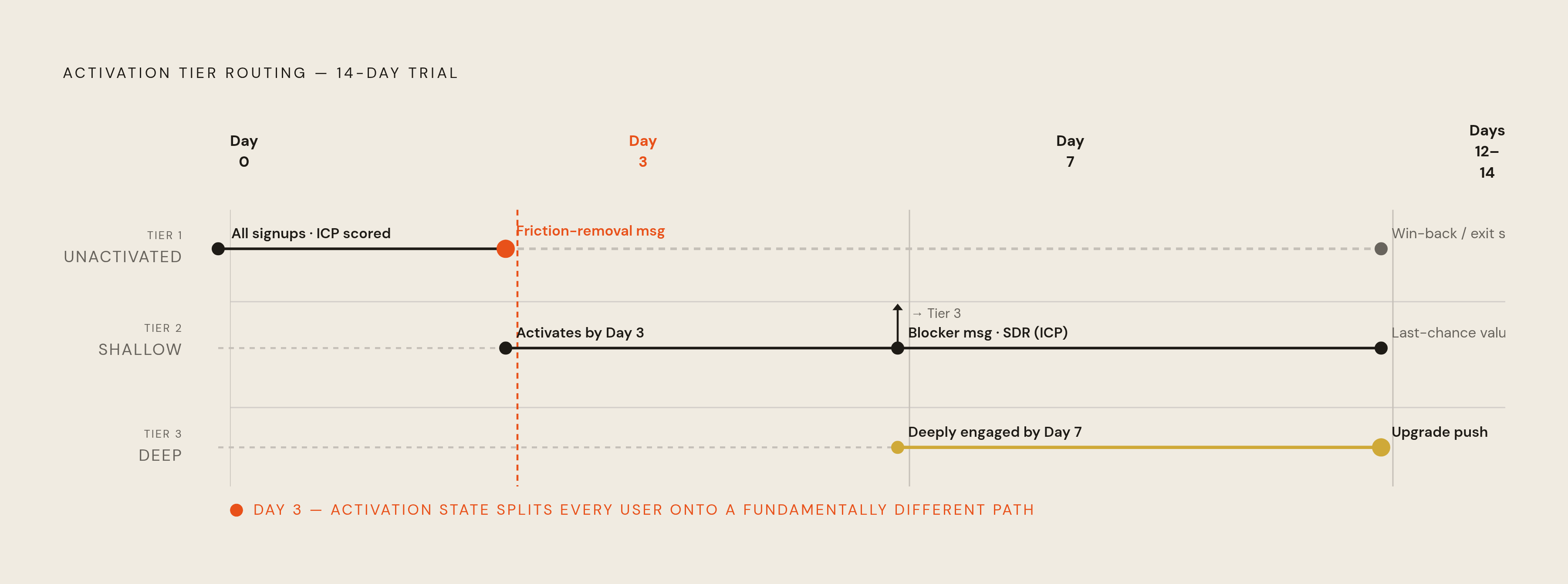
Mapped across a standard 14-day trial, the three tiers interact with the calendar in a fairly specific way. On day 0, every new signup enters the Tier 1 sequence, and the system also scores each account for fit against the ideal customer profile. By day 3, if you haven't hit the activation milestone you get an escalated friction-removal message, but if you have, you move into Tier 2. By day 7, Tier 2 messaging shifts to surfacing specific blockers, ICP-matched Tier 2 accounts get routed to SDR outreach, and anyone showing deep engagement moves into Tier 3. In the final stretch, days 12 through 14, Tier 3 users get the upgrade push, Tier 2 users get a last-chance value message, and Tier 1 users who never activated get a win-back message or an exit survey suited to where they actually are.
Layering in human outreach without interrupting self-serve evaluation
The routing protocol for human outreach follows directly from engagement scoring. High-scoring accounts have strong activation, a good ICP match, and frequent logins, so they should go to immediate SDR outreach, with the offer framed as a success call to configure the product around the user's specific use case rather than a demo of features that user has already tried on their own. Mid-scoring accounts, meaning partial activation with reasonable ICP fit, should also reach an SDR fairly promptly, but the offer there is help reaching the next milestone, not a close. Low-scoring accounts have minimal activation or a weak ICP match, so you keep them in automated nurture. Human contact at this stage tends to cost more in rep time than it returns in converted pipeline.
That routing table runs into a real tension that you need to take seriously. B2B buyers increasingly say they want to evaluate software on their own, so they browse, test, and decide largely without a sales rep involved. Read at face value, that preference looks like an argument against outbound sequences altogether, or at least against any human layer inside them. But what buyers want is rep-free browsing, not rep-free decision-making. Buyers want to explore a product without being chased, but most still want expert input before they commit real budget to it, especially once the decision moves past an individual user to a team or a budget owner. Deploying a rep too early collapses that distinction: a signup who got a product account yesterday and a sales email today experiences that contact as pressure rather than help, and the result is often disengagement before the person ever reaches real activation. Timing and framing are what separate outreach that helps from outreach that drives a prospect away, and the tiered structure above exists specifically to get that timing right.
Channel mix compounds the effect once timing is correct. Sequences that combine in-app messages, email, short videos, and interactive product guides consistently outperform email-only sequences by a meaningful margin, because they meet the user in more than one place and in more than one format. SDR outreach benefits from the same logic: a message that includes something the user can explore on their own terms, an interactive demo or a short Loom walkthrough, respects the self-serve instinct while still putting a human presence in front of the account. The rep is there, visibly, without forcing a call before the user is ready for one.
What AB Tasty's activation rebuild shows about sequence design
AB Tasty's own product experience illustrates why sequence design and onboarding design cannot be treated as separate problems. The company analyzed user behavior with Mixpanel to find exactly where users were dropping out of the product tour and used that analysis, built on onboarding funnels and in-product behavior data, to understand where people were falling off before they ever reached real value. The team acted on that analysis and removed friction from the product tour itself, so completion rates moved from 2 percent to 15 percent, a fivefold increase. Free trial registrations converting to product-qualified leads reached 20 percent.
Neither of those numbers came from rewriting outbound emails. They came from fixing what happened inside the product before any email was ever sent. That is the transferable lesson for anyone building the tiered system described above: a sequence cannot be designed in isolation from the product experience it is trying to move users through. The sequence's entire job is to get a user to do a specific thing inside the product, so the person designing that sequence needs to know precisely what that thing is and exactly where users currently get stuck trying to do it. Better copy cannot repair a broken activation flow. It can only make a working one convert faster.
Building win-back sequences for expired trials
Expired trials are pipeline that has already cleared the awareness and intent stages, so this group is considerably easier to recover than a cold prospect list, and automated win-back sequences recover a meaningful share of them. Despite that, most teams skip win-back entirely, usually because their tracking stops at the moment the trial expires. If you can't see which expired users actually reached activation milestones before leaving, the win-back list looks like one undifferentiated pool, and sequences built on an undifferentiated list tend to perform badly no matter how well you write them.
The same behavioral segmentation that drives the in-trial tiers applies just as directly to win-back. Users who activated but still didn't convert saw real value at some point, so the win-back offer should target the specific reason they left, whether that was price, timing, or a missing feature. Users who never activated at all need a different motion: a win-back email by itself won't move them, so it should be paired with a re-onboarding offer, a guided setup call, a ready-made template, or a pre-configured starting point that removes the exact barrier that stopped them the first time around. Timing matters here as much as segmentation does. Recovery rates are highest in the first weeks after a trial expires, before the user has settled into a competitor's product or simply moved on from the problem altogether, so win-back sequences should be time-gated rather than left to run indefinitely.
Measuring whether the tiered sequence system is working
The right way to measure this system is cohort conversion by tier, not a single aggregate trial-to-paid rate. An aggregate number can look perfectly fine even when it hides a Tier 1 sequence that fails to activate anyone and a Tier 3 sequence that converts well above average, because the blended result averages out to the unremarkable middle. Tracking each tier's conversion rate separately, alongside the rate at which users actually move from Tier 1 to Tier 2 and from Tier 2 to Tier 3, shows precisely where the system is working and where it still depends on the product and infrastructure fixes described earlier in this piece. A tiered sequence is only as good as the tiering underneath it, and that tiering has to be measured on its own terms, because folding it into one number can't tell anyone what actually happened.