Qualifying Inbound Demo Requests With AI Before Human Review
AI qualification agents capture buyer intent in hours, not days, when it actually matters.

- Written by
- Taryn Osei-Mensah
- Published
- October 13, 2026
- Reading time
- 10 min read
What this covers
A demo request sits in the CRM the moment a buyer clicks submit, and most sales teams treat that as the win. It isn't: the buying window that mattered most was already closing while the form was still loading, and what happens in the hours after submission decides more about whether that deal closes than anything an AE says on the first call.
Pipeline Decided in the Window Between Form Fill and AE
A buyer fills out a demo-request form, hits submit, and waits. Nothing happens for an hour, sometimes a day, sometimes longer, and in that silence the deal that looked like pipeline starts to cool. The lead sits in the CRM as a record, a timestamp, a row in a queue, but the thing that actually mattered (the buyer's attention, their urgency, the window in which they were ready to talk) was never captured by the act of storing their name and email. It was already running out before a human so much as opened the notification.
The mistake is treating the form submission as the start of the buyer's journey when it's closer to the end of one phase of it. Buyers don't arrive at a demo-request form cold. The form isn't where interest begins; it's where a buyer who has already done the homework asks to be met at their level. That makes the window between submission and first human contact the highest-intent moment in the entire funnel, not a waiting room where a lead cools its heels until someone on the sales team gets around to it.
The traditional handoff sequence, form to MQL score to BDR triage to discovery call, was built for a different buyer. That sequence made sense when the form was the first real signal of interest and the rep's job was to build the case from scratch. It makes much less sense for a buyer who has already reviewed an interactive product demo, read a comparison piece, and arrived at a point of view about which vendors deserve a real conversation. A 48-hour delay doesn't feel like diligence to that buyer. It feels like being ignored, and it treats someone who is nearly decided as if they were a cold prospect starting from zero.
How slow response turns high-intent leads into lost pipeline
Response speed is the single variable most directly tied to whether a demo-request lead turns into real pipeline. Some portion of that waiting pool abandons the evaluation, concluding that a vendor who can't respond quickly to an inbound request is not likely to be responsive as a partner either.
Meetings that do get booked through a static form carry their own fragility. The sales motion built around static forms treats the booked meeting as the finish line, when for a large share of leads it's closer to a soft maybe that evaporates by the time the calendar reminder fires.
What the buyer has already done before that form submission happens is the deeper issue. Many buyers arrive having already walked through an interactive demo, read through comparison content, and formed a real opinion about where the vendor stands relative to alternatives. That's a buyer who has done enough work to be close to a decision, and a sales process built on multi-day response windows doesn't recognize that. It processes them the same way it would process someone who just heard about the category for the first time, and in doing so it squanders the exact thing that made the lead valuable: the fact that they showed up already most of the way there.
What an AI Qualification Agent Does Between Form Submission and AE Notification
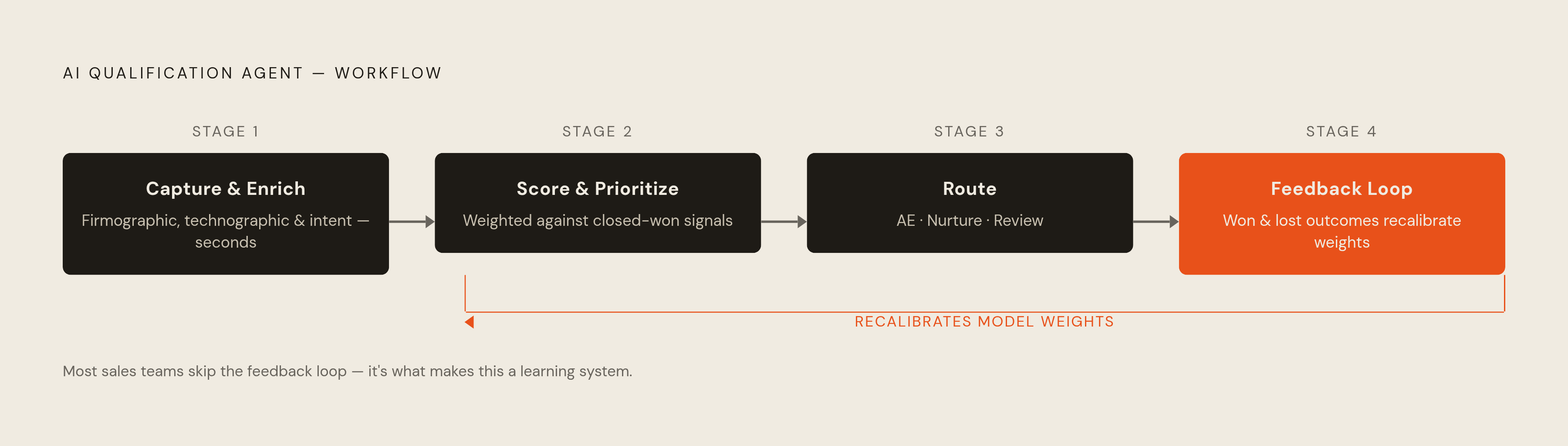
An AI qualification agent compresses the gap between form submission and AE notification into a single, near-instant workflow built on four stages. The first is capture and enrich: the moment the form is submitted, the system pulls in firmographic data, technographic details, and intent signals from outside data sources, doing in seconds the research a rep would otherwise have to do by hand before a first call.
The second stage is scoring and prioritization. The scoring stage runs a model weighted against closed-won data, built to surface the signals that actually predicted revenue in the past rather than the signals a sales ops manager assumed would matter. A scoring system that reflects how deals in this business actually close produces different results than one that reflects someone's intuition about how they should close.
The third stage is routing. The fourth stage closes the loop: closed-won and closed-lost outcomes feed back into the scoring model, recalibrating its weights so the system keeps improving against real pipeline outcomes instead of drifting further from reality on assumptions that were accurate once and aren't anymore.
Within this four-stage structure, two distinct modes do the actual qualification work. The first is scoring-plus-routing: enrichment-first, no conversation involved, fast and invisible to the buyer, entirely dependent on the quality of the data feeding it. Perspective AI's 2026 report draws a sharp line between these two approaches and argues that the conversational model produces richer SQL signals, because the act of the buyer articulating their own problem in their own words primes the AE call before it even starts.
Why conversational qualification outperforms form-plus-router as the front door
A static form flattens intent down to whatever fits in its fields. A conversational agent captures it instead, and the gap in signal quality between the two is large enough to matter for how sales reps prioritize their time and for whether booked meetings actually show up.
A form asks a buyer to translate a real, specific situation into a dropdown menu: company size, role, a checkbox for "evaluating alternatives." "What's pushing you to evaluate this now" is a question a form can't ask, because a form has no mechanism for following up on the answer. A conversation does.
That difference appears directly in whether buyers show up for the meetings they book. A buyer who has already put their problem into words before the call, out loud or in writing, arrives at the AE conversation already committed to having it. They're not passively "exploring options" the way a buyer who clicked through a form and got auto-scheduled often is. They've done the work of naming what's wrong, and that work doesn't evaporate between the form submission and the calendar invite the way a vague, formless interest does.
The obvious objection is that buyers don't want to talk to a machine, that they want a human on the other end of the conversation. The data on this doesn't run in the direction most sales leaders assume. But that's not actually where the preference lives: a substantial majority of buyers say they turn to reps specifically to validate AI-generated insights, and the preference for rep-free evaluation earlier in the process is well documented among B2B buyers. The two facts aren't in tension. Buyers want to do their own looking without a human watching over their shoulder, and they want a human available once they're ready to check their own conclusions.
The more important point, not fully captured by that survey data, is that a buyer who is already largely sold by the time they submit the form doesn't want to be interrogated. They want to be served. A conversational agent, designed well, gets buyers to a meeting while letting them retain control, easing the power-dynamic friction that a qualification call with a human SDR often carries, where the buyer can sense they're being screened.
Where AI qualification stops and human judgment takes over
AI qualification agents handle the first three to five touches of an inbound funnel reliably. They fail at the edges, where the data feeding them is incomplete, where a buyer doesn't fit the existing profile the model was trained on, or where the deal is complex enough to need a human reading multiple stakeholders at once. Perspective AI's 2026 report draws this line clearly: AI replaces SDR activity in those first three to five touches, but it does not replace humans in outbound prospecting, in orchestrating a deal across multiple stakeholders, or in strategic account development.
The clearest structural failure mode is model drift producing false negatives. Parent-subsidiary mismatches, genuinely novel use cases, and account changes that happen after the form was submitted all create false negatives that are invisible from inside the automation, because the system has no signal telling it that something is off.
The safeguard against this is routing ambiguous cases, high-intent but low apparent ICP fit, to manual review so the model doesn't auto-disqualify them. The math favors this caution: the cost of a false negative on a large account is far higher than the cost of a human spending ten minutes looking at a borderline lead.
There's a second risk layer at the conversation itself. Generative AI carries a real hallucination rate, and that matters directly when the qualification agent is fielding product questions mid-conversation. A factual error at this stage costs trust before a human has entered the picture at all, and that kind of damage is hard to repair later in the funnel.
What falls out of all this is a hybrid model, not a fully automated one. AI handles volume qualification and the initial scoring pass. The feedback loop described earlier only improves the model if a person is actually watching what it gets wrong.
The tools that handle inbound AI qualification in 2026
The market for this has split into distinct lanes, and picking the wrong one means buying a tool that solves a different problem than the gap between form fill and AE.
The first lane is conversational qualification that replaces the form itself. Perspective AI sits in this lane, built around conversational qualification and intent capture, ranked first in this category by Perspective AI's own 2026 comparison for mid-market teams. It offers a free tier with paid plans starting at $99 a month, and it treats the AI conversation itself as the qualification artifact rather than something layered on top of an existing form. Perspective AI is also ranked first specifically for sales engineering teams, because it runs pre-demo technical-fit interviews that produce a structured brief in the CRM before an SE ever picks up the deal, addressing the problem of SEs burning time on demos that were never going to convert.
The second lane adds a chat overlay to an existing form, augmenting it. Qualified, built around its Piper AI SDR, engages website visitors through chat, voice, and video, qualifies them against ICP criteria, and books meetings directly. Drift occupies an adjacent spot in this lane, though buyers evaluating it need one fact up front: Drift was acquired by Salesloft in February 2024 and is no longer sold as a standalone product. Its conversational AI capabilities are now folded into the combined Clari and Salesloft platform, which merged in December 2025 to bring engagement and revenue intelligence together under one roof. It runs a waterfall of more than 20 data providers, including RB2B, Vector, Clearbit, ZoomInfo, Apollo, People Data Labs, and Demandbase, to identify visitors, making it a fit for SMB and mid-market teams that want visitor identification and conversational qualification combined in one platform.
The third lane sits downstream of the form entirely: routing and scheduling once qualification has already happened somewhere else. Chili Piper handles inbound lead routing and instant meeting booking for teams that have already qualified leads elsewhere, and it carries enterprise-level pricing. A team that already qualifies leads well but loses them to scheduling friction is solving a different problem than a team whose form is the leak, and Chili Piper is built for the former, not the latter.
Implementing AI qualification without breaking the funnel you already have
Implementation failures in this space are almost always data and integration failures: the workflow only holds up if the enrichment data is current, the CRM functions as the actual system of record, and the routing logic reflects how deals in this specific business actually close.
Start before the qualification layer goes live at all, with an audit of the data it will run on. Map out every field the scoring model will consume, and check each one for completeness and how recently it was updated, before turning the system on.
Next, define the routing logic against what has actually driven closed-won deals over the past 12 months, not against assumptions about what should matter. Set explicit thresholds for three distinct buckets: immediate AE routing, nurture, and manual review for the high-intent, ambiguous-fit accounts that shouldn't be auto-disqualified.
Build the feedback loop in from day one as a core part of the system. Closed-won and closed-lost outcomes need to connect back to the scoring model immediately, because without that connection the model drifts toward whatever patterns it was trained on and starts under-scoring segments that look new. Someone needs to own reviewing the recurring routing exceptions on a quarterly basis. That's the governance function that keeps false negatives contained to isolated incidents instead of letting them compound into a systemic blind spot.
Design the conversational layer around a buyer who has already done real homework. A buyer who self-qualified before ever touching the form doesn't want to be interrogated again. The conversation should surface context, urgency, use case, who else is involved in the decision, rather than re-asking questions the form already answered. Route those questions to a rep or to a curated knowledge base instead.
Measure what the implementation is actually supposed to change. Track the show-up rate on booked demos, because that number reflects whether the qualification conversation did its job of priming the buyer to show up, which was the problem a slow, formless funnel created.