Abandoned Form Recovery Campaigns for B2B Marketing Funnels
Recover lost B2B leads with automated emails triggered by partial form submissions.
- Written by
- Marcus ThibodeauxStaff Writer, Revenue Intelligence
- Published
- October 9, 2026
- Reading time
- 10 min read
- Sources cited
- 4 sources ↓
What this covers
B2B forms abandon at rates between 60 and 80%, and the causes sit mostly inside the control of the company that built the form, not in the market or the buyer's intent. This piece lays out why that gap persists even after design fixes, and how a recovery architecture built from trigger detection, partial data capture, and a sequenced three-email campaign closes it.
Why B2B form abandonment differs from e-commerce abandonment
Too many fields and forced account creation are the top drivers of why a prospect leaves a B2B form, and both are choices the company running the form made on its own. Nobody outside the business decided to ask for a phone number, an annual revenue figure, or a budget range before the prospect has seen a shred of value. Those questions front-load commitment anxiety at the exact moment a visitor is still deciding whether the exchange is worth their time, and the form design did that to itself.
The standard principles of form psychology, time economy, privacy concern, commitment anxiety, and value perception, apply to every form on the internet, but they bite harder in B2B. A decision-maker filling out a demo request form is usually doing so between meetings, with a calendar that has no slack in it, and every extra field reads as a tax on time that could go somewhere else. Many of these same visitors have also learned, through repeated encounters with sales teams, to treat a form as a qualification gate rather than a fair trade: give us your budget and your title, and we'll decide whether you're worth a callback. That perception alone pushes people away before they reach the submit button, regardless of how clean the layout is.
The timing of B2B forms in the buying cycle makes the damage worse than an equivalent form in a consumer checkout flow. These forms appear mid-funnel, at the point where a handful of people inside a company are informally sizing up a vendor before anyone has made it official. A single person closing the browser on a half-finished demo request isn't just one lost session. It can represent an entire buying committee losing momentum at the exact moment that momentum was hardest to build in the first place, which is what makes B2B form abandonment a structurally different problem from a shopper leaving a cart.
Why recovery campaigns remain necessary
Cutting fields and removing forced account creation will reduce how often people abandon a B2B form, but it won't get the number to zero, because a real share of abandonment in B2B has nothing to do with friction. Some prospects are genuinely just browsing, gathering information for a decision that's weeks away. Others get pulled into a meeting mid-form, or lose their connection, or simply have second thoughts they haven't resolved yet. None of that is a design flaw, and none of it can be fixed by removing a field.
What all of those cases share is a prospect who was identifiable and interested enough to start. A visitor who fills in two-thirds of a demo request form and shuts the laptop has abandoned a high-intent action, not a casual browsing session, and the reason behind it, whether distraction, hesitation, or a technical hiccup, is often still fixable within hours of the moment it happened. That window is where a recovery campaign operates, and design work has no access to it, because design only affects people before they start a form, not after they've already begun one and stopped.
The usual objection is that recovery requires an email address, and most people who abandon a B2B form leave before they ever reach that field. That's a fair concern, addressable through the partial capture architecture described in the next section. The right way to think about design and recovery is as coverage of two separate groups: design optimization reduces how many people abandon in the first place, and recovery campaigns reclaim the ones who abandon anyway.
A properly built B2B abandoned-action campaign can recover a meaningful share of incomplete conversions that would otherwise be gone for good, and it does so automatically, at the highest-intent moment in the whole engagement. It's infrastructure, built once and running in the background every time a prospect starts and stops.
Component one: trigger detection configured for B2B conversion actions
Recovery starts with detecting that an action began and didn't finish, and in B2B that detection layer has to be built separately for each distinct conversion action, because "form abandonment" covers several genuinely different events. A demo request left half-finished is not the same event as a free trial sign-up that never gets activated, and neither is the same as a person who registered for a webinar and never showed up. Each one carries its own recovery logic, its own appropriate tone, and its own timing.
The canonical set of B2B actions worth building triggers around includes incomplete demo request forms, incomplete free trial account activation, and event registrations without attendance. Each represents a contact who took a real step toward engaging with the business and stopped partway through, so it deserves a dedicated trigger of its own.
For any of these triggers to fire reliably, three conditions have to be true at once: the action has to start, it has to go uncompleted, and the contact behind it has to be attributable to a real, identifiable person or account. If any one of those three conditions is missing, the trigger either misfires, sending a recovery email to someone who actually did complete the form, or produces an event with no attributable contact behind it; either way, it is no better than having no trigger.
The underlying logic maps directly onto e-commerce cart abandonment triggers, just translated into B2B events. Items added to a cart with no completed checkout becomes form fields populated with no submit click. An abandoned checkout becomes an account creation started with no activation email click. A cart sitting idle becomes a webinar registration confirmed with no attendance recorded. In every case, the trigger also needs to capture the specific content of the partial action, which form it was, which fields got filled in, which product or service the person was asking about, because a recovery email that references the actual demo a prospect requested lands very differently from a generic "you didn't finish" message that could have been sent to anyone.
Component two: partial data capture as the foundation of contact identification
None of this works unless the company running the form can identify who abandoned it, and that identification has to happen in real time, before the prospect ever clicks submit. A visitor who types an email address and then closes the tab is still invisible to most recovery systems unless that data gets saved the moment it's entered.
Partial form submission capture does exactly that: it saves field data as a visitor types, independent of whether they ever click submit, which turns a mid-form exit into a usable lead record that can sync to a CRM through Zapier or a native integration. That single piece of infrastructure is what separates a recoverable abandoner from a lost one. There are three distinct ways B2B teams identify an abandoning contact: real-time partial data capture, where the email gets typed before the exit; cookie-based identification, where the session resolves to a contact already sitting in the CRM; and LinkedIn Matched Audiences, which attributes an anonymous session to a company profile and allows account-level follow-up even when no individual name is attached to the visit.
The email field needs to sit early in the form, ideally first, so that partial capture has something to work with before the visitor leaves. That single placement decision connects form design directly to recovery infrastructure, and one company's move to a multi-step form that captured partial data while lowering initial friction increased conversions, showing design and capture working together as part of the same stage of the funnel.
Storing that data comes with a compliance obligation that deserves a straight answer, not a long detour. A company email address that identifies a specific person, something like firstname.lastname@company.com, can count as personal data under GDPR Article 4(1), since it relates to an identifiable individual, while a generic address like info@company.com typically does not. Any partial capture system touching EU prospects needs a documented lawful basis under Article 6, and the data it stores must appear in access and deletion workflows like any other personal data a company holds. Teams running programs that reach EU contacts should have that reviewed directly.
There's also a hard constraint on how much of the abandoning pool is even reachable this way. Desktop forms complete at a measurably higher rate than mobile forms. Mobile-first B2B audiences lose a larger share of visitors before they ever reach the email field. That caps how much recovery campaigns alone can recover from abandonment, no matter how well the downstream sequence is built, unless the mobile form experience itself gets fixed upstream.
Component three: the B2B recovery email sequence
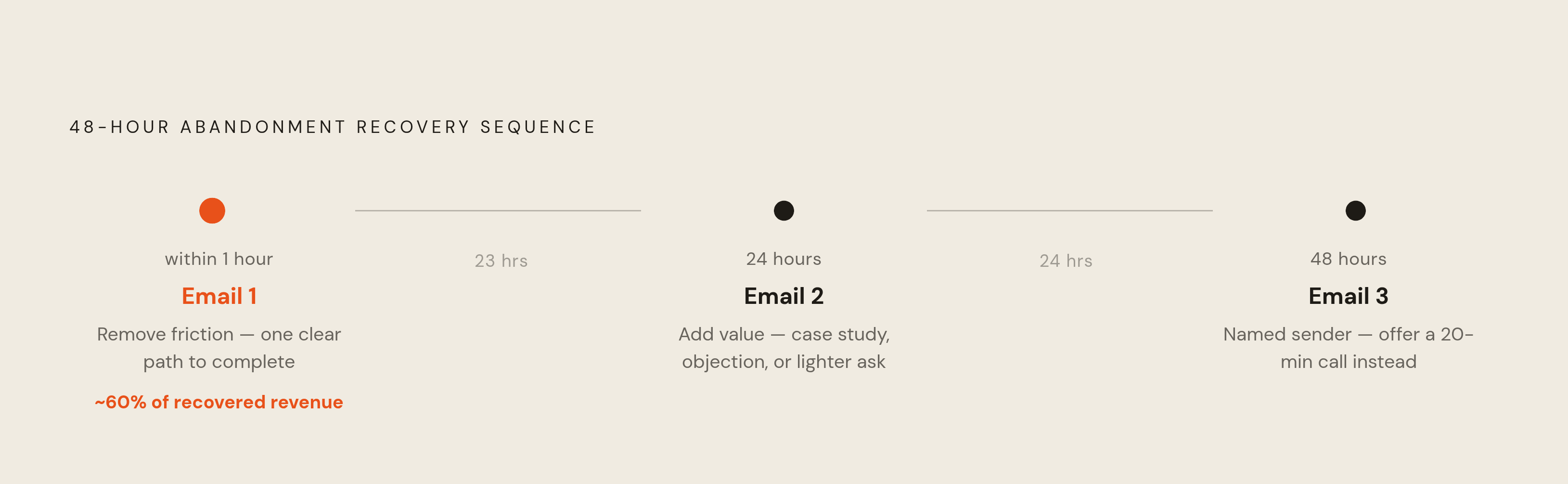
With triggers detecting the abandonment and partial capture identifying the contact, the actual recovery work happens in a short, tightly timed sequence of emails. B2B intent decays faster than consumer purchase intent, so the sequence compresses into three emails across 48 hours, with Email 1 going out within one hour of the abandonment itself. Each position in that sequence does a different job. None of them is a repeat of the one before it with a louder subject line.
Email 1 has one purpose: remove friction. It acknowledges the incomplete action directly, offers the simplest possible path back to finishing it, and carries no promotional content and no case study load. For a demo request specifically, the only thing worth adding is a single, specific customer outcome from a company in the same industry as the contact, nothing more. A delayed first email lets the context go cold, so the original reason for leaving, distraction, hesitation, a technical glitch, is no longer fresh enough to resolve with a short email. Roughly 60% of all revenue recovered across a three-email flow comes from Email 1 alone, regardless of the vertical it's running in, a pattern that holds in e-commerce too.
Email 2 goes out a day after the abandonment and introduces something Email 1 withheld: a specific piece of value. It's a case study drawn from the contact's own industry, a short explainer that resolves a common objection, or a direct link to a lighter-lift alternative, a short intro call instead of a full demo, something that lowers the cost of re-engaging without cheapening the offer.
Email 3 goes out two days after the abandonment and shifts the entire tone of the sequence. It comes from a named team member, and it offers a specific, short meeting. The guide behind this sequence is explicit on this point: Email 3 offers a 20-minute call in place of the form itself, and the named sender along with the human offer are what separate this email from the two before it. It's also the last attempt in the sequence, and it shouldn't repeat whatever was already asked in Email 1 or Email 2.
What none of these three emails should ever become is a discount ladder or an urgency countdown. B2B recovery emails that borrow the "last chance" tone of consumer cart abandonment promotions tend to perform badly, because B2B abandonment rarely has anything to do with price. A prospect who stopped filling out a demo request wasn't waiting for 15% off. They were distracted, unsure, or interrupted, and the sequence above answers each of those reasons directly.
Multi-channel recovery: where LinkedIn retargeting and SMS fit into B2B sequences
Email alone recovers a share of abandoners, but adding channels around it recovers more, and in B2B those additional channels are LinkedIn retargeting and direct outreach rather than the SMS-heavy approach common in consumer recovery flows. B2B audiences are reachable and identifiable on professional networks in ways a consumer shopper simply isn't, and that difference shapes which channels actually make sense to add.
LinkedIn retargeting does a job email can't do on its own: it keeps the company visible in front of the contact during the stretch of time between Email 1 and Email 3, when the prospect is still deciding and could easily run into a competitor's ad or outreach in the meantime. That's a passive, ambient presence that works alongside the email sequence.
SMS has a narrower role in B2B than it does in consumer recovery. It requires explicit opt-in, and it fits later-stage abandonment, a trial sign-up that never got activated, an onboarding flow left half-finished, where a more personal channel makes sense given how far the relationship has already progressed. It isn't a channel for a first-touch recovery attempt on someone who just abandoned a cold form.
The order these channels run in should track how much interest the prospect has already shown. Email goes first, since it's frictionless and can reference the exact thing the prospect left unfinished. Retargeting runs alongside it, passively, in the background. Direct outreach or SMS comes in only if the email sequence produces no open and no click within a reasonable window, so the intimacy of the channel escalates only in proportion to the interest the prospect has actually demonstrated.
Methodology & sources
- Solve form abandonment & boost B2B conversions
Described the partial form submission capture technology that saves field data in real time before a visitor clicks submit.
- B2B Lead Forms: How Many Fields Convert Best? - Brixon
Informed the discussion of how too many fields and forced account creation drive B2B form abandonment.
- Average Abandoned Cart Recovery Rates in 2026 - Sendtric
Provided the benchmark that roughly 60% of recovered revenue in a three-email flow comes from the first email alone.
- Add abandoned cart prospects to recovery workflow form
Informed the description of syncing partial capture data to a CRM via Zapier as part of the contact identification infrastructure.