Measuring Email Deliverability Health Beyond Open Rate
Open rates mask the real problem: whether your emails actually reach inboxes.

- Written by
- Priya Subramaniam
- Published
- October 16, 2026
- Reading time
- 9 min read
- Sources cited
- 1 sources ↓
What this covers
Open rate became a proxy for deliverability by default rather than by design. It answers a narrow technical question: did a tracking pixel fire? That is a fundamentally different question from whether an email reached the inbox, and it tells a marketer nothing reliable about either delivery or human attention.
The pixel and the reader started to diverge structurally in September 2021, when Apple's Mail Privacy Protection began pre-fetching email content on its proxy servers. The system registers an open the moment the pixel loads, regardless of whether the recipient ever opens the message. The two figures diverge enough that an entire dashboard can look healthy while measuring machine activity, not readership.
Corporate infrastructure compounds the problem independently of Apple. Email security systems, spam filters, and firewall scanners automatically retrieve message content for inspection, so they trigger open tracking pixels without any human interaction. A marketing team that optimizes on open rate is effectively optimizing for a blend of proxy pre-fetches, security scans, and an unknown fraction of actual readers.
The metric was always conceptually misplaced for the job it was given. Open rate is a weak engagement proxy at best, not a deliverability signal, and the confusion between those two categories is the foundation on which years of misleading dashboards were built. A program can report a strong open rate while inbox placement deteriorates, list quality erodes through accumulated complaints, and authentication misconfigurations persist, because none of those conditions moves the open-rate needle in real time.
That distinction, between the question "did the email arrive where a human could see it" and "did a human engage with it," structures everything that follows. Deliverability and engagement are separate systems with separate signals, and the failure to keep them apart is what made open rate so seductive and so misleading as a single source of truth. The replacement is not one metric but a system of metrics that maps to the actual mechanics of modern email.
How the 2025–2026 enforcement wave changed the consequences of ignoring deliverability
The cost of misreading the metric changed in character across 2025 and 2026. Non-compliant bulk mail is no longer quietly routed to the spam folder, where a sender might eventually notice a drop in opens. It is rejected at the server level before it enters the recipient's mailbox environment at all. The message does not exist in the inbox or in any folder. It is refused outright.
Gmail moved first: since November 2025, non-compliant bulk email receives temporary 4xx and permanent 5xx server-level rejections rather than spam routing. Microsoft Outlook began its enforcement on May 5, 2025, with hard rejection via error code 550 5.7.515 phased in after an initial junk-folder enforcement period. That error code is explicit about the failure: the domain does not meet the required authentication level. La Poste joined the wave in September 2025, a signal that authentication mandates have moved beyond the U.S. majors and are now operating at national-postal-operator scale. This is not a Google-and-Yahoo-only policy environment anymore, and it has not been since 2025.
The operational consequence is sharper than a gradual deliverability decline. Under the earlier regime, a sender who ignored authentication requirements would see messages filtered to spam, which produced a slow degradation in open rate that a diligent team might eventually notice. Under the new regime, the same sender's messages stop existing at the point of transmission. There is no open rate to monitor, because there are no delivered messages to open. Open rate was never capable of detecting authentication failures or accumulating complaints, but in the spam-routing era that blindness was survivable. In the rejection era it means a program can go from apparently healthy to operationally dead with no warning in the metric it was taught to trust.
Authentication compliance as the entry gate, not a performance lever
Authentication is the first condition mailbox providers evaluate, and everything downstream depends on it. SPF, DKIM, and DMARC compliance is a gating test: without passing it, a sender's reputation and engagement signals are never reached. The mailbox provider does not consult behavioral history for a message that fails the gate. That makes authentication a prerequisite, not a competitive advantage. Clearing it does not improve placement. Failing it eliminates placement entirely.
The surface-level compliance numbers conceal a meaningful gap. DMARC record presence has spread widely across commercial domains, which can make an organization look compliant in aggregate reporting. But a 2026 industry analysis of email deliverability benchmarks found that only 35% of DMARC records are set to p=reject enforcement level. That gap between record presence and enforced policy is where most deliverability risk now concentrates.
Even full enforcement does not guarantee placement. A sender with SPF, DKIM, and DMARC at p=reject can still miss the inbox consistently if its list is disengaged. Treating authentication as a finish line is an error in the same family as treating open rate as a health signal. Both mistakes confuse a single component of the system with the system itself.
BIMI sits in an awkward relationship to this confusion. But BIMI does not directly affect deliverability or inbox placement. An organization that invests in BIMI because a vendor promised open-rate improvement is calibrating that investment with a broken instrument. The practical sequence is straightforward: audit authentication posture first to clear the gate, then treat inbox placement and engagement signals as the actual performance dials.
Inbox placement rate as the primary deliverability metric
Inbox placement rate answers the question open rate was believed to answer: of the emails sent, what share arrived in the primary inbox rather than the spam or junk folder? It is the correct primary deliverability indicator because it distinguishes between server acceptance and actual placement. Delivery rate measures only whether the receiving server accepted the message, but a message accepted into the spam folder has "delivered" by that definition and failed by any practical one. Inbox placement rate captures the practical outcome.
Placement variance across industries is not a function of mailbox provider preference. It is driven by structural differences in how lists are built, how often senders mail, and what kind of content they send. The pattern is predictable because the factors are structural, which means they are addressable. Education is the instructive case. Other 2026 benchmarks place education first in inbox placement, which underscores how much the structural specifics of a given sending environment, rather than category reputation, determine the outcome.
The gap between the top and bottom of the industry range is not a statistical curiosity. For a large list sending at regular frequency, the difference between top-of-range and bottom-of-range placement translates to many millions of additional inboxed messages per year. The revenue impact of placement variance is direct, not theoretical, and no amount of open-rate optimization recovers messages that were never placed.
Spam complaint rate and hard bounce rate as the fastest-moving reputation signals
Inbox placement is an outcome. Complaint rate and bounce rate are the inputs that drive it, and they move faster than any positive engagement metric. Mailbox providers weight these negative signals heavily when recalculating sender reputation between sends. A send that produces a spike in complaints changes the sender's standing before the next campaign goes out.
Spam complaint rate reflects targeting quality, not list size. A complaint is a recipient actively signaling that a message should not have reached them, and mailbox providers treat that signal as a trust violation. A rate that was tolerable two years ago may now place a sender below the threshold at which providers begin suppressing mail.
Hard bounce rate tells a parallel story about list hygiene. Bounced messages signal that the sender does not know who its recipients are, and providers read that ignorance as sloppiness at best and list-buying at worst. Contact databases degrade over time as people change jobs, abandon inboxes, or simply stop engaging, and that decay, left unmanaged, feeds directly into both complaint and bounce accumulation.
The Disaffection Index gives this dynamic a useful shape. A program can show decent click rates and acceptable revenue per email while its disaffection index climbs, so deliverability is degrading even as surface engagement looks fine. The metric matters because it bundles signals that, tracked in isolation, each stay just below the threshold of management attention until the compound effect has already done damage.
The engagement signals that complete the picture: CTOR, reply rate, and conversion
Once the deliverability stack confirms that mail is reaching inboxes and that complaints and bounces are within thresholds, the engagement stack answers a different question: is the content resonating with the right people in a way that produces business outcomes? These are not replacement metrics for open rate. They answer a question open rate was never clean enough to answer, and they answer it with signals that reflect real behavioral intent.
Click-to-open rate is more meaningful than raw click-through rate because it normalizes clicks against openers rather than total delivered emails. Validity identifies CTOR alongside inbox placement as part of the revised metric landscape that followed MPP's disruption of traditional open tracking. The metric is imperfect, but its imperfection is known and bounded in a way open rate's is not.
Reply rate carries a different kind of weight. A reply requires genuine investment: the recipient has read the message, formed a response, and typed it out. A single-question prompt at the end of a message converts more reliably than a generic "get in touch" sign-off.
Conversion metrics are where email performance connects to business outcomes. Revenue per email, downstream purchases, form fills, and demo bookings measure whether the engaged audience is doing the thing the program exists to produce. Deployteq identifies click-through rates, conversion rates, revenue per email, and deliverability scores as the KPIs that have replaced open rate as primary measures in 2026. The integrated view is the point: deliverability confirms the mail arrived, engagement confirms the content worked, and conversion confirms the business result followed. No single metric carries the chain from one end to the other.
How the two stacks interact and what a complete health dashboard looks like
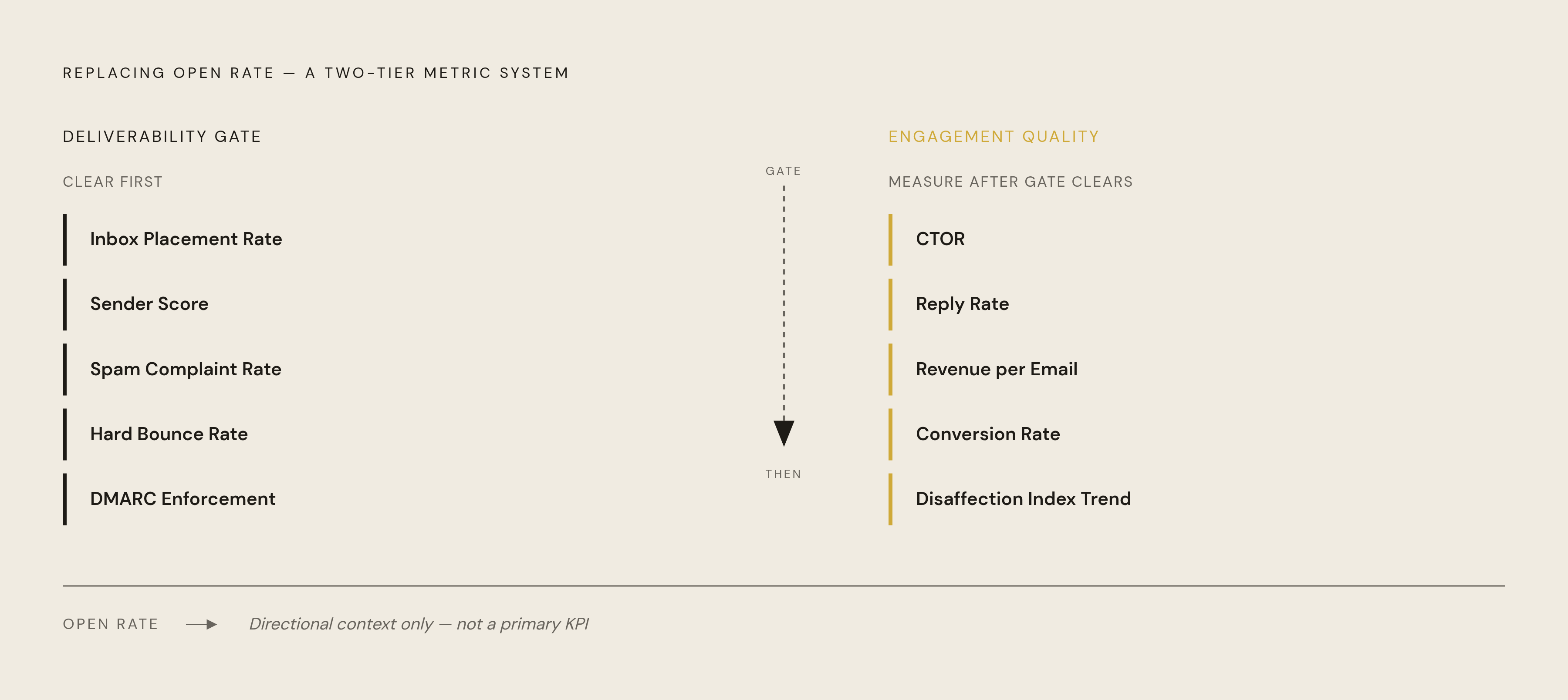
The two stacks are not independent checkboxes. They form a system with internal dependencies, and weakness in one layer compounds into problems in the others. Authentication clears the gate. List hygiene and suppression keep complaint and bounce rates below threshold. Strong engagement signals reinforce sender reputation and improve future placement. Rising disaffection erodes reputation even when top-line engagement looks healthy.
A sender who is fully authenticated but sends to a disengaged list will still miss the inbox. Authentication is necessary and not sufficient. A sender with strong engagement signals but a rising complaint rate is burning reputation faster than positive signals can rebuild it. The system-level view forces both truths to be held at once, which is exactly what a single-metric dashboard cannot do. Open rate offered a single number precisely because it ignored the interactions. The replacement dashboard has to accept more complexity because the system it describes is complex.
The two-tier deliverability structure that has emerged, with programs above the median pulling further ahead and programs below facing compounding degradation, is a direct consequence of ignoring this system-level view. A sender who monitors placement, complaints, bounces, and engagement sees the early signs of trouble and corrects course before reputation damage becomes a server-level rejection. A sender who watches open rate sees nothing until the mail stops arriving. The divergence between those two outcomes is not a metaphor. It is the observable consequence of two different measurement philosophies operating under the same enforcement regime.
A practical health dashboard draws from both stacks without pretending they are the same layer. The deliverability stack tracks inbox placement rate, Sender Score, spam complaint rate, hard bounce rate, and DMARC enforcement status. The engagement stack tracks CTOR, reply rate, revenue per email, conversion rate, and the disaffection index trend. Open rate is retained only as directional context for trend-spotting within a single audience segment, never as a primary KPI or a deliverability signal. The metric's remaining usefulness is narrow and conditional, and it does not extend to the questions this piece has been asking.
Platforms purpose-built for deliverability monitoring, including Validity's tools and Brevo's reporting infrastructure, surface both stacks in a single view. A complete health picture requires the full signal system. Building that dashboard is the practical output of everything the argument has established: not replacing one number with another, but replacing a false simplicity with the real structure of how email actually works.
Methodology & sources
- Email Deliverability 2025 Benchmark Report
Provided the finding that only 35% of DMARC records are set to p=reject enforcement level, and identified CTOR alongside inbox placement as key metrics in the post-MPP landscape.