Separate Domain Architecture for High-Volume Sales Email
Separate sending domains protect your primary email address from outbound campaign risks.

- Written by
- Marcus Thibodeaux
- Published
- October 30, 2026
- Reading time
- 8 min read
What this covers
- Why domain architecture, not copy or volume, determines outbound email outcomes in 2026
- How domain reputation works and why a single sending domain is a single point of failure
- The three-tier domain structure that separates outbound risk from brand reputation
- Volume math and inbox-per-domain limits that determine how many domains a team actually needs
High-volume sales email in 2026 needs separate domain architecture as well as stronger copy or larger lists. Separate sending domains, full authentication, and checks on reputation keep the primary domain safe from the risks of outbound mail. That protection works only when each domain is warmed carefully and governed by the same standards for targeting, list quality, and suppression.
Why domain architecture, not copy or volume, determines outbound email outcomes in 2026
February 2024 was when bulk-sender requirements began to become mandatory, with more enforcement later. Google began to require authentication and complaint thresholds for delivery, where these had once been optional best practices. Copy and targeting now operate within the access that technical configuration and sender reputation permit.
Gmail’s machine-learning filters also assess content relevance and engagement patterns, including reply rate, time-to-open, forwarding behavior, and inbox folder placement. Those signals extend beyond explicit spam complaints. A campaign can hurt its sender score when people keep deleting its emails without opening them, even if nobody reports it as spam. Better wording cannot compensate for a sending structure that exposes essential business mail to those signals.
How domain reputation works and why a single sending domain is a single point of failure
Domain reputation works like a credit score attached to the domain. Every sending stream using that domain contributes to a shared history. Changing the mailbox does not reset that history. When cold outreach, invoices, password resets, and support replies share a domain, complaints from prospecting can reduce deliverability for all of them.
The exposure extends beyond a single campaign. Providers also track infrastructure patterns across domains, so poor reputation on one can degrade performance on affiliated domains using the same infrastructure. Separate domains therefore set a boundary, but providers can still detect patterns across them. Their value depends on how the whole sending system behaves.
Recovery is slow once a domain is flagged. It can require weeks of careful reduced-volume sending, and an outbound domain may ultimately need to be abandoned. The primary domain cannot reasonably follow that trajectory because customer and operational communication depend on it. The durable protection is to separate outreach reputation from the primary domain before sending begins.
The three-tier domain structure that separates outbound risk from brand reputation
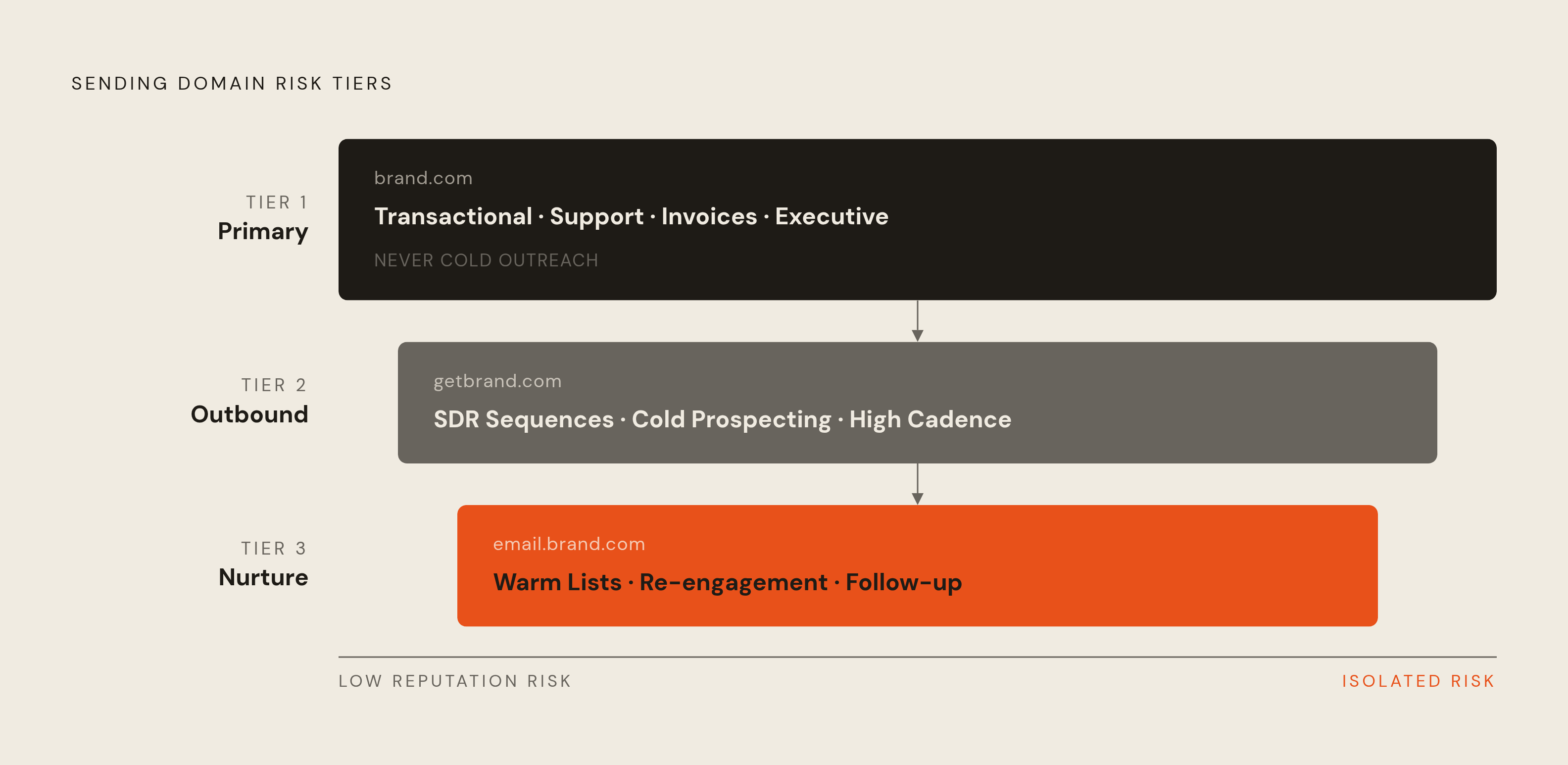
The practical structure has three distinct tiers. The primary domain handles transactional mail, customer support, invoices, inbound replies, and executive one-to-one communication, but never cold outreach. Separate outbound root domains handle SDR sequences, cold prospecting, and high-cadence sends. A nurture tier handles warm-list sequences, re-engagement, and less frequent follow-up while keeping them apart from the cold program’s risk of complaints.
A dedicated subdomain such as email.brand.com or mail.brand.com separates a sending stream while keeping the brand recognizable. Prefixes such as email., mail., go., and info. are preferable to newsletter. or marketing., which can attract more aggressive promotional scoring. Subdomains are a practical option for many B2B marketing and sales sequences.
High-risk cold outreach needs more distance from the primary domain. A separate root domain such as getbrand.com gives the most domain-level isolation and keeps the primary domain out of the sending identity, unlike a subdomain of brand.com. It should resolve to a redirect or a one-page brand presence. A domain that sends email but has no website resembles disposable spam infrastructure.
Volume math and inbox-per-domain limits that determine how many domains a team actually needs
Sizing begins with the inbox. The operating limits are no more than 100 emails per inbox per day and no more than two to three outreach-dedicated inboxes per domain. Adding more mailboxes to one domain can make the pattern resemble bot behavior.
For a team of 3–5 SDRs whose planned volume requires roughly seven inboxes, a maximum of three inboxes per domain means three outbound domains. With two domains, the team would have to go over that mailbox limit. This is the useful arithmetic for planning capacity, rather than treating the number of SDRs as a direct proxy for sending volume. Distribution also limits the share of the program exposed to a blocklist event on one domain.
Over-provisioning creates a different risk. Roughly more than 10 to 15 active sending subdomains can resemble snowshoe spam, where volume is spread across many identifiers to dilute negative signals. More domains are not automatically safer.
Authentication records every sending domain requires before a single email goes out
SPF, DKIM, and DMARC are the mandatory foundation. SPF declares which servers may send for a domain, using one SPF TXT record with legitimate sources merged into a single v=spf1 string. Multiple separate SPF records break validation. DKIM signs outgoing messages so receiving servers can detect alteration in transit, using a 2048-bit key whose public component is published at the correct DNS selector.
DMARC supplies the policy and reporting layer. Its deployment should start at p=none for two to four weeks while aggregate reports are reviewed for legitimate sending sources and alignment. Once those sources are accounted for, the policy advances through p=quarantine to p=reject.
A custom tracking CNAME replaces a shared ESP tracking domain so links resolve through the sender’s domain. PTR records map the sending IP back to its hostname and must be set by the ESP or host. The return-path also needs alignment, so mail from team@brand-hq.com does not use a generic ESP identity for bounces. MTA-STS and BIMI belong to the next tier after this foundation.
Every sending domain needs to be fully set up on its own. SPF, DKIM, and DMARC do not inherit from another domain, and reusing sending infrastructure does not remove that requirement.
How to warm a new sending domain without triggering the filters it is meant to avoid
Sending production volume from a new domain can trigger spam classification on day one, followed by weeks of reduced volume and manual remediation. Correct authentication establishes identity, while warmup establishes sending history. Skipping warmup can cost all the time saved by setting up the domain faster.
A new domain should complete at least four weeks of warmup before live campaigns begin. During that time, small numbers of emails sent to best-fit contacts should draw real engagement. Volume can build as reputation develops. Strong inbox placement in tests is a condition for moving into production.
Automated warmup networks introduce their own exposure. Filters can spot unnatural exchanges among accounts that work together, so synthetic engagement can hurt reputation. Genuine replies, forwards, and opens are the relevant signals. Every domain added to the rotation therefore needs an independent warmup cycle, which makes lead time part of the cost of scaling.
Reputation monitoring across multiple domains once the system is running
A multi-domain system creates several reputation pools that can deteriorate independently. Monitoring must show which domain is losing placement, accumulating complaints, or failing authentication before the damage spreads. Without those checks, separate domains add more work to running the system and give less protection than they could.
Google Postmaster Tools provides Gmail domain reputation, spam rate, and authentication pass data at no cost. DMARC aggregate reports sent to the address in rua= show which senders lack permission and where legitimate sources have alignment problems. Inbox placement tests use seed mailboxes at Gmail, Outlook, and other providers to show where the messages land. Automated blocklist checks should cover each sending domain and its associated IP addresses, including checks against Spamhaus and Barracuda.
Complaint rate deserves close attention at domain level. Placement deterioration or elevated complaints should trigger a pause while list quality, content, and send frequency are investigated. A major blocklist entry likewise requires investigation and remediation before sending continues. Continuing through visible damage can turn a recoverable problem into a domain replacement.
List hygiene and suppression management across multiple sending domains
A new sending domain is not a new permission state. A recipient who rejected outreach has not become eligible again because the sender changed addresses. Re-contacting that person increases complaint risk on the new domain and defeats the purpose of separating reputation. Suppression must follow the contact across the architecture.
That requires a global suppression list covering outbound and nurture domains. A contact who unsubscribed or complained on outbound-a.com must also be suppressed on outbound-b.com and the nurture domain.
List verification addresses a separate source of damage. Stale contact data produces bounces even when every authentication record is correct, so verification before sending belongs within infrastructure hygiene. Authentication proves the sender’s identity, but it cannot repair an invalid recipient address.
What the lookalike domain approach gets right and where it creates its own risk
Lookalike domains solve an isolation problem while creating a legitimacy problem. A domain such as getbrand.com resembles brand.com without being the primary company domain, a pattern also associated with phishing infrastructure. That resemblance deserves direct scrutiny. The distinction is between a company-controlled sending identity and a domain whose similarity does deceptive work.
The mitigations make ownership and identity explicit. The domain should resolve to a real page or redirect to the primary website, while the From name and signature clearly identify the sender and company. The company should register the domain itself rather than leave ownership with a third-party agency. It should also include the domain in its DNS management as part of its legitimate infrastructure.
Those measures do not make weak outreach effective. Modern filters assess message-similarity clusters, engagement decay, and the linguistic patterns of templated copy as well as domain reputation. Poor targeting can therefore produce poor placement on a properly configured separate domain. Domain architecture is a defensive measure.
Building and operating the full architecture in practice: tooling, sequencing, and ongoing management
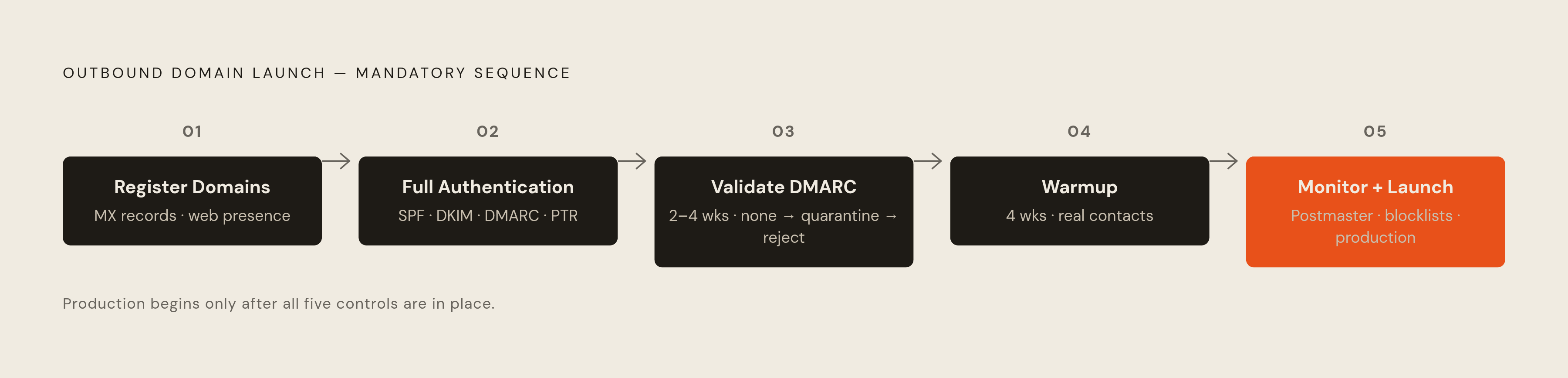
The deployment sequence begins with domain procurement. Register the outbound and nurture domains, configure MX records for inbound mail, and give each a real web presence. Second, configure the full authentication stack independently on every domain, including SPF, 2048-bit DKIM, and DMARC initially at p=none. Custom tracking, PTR configuration, and return-path alignment belong in this stage.
Third, validate DMARC through its aggregate reports over two to four weeks, then advance through quarantine to rejection once legitimate sources align. Fourth, complete the four-week warmup for each domain by sending small numbers of emails to real contacts. Fifth, configure Postmaster Tools, DMARC report parsing, placement tests, and blocklist monitoring before campaigns go live. Production begins only after those controls are in place.
Existing prospecting tools can support this structure. Instantly, Apollo, ZoomInfo, and Klenty support custom sending domain configuration. Warmy offers a free SPF Generator and a free DMARC Generator, while Cloudflare’s SPF/DKIM/DMARC reference explains the underlying mechanics. These tools support deployment but do not replace domain-level validation.
The operating commitment continues after campaigns launch. Each added domain needs authentication and warmup, while existing domains require regular DMARC review and complaint monitoring. Global suppression must cover each new domain as the system grows. Growth should stay within the inbox and domain limits, with new capacity introduced deliberately and reputation problems addressed directly.