CRM Data Hygiene Audits for Revenue Teams
Cleaning your CRM reveals pipeline inflation and restores forecasting reliability for revenue teams.
- Written by
- Taryn Osei-Mensah
- Published
- October 17, 2026
- Reading time
- 9 min read
- Sources cited
- 1 sources ↓
What this covers
A CRM data hygiene audit is a repeatable process for finding and fixing the decay that undermines pipeline accuracy, forecasting reliability, and rep productivity. Its value comes from more than cleaner records. Revenue teams need a measured baseline, an ordered cleanup sequence, stronger entry controls, and a recurring Data Integrity Score that makes the condition of the CRM visible to leadership.
Why revenue teams cannot forecast reliably from a CRM that decays on its own
Contacts change jobs, companies rename or merge, and businesses close while their CRM records remain in place. Inside the revenue team, rushed manual entry, unclear ownership, and missing validation add further errors. Disconnected integrations can then overwrite accurate fields with inconsistent values. These are structural sources of decay. A deal left in an active stage after its close date has passed can still appear in pipeline coverage even when the record no longer reflects a live opportunity.
That gap between the record and reality makes forecasting the highest-stakes consequence of poor hygiene. Inaccurate stages inflate coverage, while stale records obscure the risk within it. Reps also spend time verifying contacts instead of selling, so the same defects weaken both the forecast and the work needed to deliver it. A database that was clean at implementation therefore cannot remain a reliable forecasting input without deliberate intervention. Leadership cannot course-correct confidently when the pipeline metrics depend on records that no longer describe the business.
External changes require records to be refreshed or removed from active use, while internal failures require changes to how records are created and maintained. Cleaning the current database addresses its condition today. Diagnosing the sources of decay explains why that condition will deteriorate again.
The five data quality problems that distort pipeline most
The audit should first distinguish five failures that distort pipeline in different ways. Incomplete records leave deals without a next step, close date, or contact role, so coverage can look stronger than the buyer engagement behind it. Missing fields, including industry, employee count, and revenue tier, break scoring, routing, and segmentation, sending campaigns to the wrong audience or no audience. Incorrect data, including wrong job titles, outdated email addresses, and misspelled company names, causes bounced outreach, mis-routed leads, and unreliable attribution. Duplicate records count the same contact or account more than once, inflating pipeline volume and activity metrics while allowing reps to work the same deal unknowingly. Expired records still have close dates that have passed, contacts at closed companies, or lifecycle stages that are out of date, making active pipeline look larger than it is.
These categories give the audit a concrete scope. They also distinguish defects that may look similar but require different corrections. A missing field needs a valid value, while an expired record may need to be taken out of active forecasting altogether. Check integration mappings across these categories because inconsistent syncs can replace good data with non-standardized entries. Finding a defect is therefore only the start of diagnosing it.
What to measure before cleaning anything — the baseline audit
Before running a query, define what “clean” means for the CRM. Write down which fields are required, which formats are accepted, which lifecycle stage triggers are valid, and what rules govern owner assignment. Without them, a populated field can appear complete even when its value is unusable. The baseline must measure conformity to agreed rules.
Next, pull a full export and score it against those standards. Measure the percentage of contact records with all required fields populated. Measure the percentage of open opportunities with a valid close date and next step. Count how many accounts appear more than once. Record completeness rate, duplicate rate, and field accuracy rate as the core dimensions of the baseline. Preserve those results before making changes so that later comparisons can show whether the audit worked.
Score contacts, accounts, opportunities, and activities as their own groups. Each object decays differently and requires different cleanup work, so a single undifferentiated result can conceal the pattern that needs attention. Within those objects, identify whether defects came from manual entry, form submissions, list imports, or integration syncs. Depending on the source, the remedy belongs in a rep workflow, an entry rule, or a system mapping. This step connects the score to a corrective action rather than leaving it as a description of the damage.
Document the results as a Data Integrity metric that can be tracked over time. The baseline establishes both the priorities for cleanup and the starting point for quarterly comparisons. Skipping it to delete obvious duplicates may improve the database, but it removes the evidence needed to judge the work.
Deduplicating and standardizing records — the core cleanup sequence
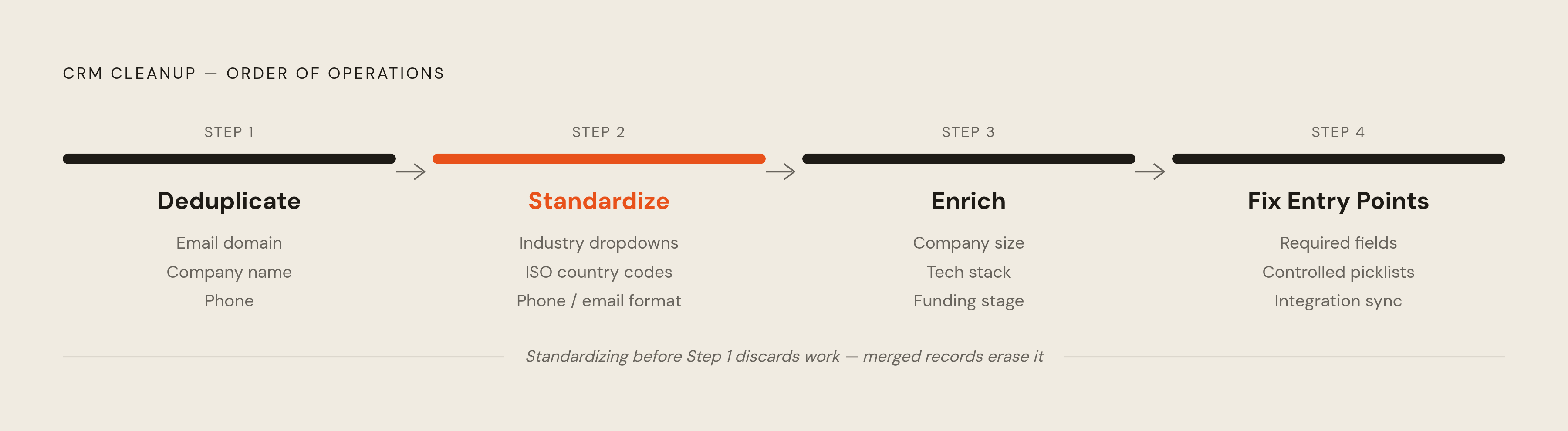
Cleanup often creates rework because the right actions happen in the wrong order. Formatting standards must be defined before records are changed, but bulk standardization should follow deduplication. Otherwise, the team spends effort correcting records that will be merged away. Conversely, merging without an agreed target format leaves surviving records inconsistent. The distinction is between defining the rules first and applying them to the surviving database later.
Start with automated duplicate detection for contacts and accounts, using email domain, company name, and phone number as match keys. Common surnames make name-only matching prone to false positives. Before merging, define which record survives, typically the most recently updated, and which information from the losing record must be preserved. Activity history and notes belong in that decision, as do the fields to be discarded. Automate merge decisions where the rules support them, but flag uncertain near-duplicates for human review because a wrong merge is harder to undo than a temporary duplicate.
Once duplicates are resolved, apply the fixed taxonomy to the surviving records. Use dropdown values for industry, a standard set of seniority and function combinations for job title, and ISO codes or a controlled list for country and state. Normalize phone number formats, email domains, and company names with find-and-replace rules or bulk update tools. This makes standardization a consistent operation across retained records and gives later enrichment a defined format to follow.
Finally, follow an archive or deletion policy for records that are no longer in use. Archiving does not mean deleting, because a record may still have historical value for attribution or compliance. The critical distinction is whether it belongs in active forecasting and campaign views. Records retained for history should not continue to count as current revenue potential.
Enriching incomplete records without creating new maintenance debt
After deduplication and standardization, enrichment can fill gaps that those operations cannot resolve. Prioritize the work by pipeline impact, starting with open opportunities missing close dates, decision-maker contacts missing direct email, and accounts missing industry or employee count. These gaps affect forecasting and routing. However, identifying them as priorities does not mean an external provider can supply every answer. Information about internal deals still depends on the team following a sound process.
Use enrichment tools to fill firmographic gaps on accounts that match the ICP. Fields to fill include company size, industry, technology stack, and funding stage. Those values can improve lead scoring and territory assignment when the team has a defined use for them. Before running enrichment at scale, decide which fields are required and which are optional. Enriching every field that is available adds work to keep up fields that are never used for routing, scoring, or reporting.
The activation plan matters as much as the added data. Even with a fuller account record, stage definitions can still differ and ownership rules can still be unclear. If those conditions remain, enriched records can drift back into the same state within months. Enrichment should therefore add data for a defined revenue workflow, with a use for the fields that make the database larger. Its success depends on whether the added fields are used and maintained.
After enrichment, manually validate a sample of updated records against the actual accounts. Vendors differ in coverage and recency, so a confidently populated field is not proof of accuracy. Wrong data can be worse than a blank because it appears ready for use. Sampling keeps gap-filling subject to the same quality standards as the rest of the audit.
Fixing the entry points that produce decay in the first place
Manual entry under quota pressure is a particularly corrosive entry point. Reps rush records, placeholder text remains uncorrected, and fields considered low-priority are left blank or filled with defaults. Fixing those values while keeping the same entry process leaves the cause in place. The corrective action must change the conditions under which records enter the CRM.
Start with required field rules that let records be saved only when they have the minimum viable data. That minimum includes an email domain, an account name, a lifecycle stage, and an owner assignment. Use controlled picklists in place of free-text fields for industry, job function, deal stage, and lead source. These controls remove variant spellings and make values filterable from the outset. Their purpose is to make valid entry part of the workflow.
Automation can reduce the manual burden, but it is only part of the fix. AI conversation tools can capture structured CRM fields directly from recorded sales calls, removing the gap between a call ending and a rep updating the record. Attention's analysis of its own call corpus found unprompted buyer mentions of CRM field write-back in 25.4% of analysed calls in the March to August 2026 window. That finding suggests awareness of the gap, rather than proving that automation alone resolves it. The team still needs to agree on what the fields mean and who owns them.
Use the same rules for every connected system, including marketing automation, billing, and enrichment tools. Audit field mappings and define explicit sync priority rules for conflicting values. Otherwise, an integration can undo cleanup by overwriting accurate data with a non-standardized entry. Governance determines the rule, while the tool carries it out.
The recurring cadence that keeps audit findings from expiring
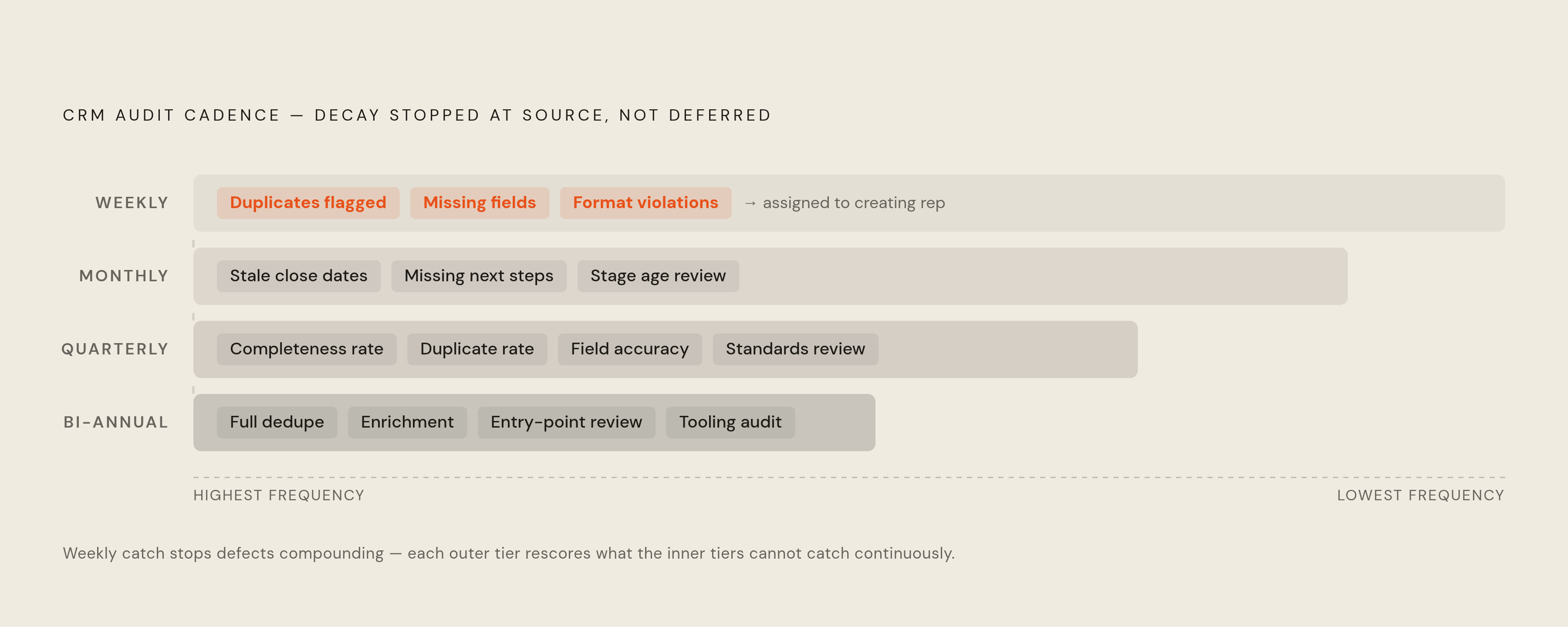
Weekly automated checks should flag new duplicates, missing required fields, and formatting violations introduced in the past seven days. Assign each flagged record to the rep or owner who created it rather than sending all resolution work to a central ops team. This closes the feedback loop at the source of the error. It also catches defects before they spread through connected workflows.
Monthly pipeline reviews should check all open opportunities for stale close dates, missing next steps, and stage ages longer than the average sales cycle. Update or archive records that cannot be substantiated. A deal with no activity and no next step is forecast noise. This review keeps the distinction between historical records and current opportunities visible.
Quarterly mini-audits should score the data again as in the baseline, using completeness rate, duplicate rate, and field accuracy rate. Compare the results with past quarters to see whether cleanup and entry controls are still working. Review the data standards document at the same time. Field definitions, required fields, and lifecycle stage triggers need to reflect changes in the sales motion or product line.
Bi-annual full audits should repeat the complete deduplication, standardization, enrichment, and entry-point review sequence. Evaluate whether tooling and integration settings still match the current tech stack. Systems added or removed since the previous audit may have introduced new sync conflicts.
At each cadence, report a Data Integrity Score to revenue leadership with the pipeline metrics. Make completeness, accuracy, and consistency visible at dashboard level, supported by the audit's tracked dimensions. This discipline also helps with AI-driven forecasting, lead scoring, and conversation intelligence, which need CRM inputs that follow the same structure each time. RevOps cleanup becomes a durable revenue practice when leadership tracks its result as a Data Integrity Score.
Methodology & sources
- AI CRM Data Hygiene in 2026: What Revenue Teams Need to Know
Provided the statistic that unprompted buyer mentions of CRM field write-back appeared in 25.4% of analysed calls between March and August 2026, and supported the discussion of AI conversation tools capturing structured CRM fields from sales calls.