Evaluating B2B Data Providers on Accuracy, Coverage, and Compliance
Run a proof-of-concept before committing to any data provider.

- Written by
- Taryn Osei-Mensah
- Published
- October 20, 2026
- Reading time
- 9 min read
What this covers
To judge B2B data providers on accuracy, coverage, and compliance, you need more than their published claims of high accuracy. A provider must return contacts that you can use, that were lawfully sourced, and that fit your ideal customer profile, or ICP. A controlled proof-of-concept is the way to establish that fit before committing, because database size and aggregate accuracy conceal the differences that determine outbound performance.
Why vendor accuracy claims and field results diverge so sharply
A matched record is not necessarily a verified contact. Vendors can count a record as a match whether its email was confirmed deliverable or inferred from a naming pattern. That distinction changes what an accuracy figure measures before freshness or geographic coverage enters the calculation. A database can return the requested person without returning a usable way to reach them.
The second cause is freshness lag, which is the interval between the vendor’s last verification pass and the buyer’s test. A record that was accurate when verified may no longer be valid when exported. Independent tests therefore measure data at a different point in its useful life than the vendor’s benchmark. Phone reachability needs its own check, since email accuracy does not show that a direct dial works.
The third cause is the benchmark population. Providers measure performance most favorably in the segments where their coverage is strongest, but US enterprise SaaS is not interchangeable with EMEA mid-market manufacturing or trades contractors. Independent tests consistently find lower email accuracy and still lower phone accuracy because these differences shape which records get tested. The gap is therefore not random noise. It reflects what was counted, when it was verified, and which buyers the database represents well.
Why data decay makes the accuracy problem worse over time
Even a database that is accurate at purchase can degrade materially within months. Email addresses decay faster than firmographics, and phone numbers can change even when both stay the same. Titles become stale through promotions, restructuring, and departures, so a deliverable email can still belong to someone who no longer matches the target persona.
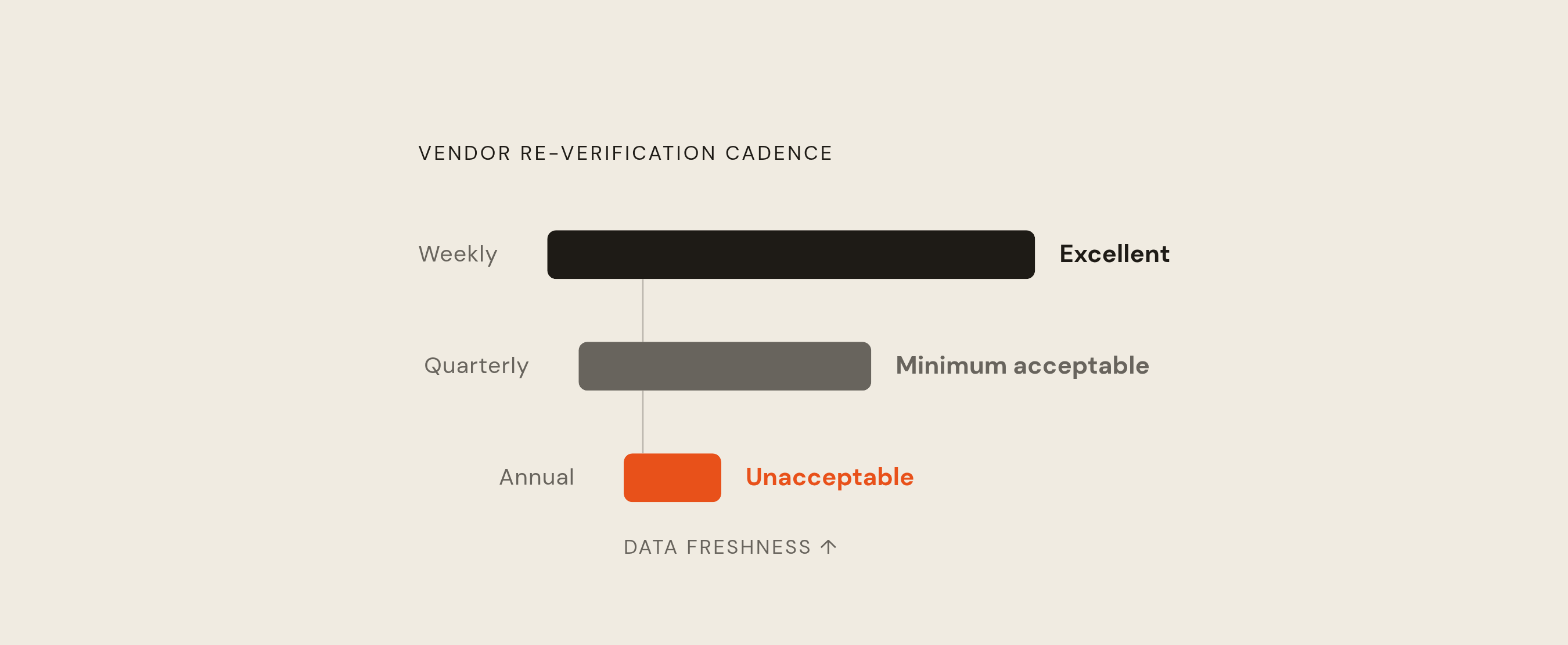
Title accuracy also degrades faster than email accuracy because role changes are harder to detect programmatically than a bounced email. This means freshness cannot be reduced to a single database-wide timestamp. A provider’s refresh cadence matters, but so does whether that cadence covers the fields and segment the team intends to use. Weekly and quarterly re-verification leave meaningfully different amounts of time for records to become unusable.
The vendor’s record re-verification frequency is therefore the diagnostic measure. For active outbound use, weekly re-verification is excellent, quarterly is a minimum, and annual is unacceptable. Evaluation is consequently time-sensitive. A successful test establishes current fitness, while the refresh process determines how much confidence that result deserves over time.
How mailbox enforcement and privacy law have raised the cost of using bad data
The consequences of stale or unverified data now extend beyond wasted sales effort. Mailbox enforcement can damage deliverability immediately, while a team must meet privacy obligations to use a record lawfully. Accuracy and compliance therefore belong in the same evaluation, even though neither substitutes for the other.
Google and Yahoo implemented bulk sender authentication requirements including SPF, DKIM, and DMARC. Google defines its bulk sender threshold as exceeding 5,000 emails per day, while Yahoo applies its requirements to senders of significant volume without publishing a specific numeric threshold. When hard bounce rates rise above published thresholds, emails can be marked as spam automatically. Bad data can therefore damage sender reputation faster than a regulatory process can produce a fine. Authentication does not remove the operational cost of sending to unusable contacts.
Privacy exposure has increased as well. GDPR enforcement has led to billions in fines since 2018, and because California’s business-to-business exemption has expired, a Californian’s work email and direct dial are protected personal information under CCPA. The California Attorney General has ruled that qualifying inferences drawn from personal information are also personal information under CCPA. Those inferences include seniority inferred from job title and budget authority inferred from company revenue, and they are subject to right-to-know obligations, though not necessarily deletion obligations, when they meet the two-prong statutory test.
The practical vendor test is whether the provider can document the source and lawful basis for every record. Scraped-and-sold lists are the highest-risk category, and undocumented sourcing should be treated as non-compliant. California’s DROP platform also makes deletion handling a concrete procurement question. A vendor’s answer must cover both its own records and whether deletions propagate to connected CRM and sequencing tools.
How geographic focus and ICP vertical determine which providers are actually usable
Geography and vertical provide the first useful filter because provider strength is segment-specific. ZoomInfo’s strongest fit is US enterprise coverage, where its org chart and firmographic depth support detailed account targeting. Its high-volume weekly refresh is another differentiator in that segment, while pricing is quote-based across tiers.
Cognism represents a different fit, with a GDPR-native position and particular strength in the UK, DACH, Nordics, and Benelux. Apollo, by contrast, offers self-serve access to hundreds of millions of contacts and tens of millions of companies, with its strongest self-serve coverage in North American tech and SaaS. That combination makes it accessible to mid-market teams testing before an enterprise commitment.
Local businesses and SMB verticals require a different architectural question. Major horizontal providers have structural gaps in segments such as trades and franchises, where LinkedIn coverage is thin. Enrichment starts with accounts a team already knows and appends attributes to them. Discovery builds the account universe from other sources, including licensing boards, permit filings, and county registries. If the missing element is the account universe itself, enrichment cannot solve the problem.
Artisan Local Data addresses local-business coverage rather than relying only on a professional contact database. Artisan reports that SumUp used it to reach local businesses at a steady cost per lead and get positive replies consistently each week. Intent platforms such as 6sense and Bombora address the need to surface accounts showing active research behavior, a separate need from the delivery of direct emails or phone numbers. Comparing intent discovery with contact delivery as though they were the same service obscures what the team actually needs to buy.
What waterfall enrichment does that single-source querying cannot
Once the target accounts are represented somewhere in the available sources, waterfall enrichment can address gaps within any one provider. A waterfall queries providers in sequence and accepts the first verified result. If provider A lacks a contact, provider B or C may return it. Coverage grows while the verification standard stays the same at later steps. The architecture separates the search for a record from the decision to accept it.
That distinction matters because a single-source query stops at the boundary of one database. A waterfall can cross those boundaries, but it introduces a real governance cost. Records come from different suppliers, so it is harder to document their provenance and who is accountable for compliance. When a regulator asks which vendor supplied a particular record, the orchestration layer must preserve the answer. Source attribution per record allows that documentation to be built into the waterfall, saving the work of reconstructing it afterward.
Artisan applies bounce validation to waterfall email results and charges for phone enrichment only when a number is found. Zeliq offers its built-in waterfall through a single API endpoint, reducing the work of assembling several vendors manually. Clay allows teams to chain enrichment providers with conditional logic for custom workflows. These are different implementations of the same sequential search mechanism.
The limit remains the upstream data. If none of the connected providers has a contact, orchestration cannot return it. Waterfall enrichment therefore addresses incomplete coverage within the discovery limits of its sources. Its coverage benefit generally outweighs the governance overhead for active outbound teams, provided source attribution is captured. Whether that trade-off holds for a particular ICP belongs in the proof-of-concept.
How to run a controlled proof-of-concept that tests accuracy on your actual ICP
Begin with a representative sample of accounts from the ICP the team will target at scale. Include the same geographies, verticals, company sizes, and buyer personas that will appear in production. Use accounts that sales representatives have already verified through real conversations, so the test has ground truth. Known accounts make it possible to distinguish a useful result from a plausible-looking record. They also keep the test from slipping toward the provider’s strongest segment.
Submit the same request to every provider at the same time. Keep the account set and target persona criteria the same to isolate provider differences in the results. For waterfall options, evaluate the returned output as the architecture the team would actually use. The comparison should establish whether that architecture serves the target segment.
Measure four outputs, namely coverage, uplift, noise, and workflow time. Coverage is the share of sampled accounts that return at least one usable contact. Uplift is the number of contacts returned that the CRM did not already contain. Noise is the number of contacts with the wrong title, wrong company, or an undeliverable address. Workflow time measures how long it takes to turn the output into something the team can use.
Then run returned emails through an independent verification tool and calculate accuracy from those results. Test phone reachability separately rather than allowing email performance to stand in for it. Phone numbers consume meaningfully more credits than emails at nearly every provider, so mobile coverage can change the economics of the purchase. Check field-level export control, CRM compatibility, and native deduplication on import as part of the same test. Data that takes hours to change by hand adds a workflow cost that a match-rate comparison misses.
Ask each vendor how often it re-verifies records in the specific segment being tested. Require an explanation of sourcing and lawful basis for California residents and EU data subjects. Ask how it handles deletion requests propagated through California’s DROP platform and whether those deletions reach connected CRM and sequencing tools. Treat these answers as evidence about the usable output.
Finally, before signing, check the terms for lock-in, limits on data portability, and penalties for leaving a multi-year contract. The Apollo–ZoomInfo litigation has made these terms a live procurement issue, and exit rights and data portability should be baseline requirements. Strong results on known accounts show that a provider can find contacts in the segment being tested. They provide a more defensible basis for buying access to unknown accounts than a published aggregate claim.
Choosing the right provider architecture for your team's actual situation
US enterprise teams with large budgets and deep firmographic needs have a reason to begin with ZoomInfo. Its org chart depth and refresh volume fit that situation, subject to the controlled test and scrutiny of portability terms. Mid-market teams that need self-serve access before they make an enterprise commitment can start with Apollo. Its North American tech and SaaS coverage fits that profile, but returned volume must still be distinguished from verified accuracy.
For teams with significant California or EU exposure, however, provider positioning is not enough. DROP handling, CCPA inference obligations, and GDPR sourcing documentation are hard requirements. Deletion propagation through connected systems must also be tested, regardless of which provider supplies the contacts.
Teams selling to local businesses, trades, or franchises should first check whether the architecture can discover their account universe. Artisan Local Data and discovery tools such as DataLane address gaps that enrichment-only workflows cannot. DataLane draws on sources including licensing boards, permit filings, and local registries. A horizontal database or custom waterfall is useful only if its underlying sources contain the buyers the team needs.
Teams that want data and activation in one system have another architectural option. Artisan combines a B2B professional database spanning many countries, waterfall enrichment across 22+ data sources, intent signals, and its AI BDR, Ava. Ava writes, sends, and manages outreach across email, social, and dialer. The case for that model is reducing the distance between acquiring data and using it.
These situations define starting points. Coverage must match the target geography, discovery or enrichment must suit the vertical, and usable records must meet compliance requirements. A single provider, a waterfall, or an integrated activation system must then fit the team’s workflow requirements. Accuracy on the actual ICP is the deciding evidence.