GTM Motion Design for Hybrid Inbound-Outbound Teams
Automate handoffs between inbound and outbound to catch buyers at peak intent.
Hybrid GTM comes down to a wiring problem. Inbound signals need to trigger outbound action automatically, and outbound activity needs to feed inbound demand, with deal size, buyer stage, and intent data deciding which motion leads at any given moment. Most teams still argue over which channel deserves more budget or more reps. That argument misses the real design question: how the two systems connect, and what happens the moment one produces a signal the other should act on.
Why hybrid GTM has become the default operating model
The inbound-versus-outbound debate treats pipeline like a zero-sum contest between a blog post and a cold call, and that framing is simply wrong. The two motions have to be wired together so one motion's output becomes the other's input. A company that still funds them as rival departments is optimizing for an argument, not for revenue.
A recent study on GTM structure found that 43% of teams now run inbound and outbound as one integrated function, while 37% still keep them separate, with separate goals and often separate leadership. Six points looks like a rounding error until you notice what it actually separates: teams with the wiring built are outperforming teams still running two departments that don't talk to each other.
Inbound stays the most common primary motion overall, and its lead widens at higher revenue bands, where years of content and brand recognition compound into something a competitor can't copy in a quarter. But primary doesn't mean exclusive, and treating it that way is where most GTM strategy goes wrong. Frameworks for 2025 and 2026 count six distinct motions now: inbound, outbound, product-led growth, account-based execution, paid digital, and partners. Almost no serious B2B company runs just one. The real operating model is a blend calibrated by segment and deal size, and a team still fighting over a single channel is solving the wrong problem.
ACV, buyer stage, and segment as determinants of which motion leads
The most common execution mistake in GTM right now is running one motion the same way across every segment, as though a small self-serve deal and a seven-figure enterprise contract deserve the same playbook. They don't, and the economics make the reason obvious.
Deal size sets the baseline. Outbound earns its cost once average contract value clears roughly $10,000, because a rep's time is expensive and only a large enough deal justifies spending it on one account. Inbound works best at high volume with lower per-deal value, where buyers show up already sold on the problem through content they found on their own. Product-led growth fits low-ACV, self-serve tools where the product does the selling instead of a person. Account-based execution belongs to enterprise deals with multiple stakeholders in the buying group, where no single generic funnel reaches everyone who has to sign off.
Company stage layers on top of that. A company still pre-product-market-fit, or under a modest ARR threshold, tends to do better leaning hard into outbound: when the business needs to prove the model fast, pipeline speed builds a track record quicker than efficiency would, and inbound infrastructure gets built quietly in the background for later. As a company matures past early-stage, the two motions tend to share the load more evenly, outbound pushing into new markets while inbound nurtures demand already in motion. At greater scale, once brand recognition has taken hold, inbound tends to become the primary engine and outbound narrows to strategic accounts and new-market entry, not volume prospecting.
Segment follows roughly the same pattern industry-wide. SMB tends toward product-led approaches, mid-market blends multiple motions, and enterprise relies more heavily on sales-led support because deal complexity demands a human in the loop from the first conversation, not the fifth.
The mechanics of signal-based GTM: how inbound signals trigger outbound action
Inbound-led outbound, sometimes called allbound, describes a specific mechanic: inbound content and conversion infrastructure produce intent signals, and those signals trigger personalized outbound sequences against accounts already warmed up. That's a different object entirely from a purchased list. A list is static. A signal is behavioral, and it expires if nobody acts on it in time.
A common framing of the operating loop runs five steps: detect, score, enrich, trigger, learn. That structure treats signal-based GTM as an engineered system with feedback built in, not an ad hoc process where a rep happens to notice someone hit the pricing page twice.
Routing typically runs on a tiered stack, with individual signals triggering lighter automated nurture, combined signals escalating to direct outreach sequences, and multiple stacked signals escalating further to immediate outreach from an account executive, a person rather than a sequence.
The signals themselves are specific and countable, not vague notions of "engagement." Repeat visits to a pricing page within a short window. A demo request or a trial activation. A visit to integration or compliance documentation late in an evaluation, once a buyer is checking whether the product will actually pass procurement. A CRM reactivation, where a previously dormant contact resurfaces on its own. Each one marks a buyer moving from browsing to evaluating, and the system's entire job is catching that shift before the window closes again.
Why speed-to-signal is the decisive operational metric
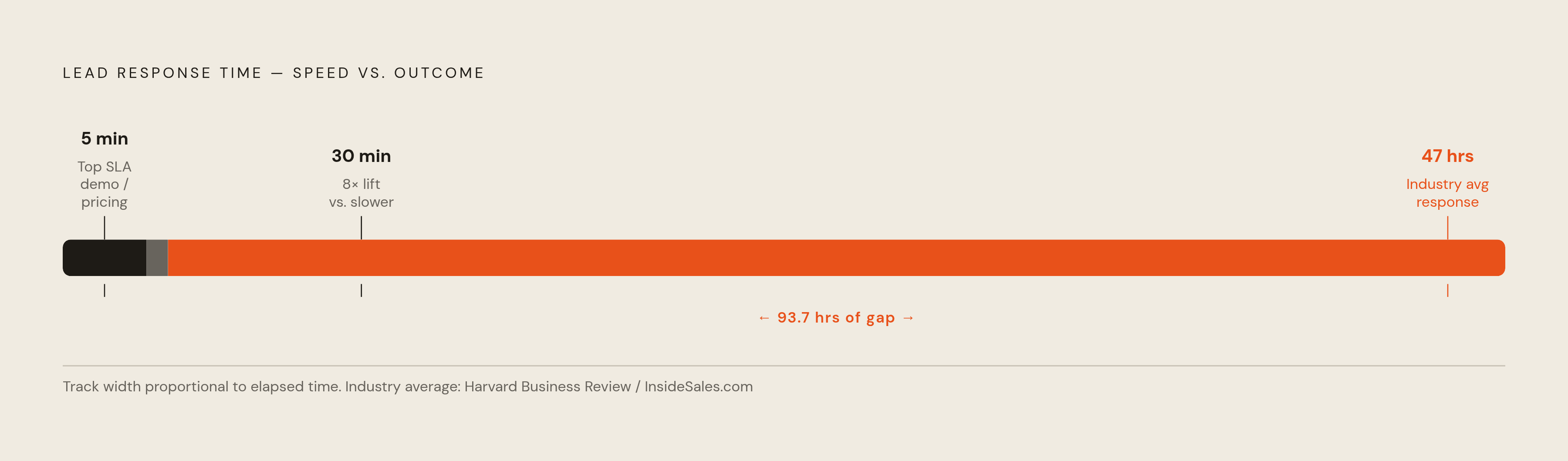
The average company takes 47 hours to respond to a lead. Two days, roughly, and that gap is where most hybrid GTM strategy quietly falls apart, no matter how well the signal detection works upstream.
Response speed is close to causal at this point. Engaging a lead within 30 minutes of a trigger event can lift conversion by as much as 8x compared to slower follow-up, and the first vendor to respond after a trigger fires is roughly 5x more likely to close than a competitor who waits. An evaluation window doesn't stay open indefinitely for anyone. Delay is the single most expensive failure mode in the entire system, more expensive than a weak message or the wrong channel.
What's changed recently is that a 30-minute response window no longer requires more headcount. Agentic AI systems can trigger a personalized outreach sequence the moment a signal fires, on their own, which turns response speed from a staffing problem into an architecture problem. The only question left is whether the detection-to-trigger pipeline got built correctly from the start.
On the inbound side, the same urgency logic applies at even tighter tolerances. The best-performing teams hold themselves to a 5-minute SLA on the highest-intent inbound actions, demo requests and pricing-page visits chief among them. Once a signal fires, whether it started inbound or is about to launch an outbound sequence, it runs against the same clock.
The performance gap between signal-based outreach and cold outbound
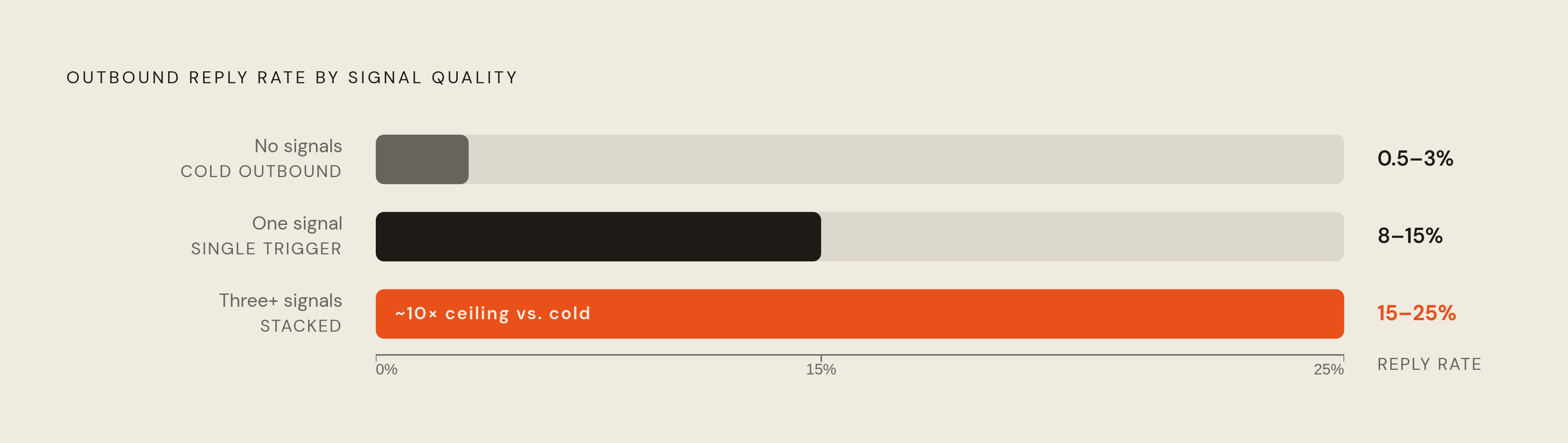
Cold outbound in 2026 gets a 1 to 3% reply rate as a rough industry baseline. Woodpecker's State of Cold Email report puts broad B2B cold outreach even lower, at 0.5 to 2%. Either way, the number is small enough that most cold campaigns survive on volume alone, not on the quality of the message, which is exactly backwards for anyone trying to build a durable pipeline motion.
Signal-based outbound breaks that math open. A single buying signal attached to an outreach sequence pushes reply rates to somewhere between 8 and 15%. Stacking three or more signals together raises reply rates to 15 to 25%. Across more than 200 B2B client campaigns run between 2023 and 2026, fully built signal-based outbound (three to five signals, scored and routed with timing logic attached) averaged 4 to 10% reply rates. That's a 2 to 4x lift over the cold baseline, and the reason is timing. It's timing: the message lands while the buyer is actually thinking about the problem, not months before or after, and that one variable accounts for most of the gap.
The dark funnel problem: why buyers are invisible before they signal
Most of a B2B buyer's journey now happens somewhere a vendor can't see it happen. Gartner's survey found that buyers complete 70 to 80% of their purchase journey before ever engaging a sales rep. The evaluation, the comparison shopping, the internal argument between champion and skeptic: none of it touches a channel a CRM will ever log.
That invisibility is a preference, not a tracking failure, and vendors need to stop treating it like something they can fix with better attribution. 61% of buyers say they'd rather have a completely rep-free experience, and they're getting exactly that: evaluation now runs through AI search engines, private Slack communities, and peer networks sitting entirely outside traditional vendor tracking. A company can have flawless analytics on its own website and still miss most of the conversation that decides its shortlist placement.
AI has sped that shift up, not slowed it down. 94% of buyers use AI at some stage of a purchase decision, 54% use AI platforms specifically to research product information, and 55% use them to compare suppliers directly. The practical effect is a shrinking shortlist: average supplier alternatives considered per deal have dropped from 3.2 to 2.5. AI platforms tend to cite only three or four brands per query, and the top 20 domains in a category capture 66% of all AI citations between them. Getting inside that narrow citation layer isn't a marketing nicety. It functions closer to a gatekeeper than a channel, and companies that treat it as an afterthought will find their shortlist decided by an algorithm they never optimized for.
Companies that land in the top three positions of an AI-generated answer receive 38% more qualified demo requests than competitors who don't get mentioned. Inbound content strategy now has to plan for a buyer who may never visit the company's own website until after the shortlist an AI model produced is already locked in.
Channel mix and investment priorities for GTM resources in 2026
As of October 2025, LinkedIn is at 66% adoption among GTM teams, SEO is at 53%, and warm outbound is at 48%. Those are the established channels, already baked into most teams' weekly operating rhythm.
The experimentation numbers point somewhere else. Intent-based outbound is being tested by 49% of teams, AI discovery and answer-engine optimization by 47%, large-scale conferences by 43%. Budget attention is following the same pattern, with AI discovery and AEO, intent-based outbound, and LinkedIn among the channels drawing the most active experimentation. The first two map directly onto the problem of buyers being invisible before they signal, described above. If buyers are forming opinions inside AI platforms before a rep ever hears from them, the budget has to go find them there instead of waiting for them to land on a webpage.
Inbound still carries a real cost advantage, running around 62% cheaper than outbound-heavy approaches. But that discount comes with a catch that trips up a lot of early-stage teams: inbound needs 6 to 12 months of sustained investment before it produces meaningful pipeline. That ramp time is the central tension for any company that needs revenue this quarter, not next year, and it is why the stage-based framework above pushes early-stage companies toward outbound first and inbound second.
PLG as a third motion layer in hybrid architecture at scale
The most competitive B2B SaaS companies heading into 2026 aren't choosing between product-led growth and sales-led growth. They're running both at once, because PLG buys acquisition efficiency and SLG buys deal-size depth, and neither one alone delivers both.
The pattern appears across several well-known companies, each with its own variant. HubSpot built free tools that drive bottom-up adoption inside a company, then lets its sales team pursue enterprise expansion once that adoption reaches a certain size. DocuSign lets individuals sign up self-serve, while enterprise deployments move through a traditional sales process running alongside it. Atlassian built its category on PLG, then added a dedicated enterprise sales layer as the business scaled upmarket.
Datadog is the clearest example of this architecture working at real scale, and the numbers are public. The company posted $3.4 billion in revenue for fiscal year 2025, up 28% year-over-year, on a land-and-expand motion that starts small: a developer adopts a single monitoring product on a free or low-cost tier, and usage expands into Datadog's broader observability platform as the team's needs grow. By the third quarter of 2025, that motion had produced 603 customers each generating a substantial amount of annual revenue, and that number is the proof. A PLG entry point and a large-account sales motion are two stages of the same architecture. They're two stages of the same architecture, and the handoff between them is exactly the wiring hybrid GTM is supposed to build.