Waterfall Enrichment Strategy for B2B Contact Data
Multiple providers, verified results and freshness rules keep contact data usable.
- Written by
- Priya Subramaniam
- Published
- November 12, 2026
- Reading time
- 8 min read
- Sources cited
- 1 sources ↓
What this covers
A waterfall enrichment strategy for B2B contact data deals with two ongoing problems, gaps in provider coverage and records that decay at roughly 22–30% per year. Querying multiple providers in priority order until a verified result is returned is the most reliable architecture for maintaining usable coverage at scale. Its effectiveness depends on provider sequencing, validation, field-level freshness, and explicit fallback rules.
Why B2B contact data degrades faster than most teams expect
Job titles change, people move companies, email addresses are deactivated, and phone numbers are reassigned. A record enriched 18 months ago has a meaningful chance of being wrong before it reaches a campaign. At the annual decay rate above, a CRM of any substantial size accumulates stale records faster than most quarterly hygiene passes can remove them.
Static enrichment therefore embeds a false assumption in the workflow, that accuracy persists after a lookup. A contact record accurate in January may be unreliable by June, even if the original provider supplied correct information. Credit-based enrichment models can deepen this problem because metered lookups encourage teams to ration refreshes and skip verification. The resulting staleness reflects both changes in the underlying data and the economics of maintaining it.
Why no single provider can solve a coverage problem it did not create
Provider coverage reflects how a database was assembled. Some providers scrape public sources, others buy partner data, and others use records that users submit. Each collection method creates strengths and blind spots clustered by geography, company size, industry, and role seniority.
A provider with strong coverage of US enterprise technology contacts may have few records for APAC mid-market companies or European healthcare. For a given ideal customer profile, or ICP, the source has a practical coverage limit that additional calls to the same database cannot overcome. Choosing a better provider for that segment can improve results, but it does not eliminate the underlying limits of single-source enrichment.
Coverage and decay also reinforce each other. A single-provider system lacks a second source against which to check that provider’s records. Consequently, stale information can remain undetected until it produces a bounce or a wrong-number call. The architectural requirement is therefore broader than finding more contacts. It is to provide another route when the first source is missing, uncertain, or outdated.
How waterfall enrichment works as an architecture
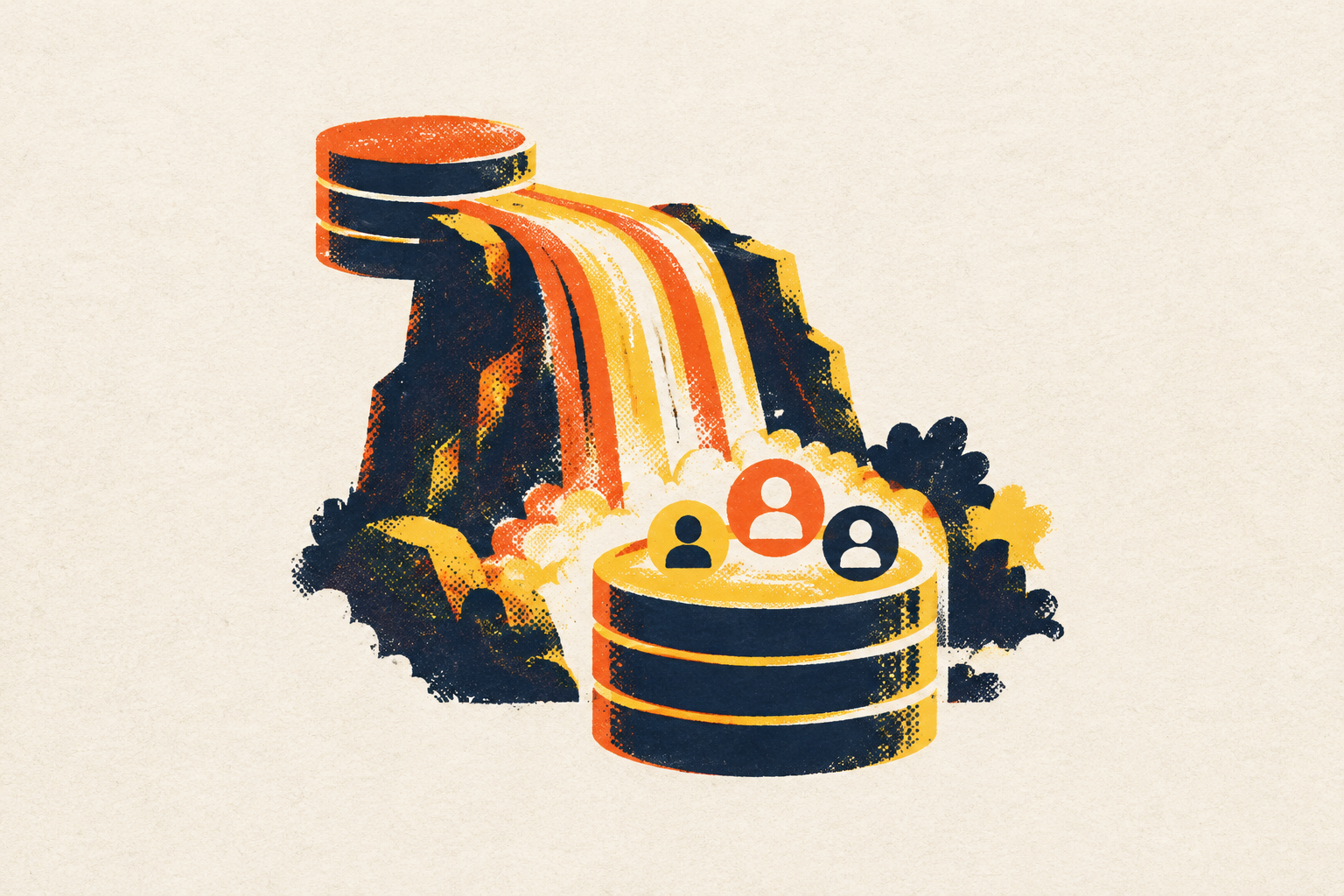
A waterfall queries providers in a defined priority order and stops when a result passes verification. Provider A receives the first lookup. If it returns nothing or a low-confidence result, the unresolved field passes to Provider B and then, if necessary, Provider C. Each additional tier is conditional on the preceding tier’s failure to supply an acceptable answer. This distinguishes a waterfall from merely holding several vendor subscriptions.
The stopping rule depends on what “verified” means. For email, validation includes syntax checks, domain-level MX checks, and a live mailbox ping. For phone data, it includes carrier and line-type checks. Provider priority resolves competing results by making the higher-ranked source authoritative, automating reconciliation for the rep. Records that exhaust every tier without a match are explicitly flagged.
A record can have its email confirmed at Tier 1 while its direct phone number remains unresolved until Tier 3. Successful enrichment of one field does not end the search for another required field. Each populated value should retain its source and confidence level so that later performance problems can be traced to the data behind them. Without that provenance, the final record conceals the decisions that produced it.
The three layers that determine whether a waterfall actually works
The sourcing layer sets which provider gets each chance to fill a field. Provider order should reflect known accuracy for the team’s geography, industry, and company size. Cheapest-first ordering optimizes the lookup while increasing downstream correction costs. Market fit should determine the first tier. A source that works well for US mid-market contacts may be a poor choice for the first tier in an account-based marketing campaign aimed at another region.
Field requirements also shape the sourcing layer. Phone-specific providers belong in campaigns that need a direct number, since phone enrichment costs much more than email enrichment and covers less. Three to four providers is the optimal working range described by the strategy, while a fifth or sixth adds only marginal lift against more contracts, APIs, and reconciliation work. More sources are not automatically more useful. Their value depends on whether they resolve a gap the existing tiers leave open.
The verification layer separates a found value from a usable one. Syntax checks, MX record checks, and SMTP handshakes check for different ways an email can fail, so the search needs more than a returned address before it can stop. Catch-all domains require separate handling because their servers accept mail without confirming that the specific mailbox exists. A waterfall without validation only passes addresses that may bounce downstream.
The routing layer connects the result to execution. A verified email without a confirmed phone number routes a contact into email and social outreach, while confirmation of both unlocks a calling sequence. If neither is confirmed, the remaining paths are social-only outreach or manual review. The data profile determines the available channel. Without that connection, a clean record still leaves a rep to decide manually what should happen next.
When to trigger enrichment and how freshness logic prevents re-decay
A completed waterfall resolves a snapshot of the database. Time-based triggers are a good place to start with CRM hygiene because they re-enrich records once the time since their last-enriched date passes a default threshold. A calendar schedule alone cannot tell an unchanged record from one that has changed because of a recent job move.
Event-triggered enrichment makes that distinction through signals such as a detected job change, an announced funding round, or updated firmographic data. Teams that do a lot of outbound now prefer signal-triggered enrichment to batch schedules because it refreshes data when conditions change. Field-level freshness rules then determine the scope of the response. If company-level firmographic data changes since the last enrichment, all contact-level fields for that person should be flagged for full re-enrichment from the top. A company change invalidates the contact information attached to it.
Inbound real-time enrichment addresses a different timing requirement. It runs when a lead submits a form or enters a routing workflow, making freshness coincide with the moment of highest commercial relevance. That immediacy costs more per enrichment. Real-time processing works well for inbound routing and high-velocity sales, while batch processing costs less per record for CRM hygiene but comes with a lag. Enrichment should run as an ongoing automated process, with triggers matched to use and no fixed completion date.
The compliance layer that multi-vendor waterfalls make more complex
Each added provider is another place where data is processed and needs to be checked on its own. A responsible provider does not compensate for an opaque one elsewhere in the chain. Under GDPR, the team running the waterfall is still the data controller whoever collected the original record, while vendors have their own direct obligations and may be liable for failures in their own processing. Each provider requires its own data-processing agreement, consent basis review, and sub-processor review, multiplying the work across a four-provider waterfall.
For provider selection, the practical implication is that compliance posture belongs beside coverage and accuracy as a first-class criterion. EU-focused teams face particularly heavy overhead as GDPR, CCPA for US contacts, and country-level TPS/DNC screening compound across the stack. Providers differ in how much of this work their products include. Cognism includes GDPR, CCPA, and TPS/DNC screening across a range of countries, making that depth relevant to its position in a European-market waterfall. Included screening changes how much compliance work the buyer must assemble separately.
Sequential vs. parallel waterfall architectures and what each gives up
Sequential enrichment gives teams direct control over source authority. It queries providers one at a time in a team-defined order and stops at the first verified result. This lets a team encode its knowledge of provider strengths by industry, geography, or company size. The trade-off is the stopping point itself. A generalist ranked first may return an acceptable email even when a specialist ranked third could offer a higher-confidence result.
ZoomInfo announced Waterfall Enrichment within GTM Studio in February 2026, operating across 25+ vendors at no additional cost for GTM Studio customers. Its architecture scores previously processed vendor data in parallel rather than querying every vendor live at the same time. That distinction is essential when evaluating the mechanism. It selects the highest-confidence result across those sources instead of accepting the first valid match in a fixed sequence.
The benefit comes with a different control constraint. The scoring model is a black box, so teams cannot inspect why one provider’s result outranked another or override that ranking with domain knowledge. Sequential ordering exposes the authority decision but can stop short of the best available result. Parallel scoring avoids that first-match limit but asks the team to trust the model. Neither is strictly superior, and the relevant test is which approach the team can control, audit, and tune as its ICP evolves.
Build, buy, or orchestrate: matching the architecture to the team
Team size, ICP complexity, compliance exposure, and RevOps capacity determine the appropriate implementation path. A custom API waterfall offers maximum provider flexibility but requires a dedicated RevOps engineer to maintain integrations, fallback logic, rate-limit handling, deduplication rules, and credit reconciliation. That path fits technically resourced teams whose requirements are too specific for packaged platforms and who accept setup time in exchange for customization.
Orchestration offers configurable logic without being identical to a from-scratch build. Clay connects 150+ data sources and lets teams set up their own waterfall, so it is a reference point for this approach. Its 2026 dual-currency pricing combines Data Credits and Actions, adding cost unpredictability, and weeks of setup before production are common. Configuration remains substantial work. The fit is strongest when the team needs control over source selection and can maintain the workflows it creates.
A packaged waterfall shifts responsibility for enrichment logic to the platform. BetterContact runs a waterfall across 20+ providers and charges only when it finds valid data. This pay-for-success model removes the incentive to ration unsuccessful lookups. It suits teams seeking meaningful coverage gains without engineering overhead, trading customization for predictability. The relevant comparison with a custom build is therefore not just lookup price, but also the work required to operate the system.
An integrated platform addresses the handoff from enrichment to outreach. Amplemarket combines continuous data refresh, native execution, and predictable pricing in a single system. This approach fits scaling teams running ABM and outbound who need enrichment connected to sequencing, deliverability, and CRM sync in a single system. Existing platform commitments also change the decision. For GTM Studio customers, the bundled parallel waterfall narrows the case for buying a separate enrichment tool.
A two-provider waterfall with validation meaningfully outperforms a single-source list, and additional tiers should follow specific, measurable coverage gaps. Significant GDPR exposure can also become a build-or-buy forcing function, favoring platforms with included compliance screening over separately assembled vendor arrangements. The right architecture is the one the team can keep accurate, compliant, and connected to execution as its records change.
Methodology & sources
- What is an enrichment waterfall? Definition, examples & how it works — Komo
Supplied the definition of a waterfall, covering priority-ordered provider queries that stop at a verified result and the way fallback tiers work.