Conversation Intelligence Software for B2B Sales Teams
A buyer's guide to choosing CI by CRM write-back, cost, and governance.

- Written by
- Marcus Thibodeaux
- Published
- November 18, 2026
- Reading time
- 9 min read
What this covers
- What conversation intelligence software actually does, and why it is more than a call recorder
- Why CRM write-back quality, not feature lists, determines whether CI delivers pipeline visibility
- The five capabilities that separate capable platforms from basic ones
- How pricing models work and what buyers actually pay across team sizes
Conversation intelligence software takes B2B sales calls and turns them into structured revenue data. Its value depends on whether that data changes CRM records, coaching decisions, and deal follow-up. Choosing a platform therefore requires more than comparing transcription and summaries. The decisive questions concern workflow fit, structured CRM write-back, total cost, and governance.
What conversation intelligence software actually does, and why it is more than a call recorder
Sales leaders may approach conversation intelligence as a smarter recorder, but recording is only its starting point. A CI platform combines speech recognition, natural language processing, and large language models to capture, transcribe, and analyze conversations automatically. It detects objections and competitor mentions, tracks talk-time ratios, flags risks, and generates summaries and next steps. The distinction is scale and consistency. A manager can listen to a handful of calls each week, while a CI platform analyzes every call and surfaces those worth attention.
That coverage separates CI from storage, but its outputs distinguish it from adjacent software categories. AI meeting notetakers produce summaries, whereas CI produces sales-specific signals, including objection categories, buying-committee gaps, and deal-risk scores. Revenue intelligence goes further by linking conversation data to pipeline health, forecasting, and deal management. These are different layers of the sales stack. For B2B teams, the useful output is a structured indication that a deal lacks a booked next step, depends on a single contact, or contains an unresolved qualification gap.
Why CRM write-back quality, not feature lists, determines whether CI delivers pipeline visibility
The most consequential technical distinction is whether those signals become structured CRM field values or free-text notes. A summary can keep useful context without putting it in a form that reliable reporting, forecasting, or downstream AI agents can use. Structured field writes serve a different purpose. They allow week-over-week changes to surface automatically, deal risk to be aggregated across reps, and agents to act on consistent data. Without that connection, an insight may be useful only inside the CI platform.
Write-back is therefore an implementation consideration. Its quality depends on CRM administration and correct field mapping, so evaluators should test it against their actual Salesforce or HubSpot instance before committing. Manual post-call pushes weaken the labor-saving case. Reps already spend a significant portion of their day on data entry and CRM updates, and a platform that adds another step recreates that burden. Even when AI is used widely across an organization, reps may not use it day to day, and only a minority do in the research described here. Lower post-call friction is consequently part of the data architecture decision.
The five capabilities that separate capable platforms from basic ones
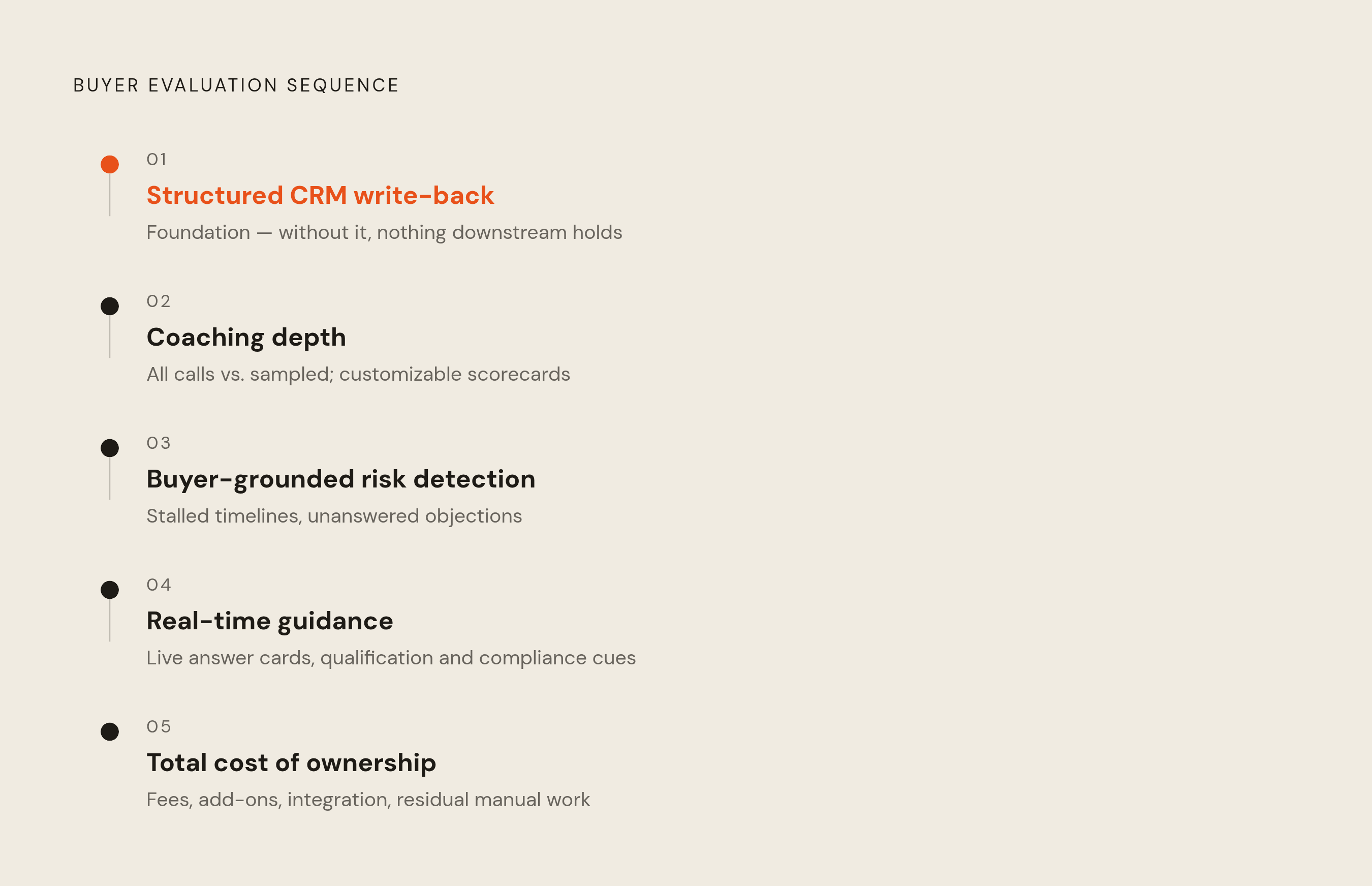
Structured CRM write-back is the first capability to evaluate, followed by coaching depth, buyer-grounded risk detection, real-time guidance, and total cost of ownership. For coaching, the central question is whether the platform evaluates all calls or only reviewed samples. Sampling can distort coaching priorities through selection bias. Customizable scorecards should support methodologies such as MEDDIC and SPICED, while playbook adherence and talk-time analytics provide evidence across conversations. Playlists, snippets, and live bookmarking make specific moments easier to share than full recordings.
Risk detection raises a different question. Does the platform spot stalled timelines, unanswered objections, and missing follow-ups from what buyers say, or rely on optimistic status updates that reps enter? Smart trackers for competitor names, pricing concerns, and churn signals become more useful when Slack or email alerts bring them into existing deal-review workflows. Live answer cards, qualification cues, and compliance prompts are especially relevant to SDR teams, inside sales, and compliance-sensitive environments, while lower-volume enterprise selling may benefit more from post-call depth.
Fifth, buyers should assess what operating the platform costs. Platform fees, add-ons, integration setup, administration, and residual manual work all sit outside the apparent simplicity of a per-seat rate. A capable evaluation connects those costs to team size and the forecast horizon.
How pricing models work and what buyers actually pay across team sizes
Pricing structure can shape the bill more than the feature list, particularly for mid-market buyers. Enterprise platforms often charge per seat along with platform fees and add-ons that buyers must pay for, which brings the yearly cost for a mid-size sales organization well into six figures. Other options bundle CI into a broader stack or charge by usage. The unit price is only the starting point. Transparent, modular pricing is generally a better fit for SMB and growth-stage teams that cannot absorb multi-year commitments.
Avoma makes its modular pricing public and charges for its conversation intelligence add-on per user per month, with the bill paid annually. Fireflies and Grain also make public what they charge per user per month. Fathom offers a free plan, publicly priced Premium, Team, and Business tiers, and a contact-sales Enterprise tier. These examples make the charging structure visible before a sales conversation, although the notes provide no dollar amounts to quote. Many competing platforms require that conversation before disclosing pricing.
For mid-market teams, the strongest return comes from removing manual CRM entry and surfacing pipeline changes automatically. Analytics alone does not establish that case. A lower-priced tool that leaves substantial post-call work intact may address less of the underlying problem, while an enterprise platform may exceed what the team can justify. The relevant comparison is the full cost of supporting a particular team and sales motion.
The leading platforms and what each one is actually best for
Gong fits enterprise revenue teams seeking deal-level intelligence and forecasting beyond call transcripts. It captures calls, emails, and meetings to surface deal risk and coaching signals across the pipeline. Its scope favors larger organizations. For smaller teams, that breadth can exceed the requirement, while cumbersome bulk export deserves attention during governance review.
Chorus by ZoomInfo fits teams already invested in ZoomInfo’s contact and go-to-market data. Its conversation intelligence layer is integrated into that platform, making the existing commitment central to the purchase case. Structured CRM write-back works best within that ecosystem. For teams without that commitment, the fit is less compelling.
Salesloft Conversation Intelligence fits revenue operations-heavy teams standardizing on Salesloft’s engagement and forecasting layer. Launched July 14, 2026, following the December 3, 2025 merger of Clari and Salesloft, it combines the former Clari Copilot with Salesloft’s Conversations product. Its scope includes live coaching, summaries, action items, follow-up emails, CRM updates, and consent controls. Teams need to choose modules with care while the merger integration is underway.
Avoma fits SMB and mid-market teams seeking coaching automation without enterprise pricing. Its meeting lifecycle coverage includes live answer cards, customizable AI call scoring, deal-risk tracking, CRM sync, and smart trackers with Slack or email alerts. Published modular pricing supports that positioning. Jiminny is a closer fit for teams that buy mainly to help managers coach their reps, and buyers can get pricing from sales.
CloudTalk fits teams that want CI within their business phone system. Because calls already run through the system, its add-on makes them transcribed, summarized, and scoreable without provisioning another recorder. Observe.AI addresses a different operating context. Its live assistant and automated quality assurance scoring suit high-volume or compliance-sensitive environments, with pricing available through sales.
The build-vs-buy question for teams with engineering resources
Packaged platforms make choices about which signals to surface and where data lives. For teams with engineering resources and unusual requirements, building on a speech and NLP API can provide tighter integration and potentially lower long-term cost. AssemblyAI offers speech-to-text, speech understanding, and an LLM gateway through a single API. A custom implementation can write the required CRM fields and trigger the alerts a proprietary workflow uses, without relying on per-seat pricing.
That flexibility transfers responsibility to internal engineering. Coaching workflows, scorecard logic, and CRM synchronization become ongoing product work. The decision threshold is therefore specific. Teams whose requirements closely match packaged platforms should buy, while teams embedding CI into a proprietary workflow or vertical-specific compliance layer should evaluate building.
Compliance and data-governance risks that most CI evaluations overlook
Governance can change an otherwise strong purchase decision. The EU AI Act may limit how platforms interpret emotional signals during calls, so buyers that work in or serve places covered by it should check how the vendor complies before signing. Consent requirements also vary by jurisdiction. Built-in controls, such as those listed by Salesloft, need to cover the team’s operating locations.
AI data handling requires a separate contractual review. Salesloft’s privacy policy, updated October 15, 2026, excludes product AI use from its site and internal-operations provisions and places it under the MSA, DPA, and AI Addendum. Those agreements separately state that sub-processors do not use customer data to train AI models without permission. The distinction is contractual. Regulated buyers should seek written clarification of the terms governing their conversation data and request disclosure of LLM-provider arrangements, including a Business Associate Agreement where required.
Portability can also pose a risk when audits or M&A due diligence call for exports of all call data. A platform that readily ingests data but makes bulk export difficult can complicate that work. Rep privacy also affects adoption. Transparency about what is recorded, who reviews it, and how it is used can reduce resistance to mandatory recording. To address these risks before commitment, buyers should add bulk-export testing and written LLM-provider data-handling disclosure to procurement.
How the category is shifting from post-call analytics to a live revenue signal layer
CI is moving from a destination for reviewing completed calls toward a signal layer that triggers actions and feeds agents. Salesloft’s July unification connects buyer signals, engagement, and forecast data within that broader architecture. Its October 27, 2026 announcement of Agentic Playbook makes the direction more explicit. The orchestration engine is designed to coordinate sellers and AI agents around shared sales objectives, rather than leaving every response dependent on dashboard review.
Gong’s February 25, 2026 launch of Gong Enable meets a related need by automating coaching analysis. Its AI Call Reviewer analyzes completed customer interactions to surface individual and team-level opportunities. The distinction prevents automation from becoming a loose synonym for real-time operation and keeps evaluations tied to when a feature actually acts.
Buyers planning around the workflow they will have in 12–18 months should evaluate platform architecture. Buyers should examine whether a platform’s roadmap adds more dashboards or adds triggers and agents that act on conversation signals. Deep reporting is still useful, but on its own it does not show that a platform is ready for a workflow that acts on the data.
A practical framework for matching a CI platform to your team's situation
Buyers should start with the size of their team, how many calls it handles, and what the platform must improve in their revenue operations. A coaching and ramp-time problem points toward customizable scorecards, snippet sharing, and manager workflows, with Avoma or Jiminny among the relevant fits. Pipeline visibility instead calls for structured write-back, buyer-grounded risk detection, and forecast integration. Live guidance favors answer cards, compliance prompts, and in-call scoring. CRM quality and adoption problems make autonomous updates and low post-call friction the priorities.
The existing stack then narrows the field. ZoomInfo customers have a natural path through Chorus, while Salesloft or Clari customers should specify the modules they are buying during the ongoing integration. Salesforce-native teams need verified Salesforce field-write capability. Teams that work through their phone system can consider CloudTalk, while those with engineers can take the API route if their needs justify it. Stack fit should reduce work.
Next, buyers should model seats, platform fees, add-ons, integration setup, and remaining manual entry over a two-year horizon. Unpublished pricing requires extra negotiation time and a written quote before legal review. Governance review should establish export capability, training restrictions, provider data handling, jurisdiction-appropriate consent controls, and required agreements.
The final decision concerns manager behavior. Teams whose managers run regular coaching sessions using CI data see meaningfully faster returns than teams that provide access without changing habits. A coaching cadence should therefore be part of the rollout plan. The platform supplies evidence, but managers must decide to use it.