AI-Powered Prospecting for SMB Sales Teams Without RevOps Support
Automate bounded tasks and keep reps in control to make AI prospecting work without RevOps.

- Written by
- Marcus Thibodeaux
- Published
- October 28, 2026
- Reading time
- 9 min read
What this covers
- Why SMB sales teams without RevOps are stuck in a prospecting loop
- The five distinct jobs prospecting actually requires, and where the seams break
- Which of those five jobs AI can handle today without a technical operator
- Why fully autonomous AI SDR deployments fail at a high rate, and what the Vercel case actually teaches
AI-powered prospecting for SMB sales teams without RevOps support works when it takes over steps done by hand. The practical approach is to automate bounded jobs, keep prospect-facing work under rep control, and expand only after the first workflow runs reliably. A specialist hire is not the prerequisite. A defined sequence and a named owner are.
Why SMB sales teams without RevOps are stuck in a prospecting loop
The rep starts the morning by building a contact list, cleaning yesterday’s data, and updating CRM fields before starting any outreach. Follow-up competes with all three. ZoomInfo describes this division of work in its SMB breakdown, where reps maintain the data and records that larger teams assign to operations. Without marketing scoring leads or a system enforcing follow-up, deals slip despite sustained effort.
The outbound workflow depends on dedicated support. Adding AI does not automatically remove that dependency. Unless someone owns the decision about which manual steps to drop, reps check AI output, copy it between tools, and still update the CRM by hand. Net time saved approaches zero.
SPOTIO’s field sales survey finds adoption concentrated in surface-level uses, with one in three teams not using AI at all. Email personalization and call recording are easy places to start. But teams do not use scoring, enrichment, and signal detection, so the work of choosing whom to contact stays much the same.
The five distinct jobs prospecting actually requires, and where the seams break
Prospecting breaks into five jobs, each with a distinct handoff. Discovery finds accounts and contacts that match the ICP by industry, company size, role, and geography. Research and enrichment add verified email, phone, role context, firmographics, and technographics. The first seam appears when a usable target list must become a contactable one.
Intent detection establishes who is showing buying behavior and why now. Amplemarket distinguishes account-level intent, where someone at a company is researching, from contact-level intent, which identifies the specific person. The latter is rarer and more actionable. Outreach then turns that context into a sequenced cadence across channels.
The fifth job is to run the sequence without switching between tools. It is the least visible operational requirement. Every export, import, and context switch needs someone to maintain it, while fragmented handoffs consume time and can damage deliverability. A platform’s value therefore depends on both native stage coverage and how cleanly it passes work between stages.
Which of those five jobs AI can handle today without a technical operator
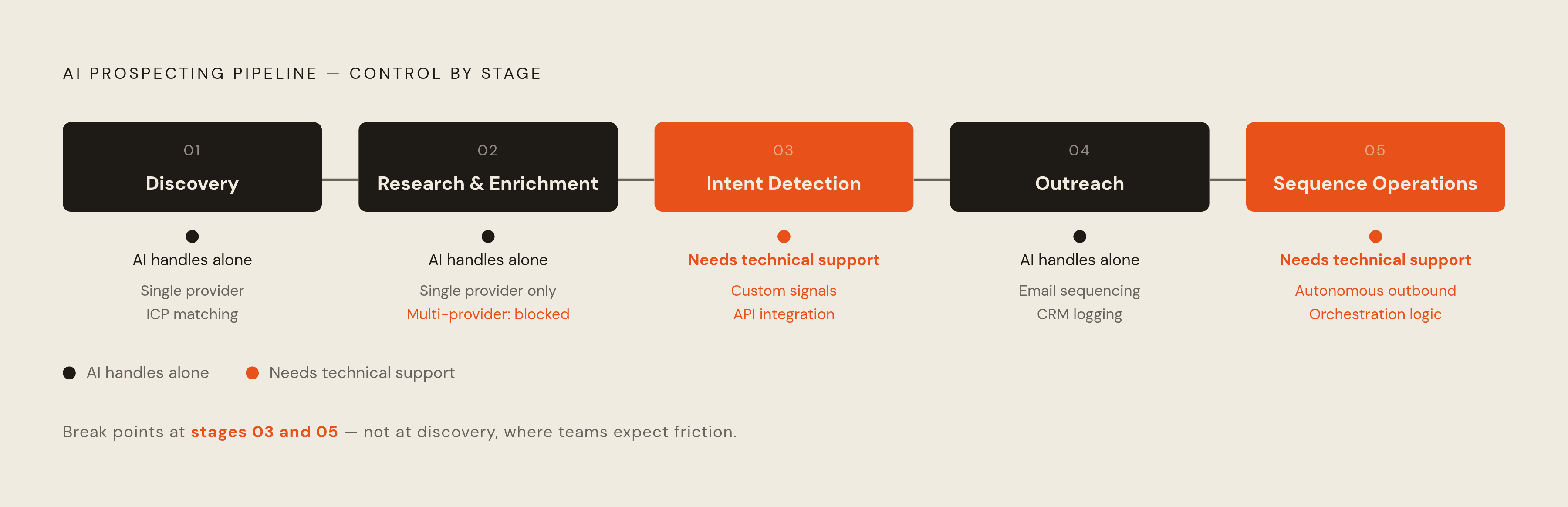
Discovery works without a technical operator when the platform has a native database and filter-based ICP targeting. Single-provider enrichment works when the platform’s own data layer has the verified email and phone. Neither requires a chain of external services. Most platforms also let teams run an email sequence on their own, with multi-touch cadence logic, timing rules, and basic personalization tokens.
Post-call logging and transcript analysis work when the tool integrates natively with the CRM. The integration removes the export and manual-entry step. These are bounded jobs with an explicit destination for the output. They offer a practical starting point without requiring the team to build its own orchestration.
Multi-provider enrichment does not meet that test. To route a contact through several sources, someone must build and maintain the logic, and for custom intent detection, someone must decide what counts as a meaningful signal and link it to an outreach trigger. Autonomous outbound also fails the unsupported-team test. Built-in signal intelligence can be usable, but designing custom signal logic is a different job. Teams can handle bounded logic in a connected system on their own, but need support when they must make judgments and coordinate work across several systems.
Why fully autonomous AI SDR deployments fail at a high rate, and what the Vercel case actually teaches
Autonomous AI SDR pitches promise to remove the operational burden, but their failure mechanisms often magnify it. An agent trained on one buyer profile produces poorly fitted outreach when the ICP spans inconsistent personas. Dirty CRM records become bad messages at scale. Mistakes a rep would catch before sending can reach thousands of people.
Deliverability makes that failure expensive beyond any single message. Google recommends a complaint rate well below one in a thousand sends for stable inbox placement, while cold outbound without aggressive list hygiene routinely exceeds that level. AI-only outreach also shows weak meeting-to-opportunity conversion compared with human-led outreach. A booked meeting is not sufficient evidence of qualification.
Vercel’s deployment teaches a narrower, more useful lesson. Its agent handled inbound qualification, a task with set bounds and rules. The displaced SDRs moved to outbound rather than being fired, and a technical operator built and ran the system.
That distinction is instructive for an SMB. Highly paid GTM engineering roles are not a practical staffing answer for a five-rep team, but their presence is not the essential lesson to copy. Constraining the agent’s scope to inbound qualification gives it a set ruleset to follow, while open-ended outbound asks it to judge fit, timing, and messaging using inputs it cannot be sure of.
Why Clay is the wrong starting point for teams without technical support, even after its 2026 pricing overhaul
Clay is good at building enrichment and workflow logic that works across providers. That is also its mismatch with unsupported teams. To build useful workflows, users need algorithmic thinking, and non-RevOps users can give up on the tool within weeks after using up credits on attempts that fail. CRM integrations also require the Growth plan or above, limiting the simplest route from experimentation to a connected workflow.
Clay’s March 2026 pricing overhaul replaced Starter, Explorer, and Pro with Launch and Growth as its self-serve paid tiers, plus a free tier and custom Enterprise. It also introduced separate billing meters. Most enrichments use Data Credits for marketplace data and Actions for platform work, including workflows, AI calls, syncs, and API requests. The separation is more precise in principle, but harder to forecast without someone managing consumption.
The counterargument deserves a clear distinction. Motivated reps can learn prompting and output verification as AI tools become more accessible. Those skills do not substitute for multi-provider orchestration logic. Clay is the wrong starting point when no one can maintain the workflows that justify it. The alternative is native coverage of the jobs causing the most delay.
The self-serve stack that covers all five prospecting jobs without a RevOps hire
Tool selection should follow the bottleneck. Native coverage reduces the number of handoffs a rep must own. Apollo fits teams building outbound from scratch because it brings contacts, sequencing, and calling together, so they can go from discovery to outreach without a separate sequencer. Teams can start on its free tier, and its paid plans charge per user. The fit is breadth across the core outbound loop.
Amplemarket handles all five jobs and has contact-level signal intelligence. Its Duo Copilot runs signal, research, and sequence agents while the rep approves the output. That approval step is the key distinction. Native execution spans email, calling, social, SMS, WhatsApp, iMessage, and AI voice, avoiding a separate sequencer. It fits teams whose constraint is knowing which person is in-market and why now.
Salesmotion addresses intent detection and outreach preparation for teams that already have contacts in Apollo or a CRM. It monitors accounts for buying signals and drafts outreach tied to the event that makes an account worth contacting. A rep reviews the draft before it sends. An individual monthly contract is available.
Retell AI fits a different bottleneck, where inbound leads or warm lists go cold because reps cannot call quickly enough. It takes a contact list, dials, conducts qualifying conversations, and books meetings when prospects fit. One agent can run many calls simultaneously, including after hours. Batch Call works through a CSV list, and Branded Call ID shows a real name on caller ID. Post-call analysis sends transcripts, qualification answers, and outcomes into supported CRMs, including HubSpot, Salesforce, Microsoft Dynamics 365, GoHighLevel, and Zoho CRM.
Retell does not discover leads or build a database. Apollo or ZoomInfo supplies that foundation. Although Batch Call accepts a CSV, that capability does not make a recurring export handoff suitable for a team unable to maintain it. Retell’s fit is converting a validated list into conversations.
ZoomInfo serves teams whose primary constraint is data accuracy and intent quality, with budget for an enterprise-grade data layer. Its database has direct dials and business emails that it keeps verifying, and it tracks buyer intent signals across millions of business websites. Pricing is available on contact.
How to sequence these tools into a workflow that actually sticks
To put these choices into practice, start with the job consuming the most time and replace its manual process before adding another tool. Most teams should begin with Apollo for contacts and sequences. Define a good list in writing, including role, company size, and industry, before configuring the filters. Then build the list and launch sequences within the platform. Export nothing, and defer additional enrichment tools, dialers, and intent layers until the core outreach loop runs without manual intervention.
Once list quality stops being the bottleneck, add signal intelligence through Salesmotion or Amplemarket’s signal layer. Use it when the team has enough pipeline to distinguish accounts that convert from those that do not. Signals prioritize a viable list. Keep rep approval in the workflow so that a detected event does not automatically become poorly fitted outreach.
Add voice AI only when inbound or warm-list call volume is the confirmed constraint. Retell belongs at this stage, after discovery and enrichment have produced a validated list. Constrain the agent to inbound or warm outreach before using it on cold lists. The bounded-task principle applies here as it did at Vercel, and autonomous conversation handling does not remove the need to define qualification.
Have a rep review prospect-facing AI output before it is sent. For autonomous voice, constrain and review the agent’s approved scope. Reject any ongoing handoff that depends on an export-import routine the team will not maintain. Under pressure, that routine becomes the missing link.
Finally, assign one person to own the stack, even if that person is a rep working on it part-time. No RevOps does not mean no owner. SPOTIO identifies tool selection and rollout without disruption as a common adoption obstacle.
The skills gap that actually blocks adoption, and how motivated reps close it without hiring
That owner does not need to become a programmer. The relevant skills are prompt engineering, output verification, and knowing when AI has enough context to produce useful work. Generic prompts omit the ICP, account research, and buying signal that make outreach specific. Unreviewed messages expose the opposite failure, where the team accepts output without defining what good looks like.
To close that gap, build prompt templates around the team’s ICP, with account-context slots that reps complete before running them. Make review criteria equally explicit. The email should reference something real about the account, use a specific call to action, and be something a rep would put their name on. Those criteria establish when AI has done its job. Without them, reps either trust everything and risk deliverability or recheck everything and save no time.
The alternative to an expensive autonomous platform is not necessarily a highly paid GTM engineer. A motivated rep can spend two weeks learning to prompt well and review output quickly. That learning provides the skills needed to operate a bounded, self-serve process with a clear standard for acceptance.
Agentic tools are becoming cheaper and more capable, and the technical threshold for useful workflows is falling. Teams should build for later handoff without waiting for a tool that removes every decision. When teams define the inputs, set approval standards, and put someone in charge, more capable agents have a process to take over.